University of Nebraska at Omaha logo University of Nebraska at Omaha
REQUEST INFO VISIT APPLY

MY UNO DIRECTORY
REQUEST INFO VISIT APPLY
MY UNO DIRECTORY
  • About Backback to Main menu
    • About
    • Mission and Strategic Plan
    • Leadership
    • Community Engagement
    • Buildings and Maps
    • Parking and Transit
    • Accreditation
    • News
    • Events
  • Admissions Backback to Main menu
    • Admissions
    • Undergraduate Admissions
    • Graduate Admissions
    • Transfer Students
    • Online Admissions
    • International Admissions
    • New Student Resources
    • Cost and Aid
  • Academics Backback to Main menu
    • Academics
    • Majors & Programs
    • Colleges
    • Academic Support
    • Library
    • Class Search
    • Course Catalogs
    • Academic Calendar
    • Advising
  • Student Life Backback to Main menu
    • Student Life
    • Student Leadership and Involvement
    • Spirit and Tradition
    • The Maverick Store
    • Student Housing
    • Campus Dining
    • Campus Recreation & Wellness
    • Health Services
    • Career Services & Internships
    • Student Events
  • Research Backback to Main menu
    • Research
    • Research Support
    • Centers and Institutes
    • Research News
  • Engagement
    Students
    • Student Service and Leadership Collaborative
    • Find Volunteer Opportunities
    • Maverick Food Pantry
    • Voter Information
    • Internship Opportunities
    • Student Resources
    • Become an Engaged Scholar
    Faculty and Staff
    • Faculty Senate
    • Center for Faculty Excellence
    • Staff Advisory Council
    • Faculty Resources
    • Engaged Research
    • Service Learning Academy
    • Community-Based Learning Courses
    Community
    • Campus Resources
    • Service Learning Academy
    • Samuel Bak Museum: The Learning Center
    • Promote Volunteer Opportunities
    • Promote Internship Opportunities
    • Rent Office Space
    • Senior Passport Program
    • Community Engagement Partnership Initiative
    Office of Engagement
    • Office of Engagement
    • Connect to Campus
    • Barbara Weitz Community Engagement Center
    • Service Learning Academy
    • Rent Office Space
    • Samuel Bak Museum: The Learning Center
    • Partner With Us
    • Senior Passport Program
    • Nebraska Business Development Center
    • Community Partners on Campus
    ${cardImgAlt}
    Connect With Us

    Contact the Office of Engagement
  • Athletics
  • Alumni & Giving Backback to Main menu
    • Alumni Association
    • Thompson Center
    • NU Foundation
  1. UNO
  2. News
  3. 2024
  4. 08
  5. Standard Page - www

“Pink Noise” Exposure Research Published in Prestigious PNAS Journal

  • published: 2024/08/06
  • contact: Amanda Craig - Office of Strategic Marketing and Communications
  • email: unonews@unomaha.edu
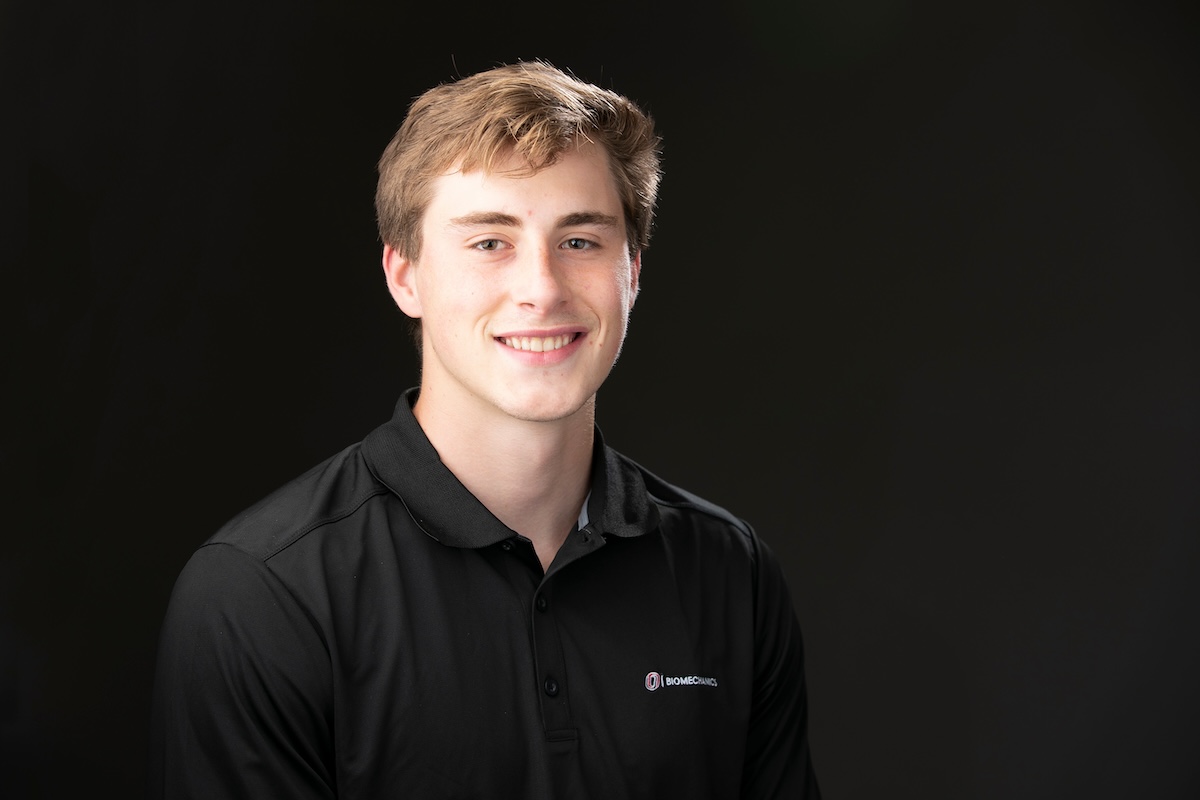
UNO doctoral biomechanic's student Kolby Brink.

UNO doctoral biomechanic's student Kolby Brink.

Aaron Likens, an assistant professor in UNO’s Department of Biomechanics.
Aaron Likens, an assistant professor in UNO’s Department of Biomechanics.

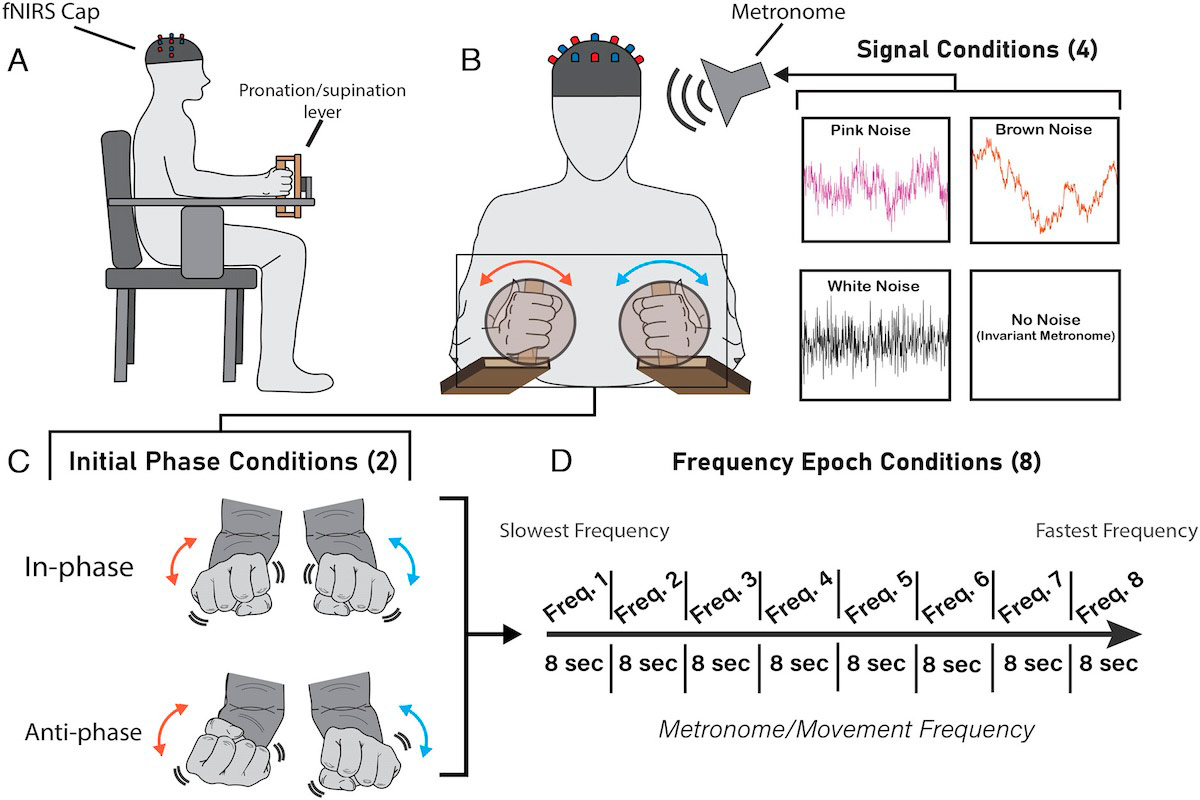
Bimanual coordination testing apparatus and conditions. (A) Brain imaging cap (functional near-infrared spectroscopy; fNIRS) and bimanual manipulanda arrangement. (B) Subjects were prompted to follow a metronome that was embedded with variability in the interbeat intervals. Four signal conditions were used for implementing variability, including an invariable (no variability) metronome, a pink noise, a white noise, and a Brown noise metronome. (C) Subjects followed the metronome in an initial coordination pattern of either in-phase or antiphase. (D) The average metronome interval increased by 0.25 Hz every 8 s with eight total epochs of increased frequency (lasting approximately 64 s).

Bimanual coordination testing apparatus and conditions. (A) Brain imaging cap (functional near-infrared spectroscopy; fNIRS) and bimanual manipulanda arrangement. (B) Subjects were prompted to follow a metronome that was embedded with variability in the interbeat intervals. Four signal conditions were used for implementing variability, including an invariable (no variability) metronome, a pink noise, a white noise, and a Brown noise metronome. (C) Subjects followed the metronome in an initial coordination pattern of either in-phase or antiphase. (D) The average metronome interval increased by 0.25 Hz every 8 s with eight total epochs of increased frequency (lasting approximately 64 s).

Highlights

  • Researchers have documented the presence of “pink noise” in nearly every human behavior and process, and can degrade with injury, disease, and aging.

  • When pink noise degrades, you may not be as adaptable to your environment and more prone to falls.

  • UNO Biomechanics researchers found that exposing subjects to auditory pink noise positively affected their adaptability in coordinated movements.

  • Their findings were published in the top science journal PNAS – another recent success story for UNO’s Department of Biomechanics.


Kolby Brink, a doctoral biomechanics student at the University of Nebraska at Omaha (UNO), and Aaron Likens, an assistant professor in UNO’s Department of Biomechanics and Brink’s advisor, received acceptance into The Proceedings of the National Academy of Sciences (PNAS) journal with their co-written paper “Pink Noise promotes sooner state transitions during bimanual coordination.”

PNAS is one of the top science journals in the U.S. with a highly selective review and acceptance process. Not only is this the first PNAS publication for either Brink or Likens, but it also marks the first time that any paper from UNO’s Department of Biomechanics has been published in the journal. The other contributors on the paper are Seung Kyeom Kim, Joel Sommerfeld, Polemnia Amazeen, and Nick Stergiou.

Brink shared, “I’m excited that this paper was accepted at this journal. I've been grateful to be on the team that I'm on and surrounded with the advisors and teammates I have. I certainly couldn't have done this without them.”

The paper’s research began as Brink’s thesis project for his master’s degree. In UNO’s Center of Research in Human Movement Variability (MOVCENTR), he studied movement and coordination in people to better understand ways to improve rehabilitation tools for motor-related disorders.

The Impact of Pink Noise on Human Movement

Working with Likens, his faculty advisor, he focused his research on how to assess the impact that variability has on human coordination. A widely used model in human movement research, the Haken-Kelso-Bunz (HKB) model, measures coordination but does not adequately address the variability in movement that humans naturally have. This variability was shown to be pink noise.

“Since the 1970s, researchers have documented the presence of pink noise in just about every human behavior and process,” explained Likens. “It’s a fundamental property that degrades when you’re injured, have a disease, or through the natural course of aging. And it seems to be associated with your ability to flexibly adapt to novel circumstances.”

An example of this is when a healthy young person is walking, they can quickly adapt their movements when encountering uneven ground or increasing their speed. When their inherent pink noise has degraded due to a disorder or age, they are not as adaptable to their environment, making them more prone to falls.

Brink was tasked with designing a model that could measure the effect of pink noise on adaptable movement and determine whether a degraded adaptability in coordination could be restored with pink noise exposure.

Through his experiments, his team found that exposing subjects to auditory pink noise positively affected their adaptability in coordinated movements.

Future Implications of Pink Noise Research on Rehabilitation Tools

“I'm hoping this could just be another step towards further developing this,” said Brink. “We had some promising experimental and simulation findings and I think that sets the stage for future studies to start implementing this newer and modified model. The HKB model is used in so many different areas, such as coordination in cells, teamwork, and communication, and we are improving this model for everyone else to use in their own fields.”

Nick Stergiou, the director of MOVCENTR and a senior contributor on the paper, is immensely proud of this accomplishment for Brink and Likens.

“I think it will really impact the careers of Kolby [Brink] and Aaron [Likens] because they are early in their careers and publishing in such a big journal,” said Stergiou. “Also, this research is very important. We are doing incredible things with variability and incorporating pink noise variability into the HKB model. It’s huge. I think it will be utilized by many other scientists around the world.”

  • News Sections:
  • UNO News Center
  • Maverick Daily
  • The Bullseye
  • Campus Events

News Sections

  • News Center
  • Maverick Daily
  • The Bullseye
  • Campus Events

Featured Stories

  • Regents Approve $67.5M Privately Funded Capital Projects at UNO for Omaha Athletics
  • Start Strong, Mavericks!
  • UNO Sees Significant Summer Enrollment Growth in 2025
  • Mavericks Set to Move Into On-Campus Housing

Contact Us

If you have a story idea, news tip, or other question, please email the UNO News team at unonews@unomaha.edu.

About the Office of Strategic Marketing and Communications (MarComm)

Services and Resources

  • Academic Calendar
  • Course Catalogs
  • MavCARD Services
  • MavLINK
  • my.unomaha.edu
  • UNO Brand Guide

Related Links

  • A-Z List
  • Employment
  • University of Nebraska System

Campus Links

  • Accessibility
  • Billing Office
  • Buildings and Maps
  • Campus Directory
  • Campus Safety
  • Events
  • Human Resources
  • Library
  • Military-Connected Resource Center
  • News
  • Registrar

Policies and Reporting

  • Emergency Information Alert
  • MavsReport
  • Notice of Non-Discrimination
  • NU Foundation
  • Privacy Statement
  • University Policies
  1. Privacy Statement
  2. Accessibility
  1. 402.554.2800

University of Nebraska at Omaha
University of Nebraska at Omaha, 6001 Dodge Street, Omaha, NE, 68182
  • ©  

Social Media


Omaha Skyline

Our Campus. Otherwise Known as Omaha.

The University of Nebraska does not discriminate based on race, color, ethnicity, national origin, sex, pregnancy, sexual orientation, gender identity, religion, disability, age, genetic information, veteran status, marital status, and/or political affiliation in its education programs or activities, including admissions and employment. The University prohibits any form of retaliation taken against anyone for reporting discrimination, harassment, or retaliation for otherwise engaging in protected activity. Read the full statement.