
UNO Research Discovers Surprising Way to Make Walking Easier
The study, published in the prestigious journal Science Robotics, was led by Philippe Malcolm, Ph.D., assistant professor in biomechanics at UNO, marking a new milestone for high-impact institutional research.
- published: 2022/03/16
- contact: Brandon Bartling - Office of Strategic Marketing and Communications
- email: unonews@unomaha.edu
- search keywords:
- Research
- biomechanics
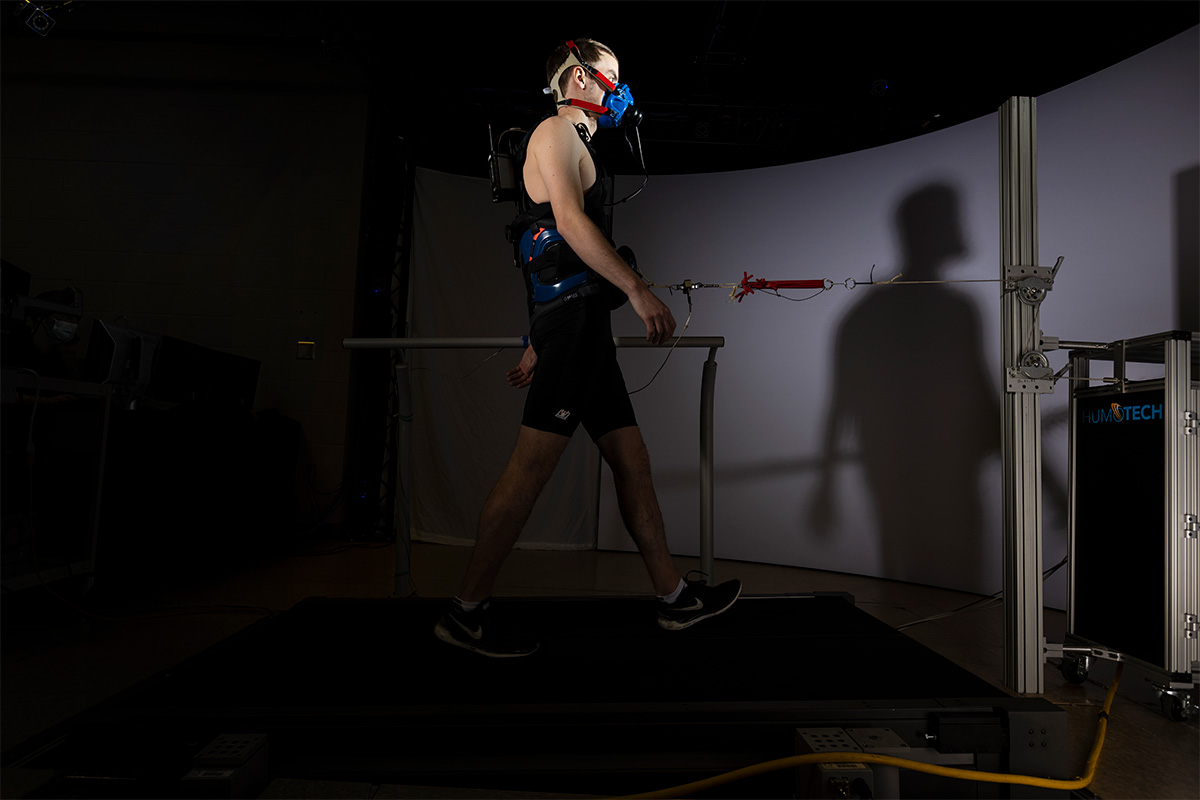
Findings by researchers at the University of Nebraska at Omaha (UNO) describe a novel way to reduce the energy people spend to walk, as much as by half, which could have applications for therapy received by patients with impaired walking abilities.
The study, published in the prestigious journal Science Robotics, was led by Philippe Malcolm, Ph.D., assistant professor in biomechanics at UNO, marking a new milestone for high-impact institutional research.
This research shows that a strategically-timed pull from a waist belt connected to a pulley can help an individual use less energy for each step while walking. However, the optimal timing of that forward pull was what came as a surprise.
“When we walk, there is a short period between steps where one foot is stopping its forward motion while the other is preparing to accelerate to take the next step forward. Our research shows that this brief window where both feet are on the ground is the best time to apply force to assist walking most efficiently,” Malcolm said.
Video credit: ONPXL
Based on previous literature, the researchers believed they would see the highest energy savings by pulling when the individual is trying to propel forward against the ground. That hypothesis was based on a bioinspired assistance strategy, meaning it is inspired by how our biological muscles work during walking.
Prokopios Antonellis, Ph.D., the first author of the study and now a postdoctoral fellow at Oregon Health & Science University, performed this research during his doctoral program at UNO. “Although bioinspired actuation can have certain benefits, our study demonstrates that this is not necessarily the best strategy for providing the greatest reduction in metabolic cost or energy expended,” Antonellis said. “This finding supports a greater emphasis on biomechanical testing rather than trying to predict optimal bioinspired strategies.”
The device works by providing timed pulls from a motorized pulley while an individual walks on a treadmill. Since it only requires wearing a waist belt, it is relatively easy to make individualized adjustments compared to more complicated devices.
The findings about optimal timing could have applications for exercise therapists in clinical settings providing care for patients with conditions such as peripheral artery disease. Iraklis Pipinos, M.D., F.A.C.S., a vascular surgeon at the University of Nebraska Medical Center (UNMC) and the Omaha VA Medical Center, who collaborated with the study team, sees the benefits of this research.
“My patients have hardening of their arteries causing problems in the circulation to their legs, resulting in leg pain and reduced mobility. I was touched to hear that certain patients felt relief in their legs for the first time when they tried the device. We are now thinking of ways these methods can be used in everyday practice, for example, by using systems for assisted walking exercise therapy at physical therapy clinics,” Pipinos said.
UNO graduate student Arash Mohammadzadeh Gonabadi and UNO faculty member Sara Myers, Ph.D. also contributed to the study. The research team was supported by funding from the NIH (P20GM109090, R01HD090333, R01AG034995, and R01AG049868), the VA (I01RX003266), and Nebraska EPSCOR (OIA-1557417).
P. Antonellis, A.M. Gonabadi, S. A. Myers, I. I. Pipinos, P. Malcolm, Metabolically efficient walking assistance using optimized timed forces at the waist. Science Robotics, 2022, Vol 7, Issue 64. DOI: 10.1126/scirobotics.abh1925
About the University of Nebraska at Omaha
The University of Nebraska at Omaha (UNO) is Nebraska’s premier metropolitan university, committed to innovating for the public good, advancing social mobility, powering workforce development, and serving as a hub for community engagement. Nearly 15,000 Mavericks choose UNO for its hands-on education experiences, nationally ranked online and graduate programs, military-connected student support, and innovative approaches to supporting lifelong learning. UNO holds the Carnegie Research Activity “R2” designation, securing more than $40 million annually in external research funding and counts its faculty among the world’s most cited scholars. Sixteen Omaha Athletics programs compete in NCAA Division I as members of the Summit League and National Collegiate Hockey Conference (NCHC).
Follow UNO on Facebook, Twitter (X), Instagram, LinkedIn, and YouTube.