

Expanding Possibilities
Dustin White Leads the CAB Lab into Its Next Chapter
- published: 2026/09/22
- contact: Melissa Lindell Kozak - Sr. Director of Communications & Marketing - UNO CBA
- email: melissalindell@unomaha.edu
- search keywords:
- CAB Lab
- experiential learning
- research
Why do some job candidates seem more competent before they ever speak? Why are certain athletes evaluated more favorably than others? And how can businesses better understand the decisions consumers make every day?
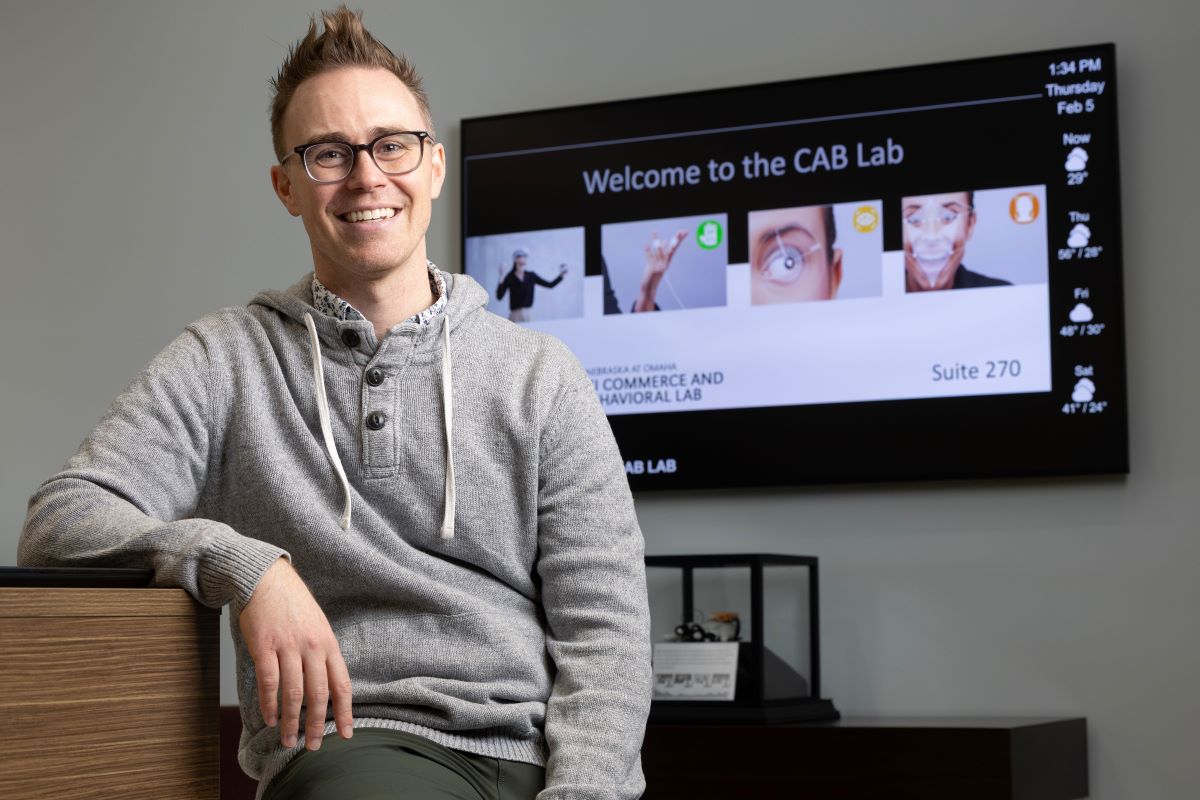
Those are the kinds of questions being explored in the Koraleski Commerce and Applied Behavioral (CAB) Lab at the University of Nebraska at Omaha's College of Business Administration.
Under the leadership of Dustin White, Ph.D., an economics professor whose research spans health and labor economics, sports economics, game theory and data analytics, the CAB Lab is helping faculty and students uncover the often-unseen factors that influence human behavior. At the same time, the lab is positioning itself as a resource for businesses seeking data-driven insights into how people think, respond and make decisions.
For White, the lab's greatest strength is its versatility.
"There is no reason that any of the departments would not be able to take advantage of the CAB Lab and put out really high-quality work in their field," he said.
Over the past year, White has focused on raising awareness of the lab's capabilities across CBA, helping faculty identify ways in which behavioral research tools can strengthen their work. From marketing and management to economics and analytics, researchers are discovering new ways to study decision-making and consumer behavior.
"It's really broadening my horizons to talk to people about all their different research and all their different interests," White said. "I'm trying to get an understanding of where people are in their research and how we can serve them."
That effort is already generating new projects, new collaborations, and new insights.
Revealing Hidden Biases
Some of the lab's most compelling research examines how quickly people form impressions of others—and how those impressions can shape important decisions.
One project explored how physical attractiveness influences perceptions of competence, trustworthiness, and friendliness in workplace settings. The study originated with Kellie Lindsay, then a UNO graduate student, who engaged White and fellow researcher Dr. Ben Smith to make greater use of the CAB Lab's behavioral research capabilities.
Participants in the study were shown photographs of individuals and asked to evaluate characteristics such as competence and trustworthiness. They received no background information about the people in the images.
The findings were striking.
Participants consistently rated more attractive individuals as more trustworthy, competent and friendly, despite having no information beyond appearance.
"It has nothing to do with who you are," White said. "It's just visual bias."
The research highlights how quickly perceptions can form and how those judgments may influence hiring decisions, workplace evaluations and professional opportunities.
While the findings may not surprise many people, White believes the value lies in measuring and quantifying those biases.
"Nobody is shocked by that," he said. "But we measured it."
Looking the Part
That initial research sparked additional questions about appearance, perception and performance.
One of White's current projects examines whether people receive more favorable evaluations when they fit society's expectations for a particular role.
To investigate, researchers turned to an unlikely setting: professional football.
Participants viewed photographs of NFL players from roughly two decades ago and were asked to identify which position they believed each player played. Researchers focused primarily on quarterbacks, a position with easily measurable performance statistics and strong cultural stereotypes.
The team then analyzed media coverage of those athletes alongside their actual on-field performance.
The early results suggest that quarterbacks who more closely matched people's expectations of what a quarterback should look like received more favorable evaluations, even when performance statistics were taken into account.
While the study centers on football, White sees broader implications.
"Everybody gets evaluated at work," he said. "Do you look like a marketing specialist? Do I look like a professor?"
The findings suggest appearance-based expectations can influence how performance is perceived across many professions, not just in sports.
For White, those studies demonstrate the power of behavioral research to uncover patterns people may not recognize in their everyday lives.
"It helps us understand the way that people think and act," he said.
Building a Research Hub
As the CAB Lab continues to grow, White is focused on expanding participation across the college.
Several student-led projects are already in development, including research examining tipping behavior and service-industry interactions. Additional faculty projects are expected to be launched as more researchers explore how the lab's tools can support their work.
What excites White most is the increasing interest from faculty and students representing different disciplines.
"It's not just the same people doing study after study," he said. "We're really starting to see more people reach out saying they're interested in using the lab."
That broader engagement is central to his vision for the lab's future.
The CAB Lab was established to help researchers generate real-world insights through consumer-focused research. Under White's direction, it continues to support academic projects through experimental design, behavioral testing, and data analysis while creating opportunities for new collaborations across CBA.
Looking Ahead
White also sees significant potential for expanding the lab's partnerships with the business community.
The lab's capabilities extend far beyond traditional academic studies. Researchers can evaluate websites, advertisements, marketing materials and customer experiences. They can track how people interact with content, measure behavioral responses and even use virtual reality technology to test environments before they are built.
"We can do all sorts of really cool things," White said.
For regional businesses, those tools could provide valuable insight into customer behavior and decision-making. For students and faculty, they create opportunities to conduct research with direct, real-world applications.
As interest in the CAB Lab continues to grow, White hopes it will become a defining resource for the College of Business Administration—a place where faculty, students, and industry partners come together to better understand human behavior and solve practical problems.
By helping researchers ask new questions and discover new answers, the CAB Lab is doing more than studying decision-making.
It's helping shape it.