

Turning Research Into Purpose
In Professor Destynie Sewell’s legal studies research course, UNO students tackle complex questions at the intersection of law, technology, and policy.
- published: 2026/08/21
- contact: Melissa Lindell Kozak - Sr. Director of Communications & Marketing - UNO CBA
- email: melissalindell@unomaha.edu
- search keywords:
- Legal studies
- projects
- Grace Cyiza
- Madalyn McKeone
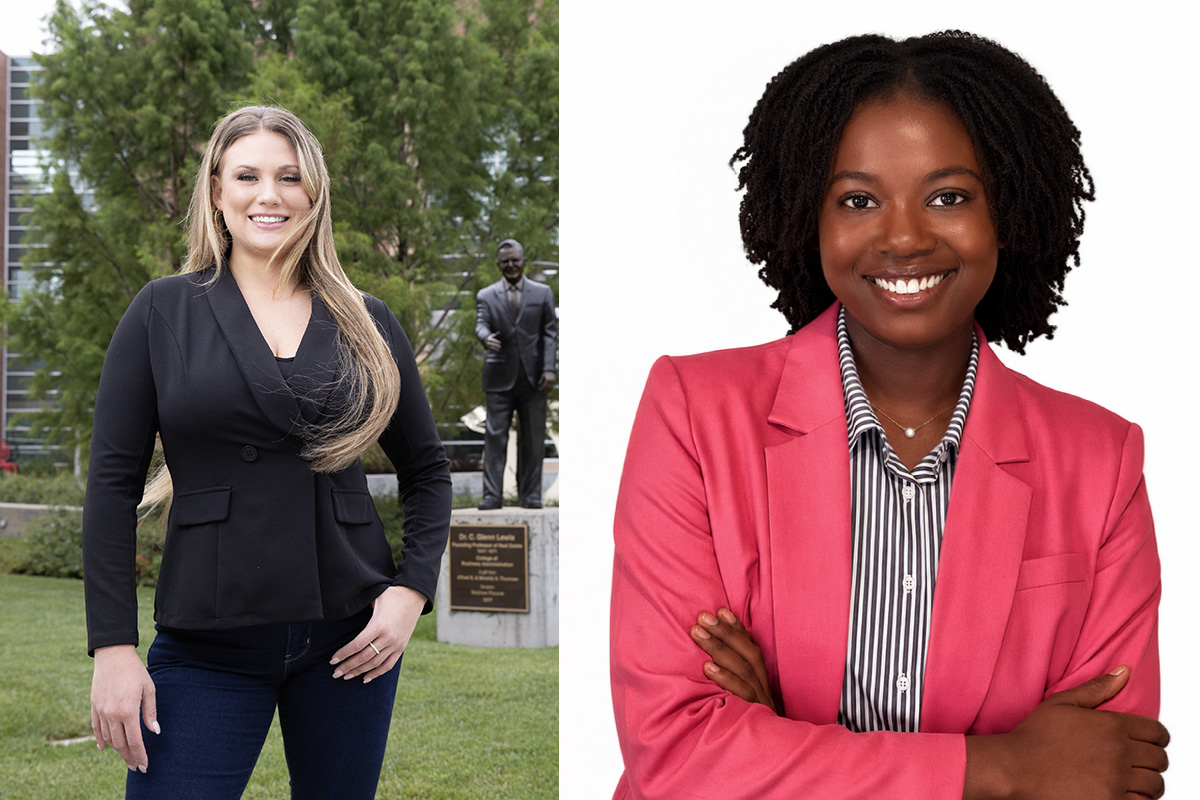
For students in the University of Nebraska at Omaha’s College of Business Administration, legal studies is not just about reading cases or learning terminology. In Professor Destynie Sewell’s advanced legal studies research course, students are asked to do something much more demanding: identify where the law falls short, develop an original argument, and propose ways to improve that policy.
Each student develops a thesis, conducts in-depth legal research, and writes a 35-page paper with their recommendations and analysis of the case. The project, which Sewell has guided for the past decade as part of the legal studies concentration, is similar to the kind of work students may find in law school and beyond.
“This is no small project,” Sewell said. “They have to come up with a thesis, research that thesis, explain why the law is insufficient, who it harms, and how they think it can be made better. They are doing real legal research and real policy work.”
This year, Sewell asked her students to focus their work on one of the most pressing issues in modern law and business: artificial intelligence.
Senior Madalyn McKeone looked at the growing use of AI-powered risk assessment tools in the criminal justice system. Her paper examines how those tools, which generate scores related to recidivism or the failure to appear in court, may raise serious constitutional concerns when relied on too heavily by judges, parole boards, or probation officers.
McKeone argues that when legal counsel cannot see or challenge the proprietary data behind those systems, defendants may be denied a meaningful opportunity to defend themselves. What began as an unfamiliar topic quickly became a powerful area of interest.
“I didn’t even know what risk assessment tools were before this semester,” McKeone said. “But the more I researched, the more I realized how little public awareness there is. I want more awareness about these things, because AI is here to stay, and this is a pivotal time to be setting integrity with these tools.”
Her interest in legal studies is deeply personal. After completing a Bachelor of Science in Leadership from Creighton University in 2021, McKeone took some time off to work. In 2024, she then returned to school with a new sense of purpose and found a way to turn difficult experiences into motivation. She now plans to take the LSAT and pursue law school, carrying with her a desire to help others understand and defend their rights.
Sewell’s course helped sharpen that purpose.
“Her true investment in me, her encouragement in me, completely changed the way I show up for other people,” McKeone said of Sewell. “The way she consistently brought positive energy, even if it wasn’t a positive moment — that’s the kind of leader I hope I can be for other people too.”
Junior Grace Cyiza approached her project from another angle, examining AI in the context of patent law. Her research focused on a major question emerging in courts around the world: if artificial intelligence helps generate an invention, who should be recognized as the inventor?
Cyiza centered her paper on the case Thaler v. Vidal, which involved a patent application listing an AI system, rather than a human, as the inventor. That question led her into a much broader exploration of law, innovation, economics, and the evolving role of AI in society.
“Patent law has always assumed a natural mind,” Cyiza said. “But when AI is being prompted, refining ideas, and becoming part of the workflow, it creates a gray area.”
As she dug deeper, Cyiza traced the history of patent law and how definitions such as “inventor” and “individual” have changed over time. Her work connected legal doctrine with business realities, including the implications for innovation, economic competitiveness, and U.S. leadership in emerging technologies.
“It’s a very interesting time to be alive,” she said. “Everything is being pressure tested.”
That kind of intellectual stretch is exactly what Sewell intends.
While many students think of pre-law preparation as rooted only in political science or traditional legal pathways, Sewell sees legal studies in business as a way for students from many disciplines to develop sharper reasoning, stronger writing, and a deeper understanding of how law shapes every industry.
“This is about teaching students how to think critically and analytically,” Sewell said. “You don’t have to become a lawyer to benefit from understanding the law. Every company has legal issues. Every company needs people who can recognize risk, understand regulation, and know when legal questions matter.”
The course also asks students to do more than write. This spring, Sewell organized a symposium-style brown bag presentation where students publicly presented their findings to faculty, peers, alumni, and outside professionals. Guests included legal scholars, technology leaders, business consultants, and former students, all invited to challenge the students’ arguments and strengthen them ahead of national competition.
“The point was to hear their arguments and poke holes in them,” Sewell said. “That way, when we get to competitions this year, they’re prepared.”
That kind of approach is making an impact. Over the years, Sewell has supervised dozens of these projects, and many of her students have gone on to law school, business careers, and national recognition. Some have earned top honors in competition; others have been encouraged to submit their policy recommendations directly to federal agencies.
But the project’s value, Sewell said, goes beyond awards.
For some students, it confirms they are ready for law school. For others, it reveals just how demanding that path can be. Either way, it gives them a clearer sense of what serious legal research feels like — and what they can accomplish.
“I think for some students, it’s the first time they realize they can actually affect policy change,” Sewell said. “If you had told them as freshmen that one day they’d be writing their own policy proposal, they might not have believed you.”
For McKeone and Cyiza, the experience has already changed the way they see the world.
McKeone says legal studies taught her to think more critically and confidently about legal issues, regardless of her future career path. Cyiza says the field has shown her how law intersects with business, technology, and everyday decision-making in ways many students do not initially expect.
“Be open,” Cyiza said. “There is so much that comes from just having the willingness to ask questions.”
In a world where the rules are still being written, Sewell’s students are learning how to be part of that process.