
UNO's Ticket to Space
High-altitude balloons provide students with a launchpad to conduct experiments in near-space and have sparked collaboration between UNO researchers.
- published: 2025/11/18
- contact: Jared Craig - Office of Strategic Marketing and Communications
- email: unonews@unomaha.edu
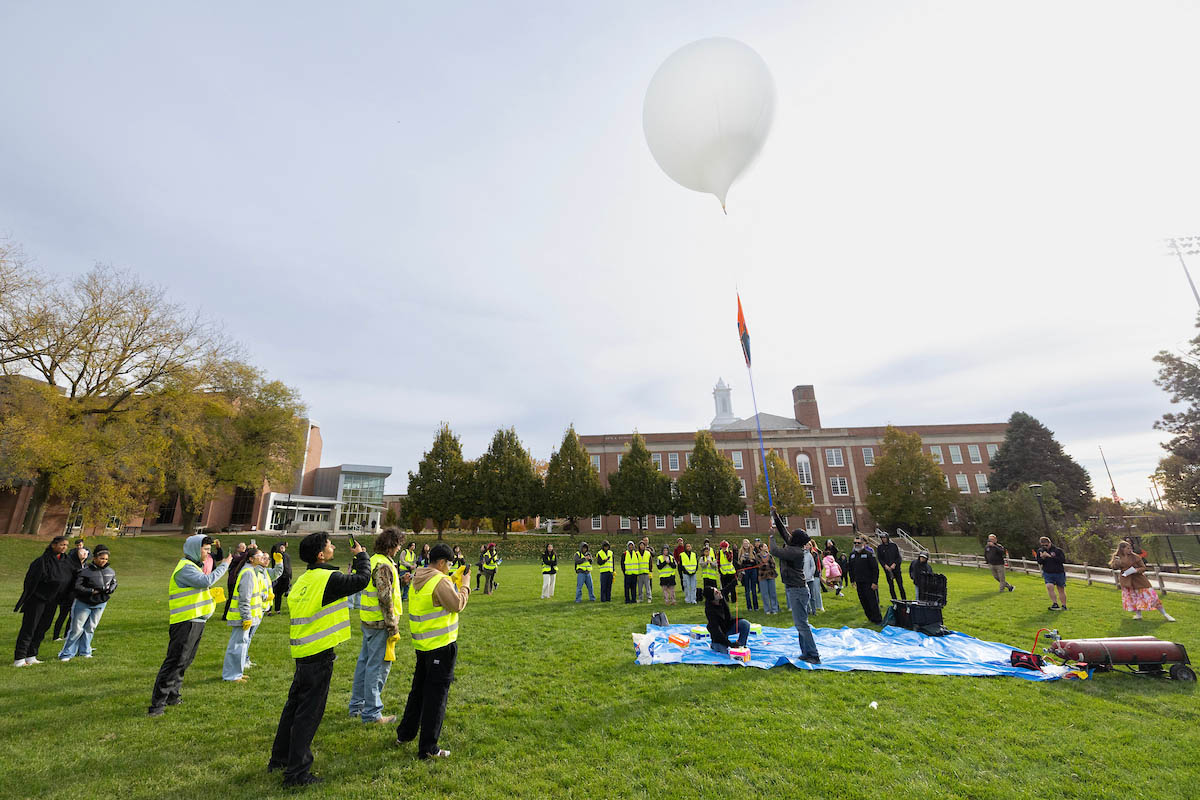
UNO Associate Professor Derrick Nero, Ed.D., conducts a high-altitude balloon launch with his class in the Pep Bowl. Photo: Ryan Sodelrin, UNO Office of Strategic Marketing and Communications.
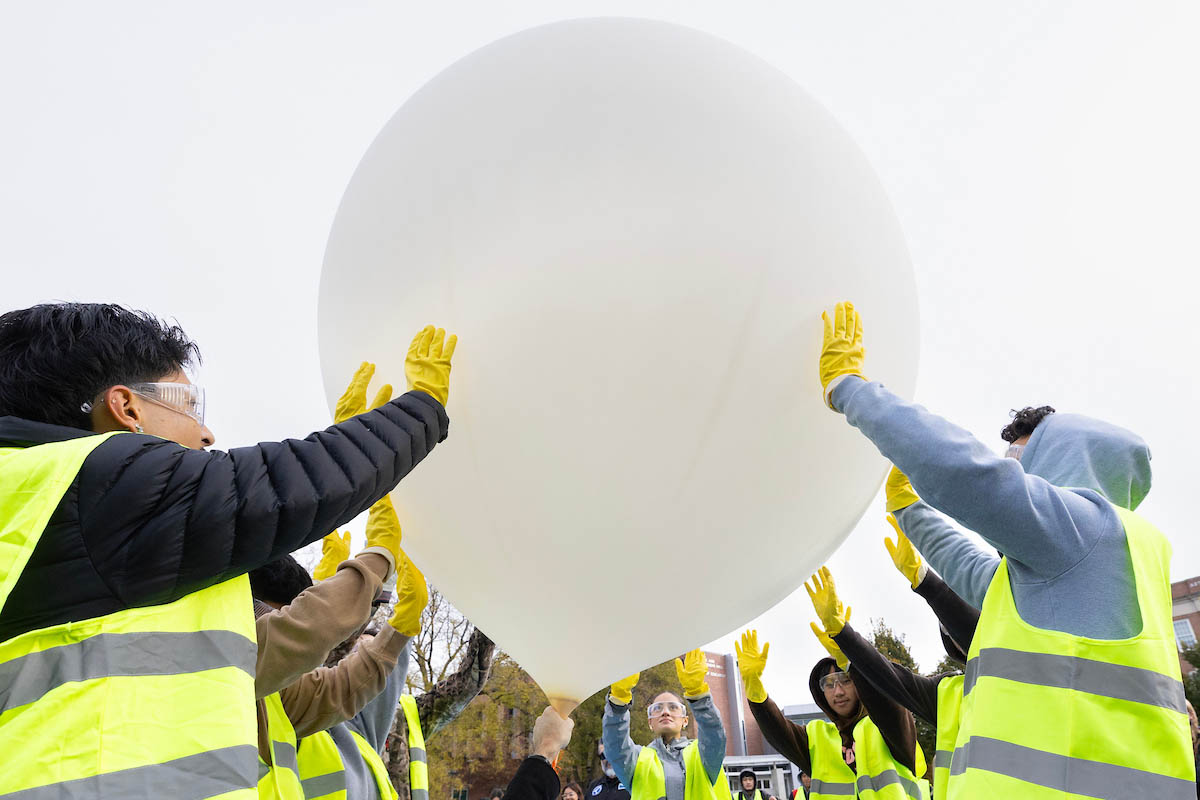
Students didn’t also create experiments. They also helped launch the balloon. Photo: Ryan Sodelrin, UNO Office of Strategic Marketing and Communications.
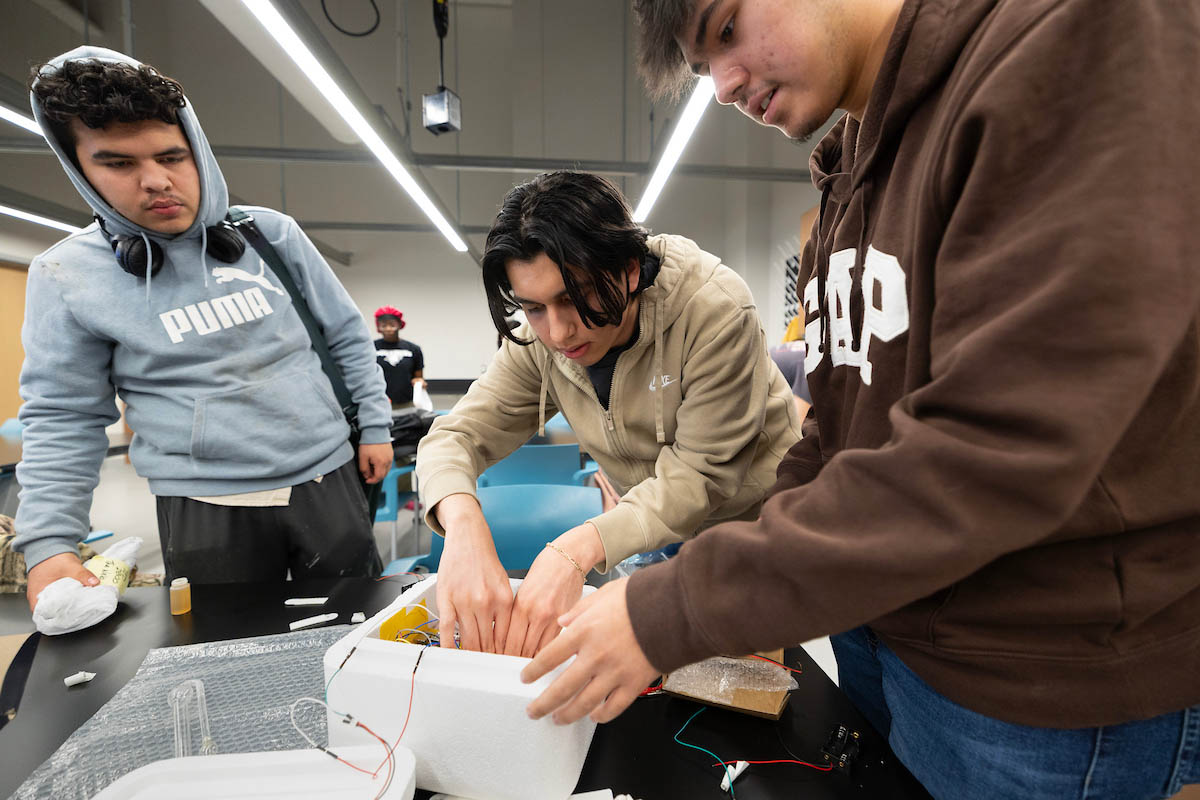
Students complete final preparations for their experiments to be launched into near-space altitudes. Photo: Ryan Sodelrin, UNO Office of Strategic Marketing and Communications.
At the University of Nebraska at Omaha (UNO), high-altitude balloon launches from campus are a common occurrence. And it’s a sight to behold every time.
When weather conditions are just right, Derrick Nero, an associate professor for the College of Education, Heath, and Human Sciences, leads students in his class to the Pep Bowl — a landmark stretch of lawn near Arts & Sciences Hall — to launch a balloon to 100,000 feet. The whole exercise catches the attention of anyone passing by, as Nero attaches the payload full of his students’ science experiments and releases it to near-space altitudes.
Throughout the day, the launches spark small talk of “Did you see the balloon launch today?” across campus and eventually found its way to a professor in UNO’s Department of Biomechanics. What began as a highlight of the year for a general education science course turned into a collaboration to test a new fabric to protect biological matter from radiation.
What Happens to a Burrito in Space?
In 2018, Nero introduced balloon launches into his course, Science Experimentation and Engineering Design, a class open to all majors but includes many education students with a desire to teach science.
“The course is about discovery,” he said. “Students come in not knowing what a near-space experiment even is, and by the end, they’re designing systems, solving engineering problems, and presenting their data like professional scientists.”
100,000 feet is roughly a third of the way to where Earth’s atmosphere meets space, a boundary called the Kármán line. These projects give students the challenge of fitting an experiment in a payload that has weight and size limitations. These are the same challenges for engineers in NASA or the private sector who launch objects and people into space. For Nero’s class, everything must weigh no more than 12 pounds due to regulations with the Federal Aviation Administration.
It creates good problem-solving challenges for students, Nero said.
Student projects have explored everything from the oxidation of metals and the decay of fruit to starfish regeneration and the viability of fungal spores in extreme temperatures. At this altitude, it can reach as low as –40 degrees Celsius. One semester, a group of students sent up an undeveloped strip of 35mm film and the flight left visible evidence of cosmic rays striking the film.
“One group tested how a burrito would hold up near space,” Nero recalled. “It started as a joke, but it became a real experiment in food preservation. That’s the kind of creativity this class encourages.”
The results: the burrito returned to the surface frozen and deconstructed in a matter of hours.
Nero also found opportunities to allow students to collaborate with NASA. In 2024, Nero’s team joined the Nationwide Eclipse Ballooning Project — an effort to study atmospheric changes along the path of a total solar eclipse. Needing to travel to find the right spot and likely looking for an excuse to visit somewhere notorious, they launched balloons at Roswell, New Mexico.
Their findings were added to a nationwide NASA database, contributing valuable insight into how solar activity impacts Earth’s atmosphere.
“It’s incredible for undergraduates to take part in a NASA mission,” Nero said.
Launchpad for Research
When Yury Salkovskiy, an assistant professor in UNO’s Department of Biomechanics, saw the balloon launches in person, he saw an opportunity to test a biopolymer protective fabric his team had produced. His lab specializes in developing various nanofibers using electrospinning technology, among other things, which have been used to help people recover from injuries and surgeries much faster.
Using similar techniques, Salkovskiy created a fabric embedded with particles, including heavy metal, that offer protection against radiation and low temperatures — exactly the kind of conditions in near-space environments.
Salkovskiy calls it nanomanufacturing, something of a new science offering exciting opportunities that could vastly change our society and economy, ranging from consumer goods like clothing to handle extreme temperatures, or providing scientists and engineers more breathable, versatile anti-radiation gear.
“I saw Dr. Nero launch these balloons and knew this is the perfect testing platform,” Salkovskiy said. “We can simulate extreme conditions in the lab, but it’s not the same as real exposure at a high altitude.”
Salkovskiy faced the same weight parameters as Nero’s students and had to produce an original design to house his experiment. With support from a NASA Nebraska Space Grant , Salkovskiy’s team created a lightweight, 3D-printed chamber that rests in a Styrofoam payload. It used a drive from a DVD player, with the chamber ejecting the containers with test bacterial cultures into near-space and exposing them to intense cold and radiation.
Salkovskiy and Nero planned for three launches to test the chamber, which contained bacteria. Everything was a collaboration. Even to pick to right bacteria, Salkovskiy worked with researchers at the University of Nebraska Medical Center’s Department of Pathology, Microbiology and Immunology Happening over the spring of 2025, the first three perfected the testing chamber and to see how the bacteria responded to harsh conditions. The fourth launch, still in the planning stage, would test the fabric to see how it protected the bacteria from radiation.
For both professors, the collaboration has opened new pathways for student learning. Salkovskiy’s passion for his work is contagious and looks to see more student participation in his research. While Nero wants his students to see how other scientists are conducting similar experiments.
"When my students found out about us working on this project, they started asking questions about biomechanics,” Nero said. “This was a good opportunity to show how science and engineering are everywhere, and it bleeds into other fields even if you're not thinking about it.”
Salkovskiy agrees. He noted how the process opened his team to think differently about how to conduct the experiment.
Standing in the Pep Bowl, the team watched the balloon and payload — with a GoPro attached — and tracked it using GPS rising through the atmosphere. After the controlled descent, the team reviewed the footage to see how the testing chamber worked, with the payload ejecting the cultures into near space. The vastness of outer space only miles away, the view was spectacular, and the sight of the balloon popping and falling rapidly to farmlandin southwest Iowa was equally impressive.
For the future, Salkovskiy plans for another launch to test the fabric and further work with Nero. For Nero, he hopes other UNO researchers and the community use balloon launches.
“This is their ticket to space,” Nero said.
About the University of Nebraska at Omaha
The University of Nebraska at Omaha (UNO) is Nebraska’s premier metropolitan university, committed to innovating for the public good, advancing social mobility, powering workforce development, and serving as a hub for community engagement. Nearly 15,000 Mavericks choose UNO for its hands-on education experiences, nationally ranked online and graduate programs, military-connected student support, and innovative approaches to supporting lifelong learning. UNO holds the Carnegie Research Activity “R2” designation, securing more than $40 million annually in external research funding and counts its faculty among the world’s most cited scholars. Sixteen Omaha Athletics programs compete in NCAA Division I as members of the Summit League and National Collegiate Hockey Conference (NCHC).
Follow UNO on Facebook, Twitter (X), Instagram, LinkedIn, and YouTube.