#NUforNE: Keeping Nebraska Communities Healthy
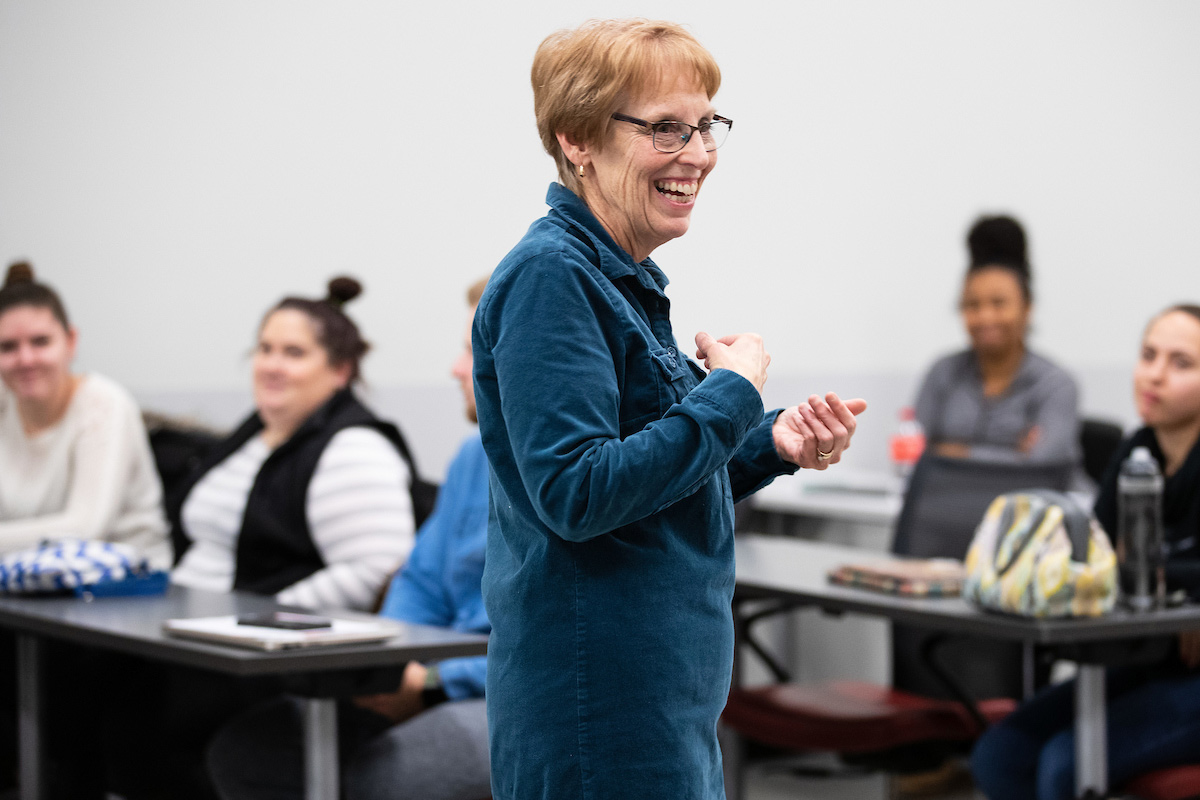
Marcia Adler, Ph.D., is passionate about her community. She’s also passionate about keeping her community healthy.
- published: 2023/02/03
- contact: Jackie Ostrowicki - University of Nebraska
- search keywords:
- #NUforNE
- Marcia Adler
- public health
- rural health
- communities
About the #NUforNE Series: This article is part of the University of Nebraska's #NUforNE series. #NUforNE features students, faculty, staff and alumni from across the University who are making an impact on Nebraska.
Dr. Marcia Adler is passionate about her community. She’s also passionate about keeping her community healthy.
She connected with public health as a sixteen-year-old from Grant, Nebraska, when she traveled alone to Cape Town, South Africa, for a yearlong Rotary exchange program. During that year, Adler worked alongside public health nurses in a grass hut providing Xhosa women reproductive health education and medical care.
That experience transformed her life, planting seeds for becoming a nurse and a career in public health.
Her training as a registered nurse brought her to clinical care. She worked in many different areas: oncology, rehab, chemical dependency services, geriatrics, K-12 school nursing and college health—where she realized that helping populations could have a bigger impact that working one-on-one with patients.
“There is a difference between direct care and population care,” Adler said. “When I work in public health, I'm working with a targeted population, not an individual. It’s one-to-many versus one-to-one.”
She received her Ph.D. in gerontology later in life. The doctoral degree created an outlet for Marcia to channel her energy toward a new generation of learners, and she began teaching full-time at UNO.
Unlike other faculty members who may have appointments in research and outreach, Adler’s appointment is focused wholly on students. Adler helps keep Nebraska communities healthy by training public health students—who learn to promote healthy lifestyles, research injury prevention, and detect and prevent infectious diseases. Her unwavering goal is to ignite in her students a passion for lifelong learning and public health—that in turn improves the lives of marginalized populations.
Protecting our Communities
Public health focuses on protecting and improving the health of people and their communities. Unlike the work of clinical care, which focuses on individuals, public health is concerned with protecting the health of entire populations. These populations can be as small as a local school—or as big as an entire country.
Professionals in public health try to prevent problems from happening or recurring. They do this through implementing educational programs, recommending policies, administering services and conducting research. This is in contrast to clinical professionals like doctors and nurses, who focus primarily on treating people after they become sick or injured.
“Public health plays a critical role in ensuring a healthy population, which is necessary for a successful and healthy state,” said Dr. Jason Coleman, director of UNO’s School of Health & Kinesiology.
The power of collaboration, community engagement, and building strong health infrastructure was taught to Coleman early in his career. After graduating with an undergraduate degree in international studies, he spent over two years as a Peace Corps volunteer in Zambia for the Community Action for Health program. He then attended the University of South Carolina and graduated from the Arnold School of Public Health with his master’s and doctoral degrees.
“On the ground in Zambia, I learned that public health is the heart of achieving social justice and equity in the developing world,” Coleman said. “I was trained to go into communities with basic health infrastructure and build capacity, and I saw a real impact of this work on the health of the community."
A large part of public health is promoting health care equity, quality and accessibility—in short, working to limit health disparities.
These efforts contribute to a strong economy by ensuring a healthy workforce and work environment. Public health initiatives also ensure that Nebraskans have access to resources to prevent and treat both acute and long-term health conditions.
“A highly skilled public health workforce is critical to the nation’s infrastructure, and we are a major engine to fuel that need in Nebraska and beyond,” Coleman said.
Developing the Public Health Workforce
When faculty like Marcia Adler train students who are passionate about the mission of public health, the impacts can be immediate. Adler incorporates a community service component into nearly all her classes. Last semester, she taught a Foundations in Public Health course, and assigned her students 20 hours with a community agency to work on a project.
After UNO’s Service Learning Center vetted the agencies, Adler provided in-class learning so that students who were going into those spaces understood what public health is about and how to honor the people they're there to help. “The last thing you want to do is cause harm to people that are already vulnerable,” Adler said.
Her students completed projects in places like the Hope Center for Kids, an after-school and summer program for low-income children. They went to Omaha Integrative Care, an integrated mental health system. They went to North Omaha Area Health, a health clinic that provides no-cost or low-cost services.
“Allowing students in those spaces early on helped them shape where they see their future—and develop a passion for the people that we work for in the world,” Adler said.
Making a Difference, One Student at a Time
The ultimate goal of the public health program is to prepare students to be successful in the workforce.
“We need to continue to train students with versatile skill sets that allow them to become the next generation of public health leaders,” Coleman said. He envisions students who serve their communities in a variety of ways: working with public health departments, non-profit organizations, hospital systems, government agencies, social service agencies, and businesses, to name a few.
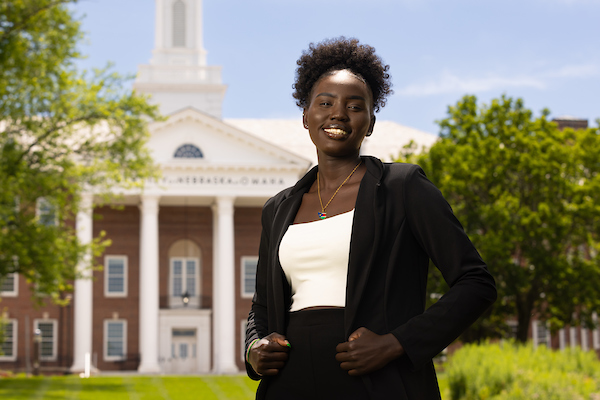
One of Adler’s students was Alakiir Mapior. Mapior graduated in August 2022 from UNO's College of Education, Health and Human Sciences with a degree in Public Health—the first female in her family to achieve a college degree. She is currently in graduate school for occupational therapy.
“I got into public health because I wanted to give back to the community. My parents are both from South Sudan and I was born there; we flew to Kenya and didn’t have a home so were settled in a refugee camp. I started school there and continued my education here at UNO,” Mapior said.
“I never thought that I would make it this far. The people I’ve met here at the University of Nebraska at Omaha, like Dr. Adler, have played an important role in my life. They’ve nurtured me to be who I am today.”
Mapior graduated in August 2022 from UNO's College of Education, Health and Human Sciences with a degree in Public Health—the first female in her family to achieve a college degree. She is currently in graduate school for occupational therapy.