
5 AI Myths We Need to Stop Believing
UNO information technology expert Deepak Khazanchi, Ph.D., and UNO postdoctoral researcher Anoop Mishra, Ph.D., break down why AI's promises, threats, and fears are overhyped.
- published: 2026/09/21
- contact: Deepak Khazanchi, Ph.D., and Anoop Mishra, Ph.D. - College of Information Science & Technology
- email: khazanchi@unomaha.edu

OMA x AI Conference attendees gather in the University of Nebraska at Omaha (UNO) Community Engagement Center's (CEC) Union Pacific Atrium. (Ryan Soderlin/UNO)
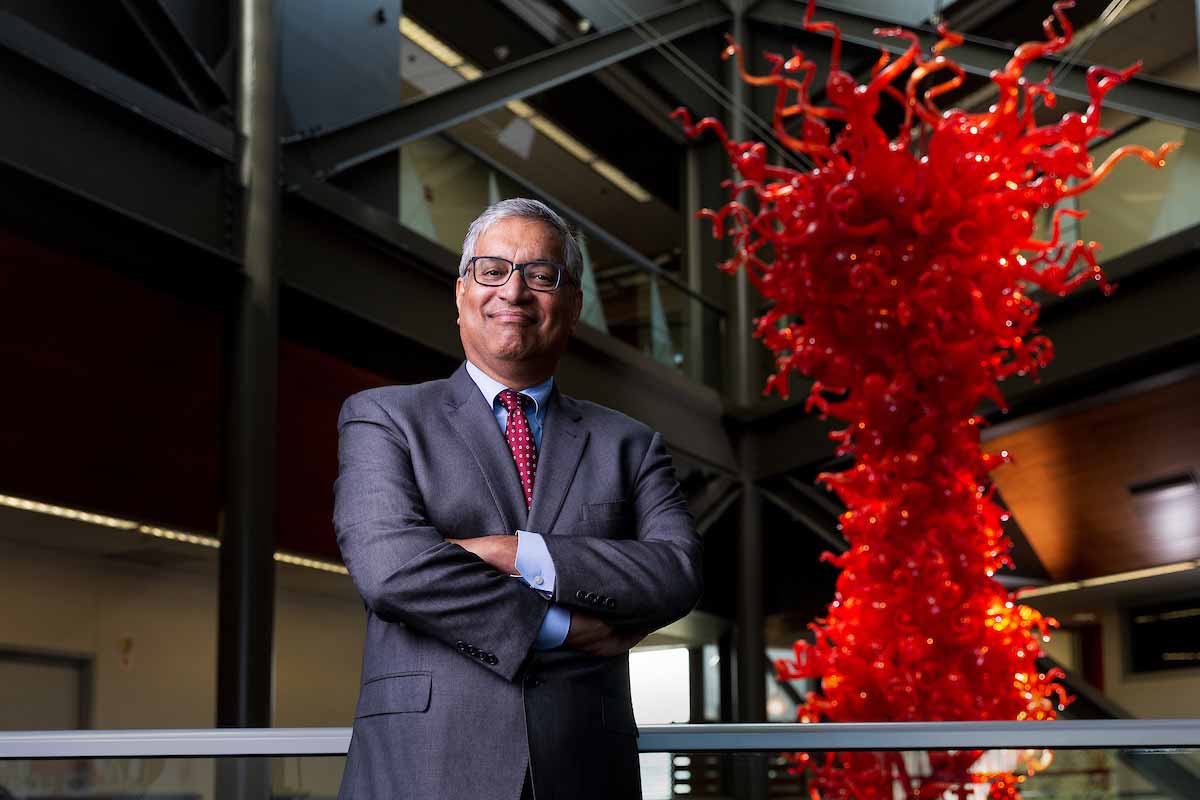
Deepak Khazanchi, Ph.D., Mutual of Omaha Endowed Professor of Information Science & Technology. (UNO)

Anoop Mishra, Ph.D., Center for Management of Information Technology Attic Lab AI Research Fellow. (Courtesy photo)
Deepak Khazanchi, Ph.D., is Mutual of Omaha Distinguished Professor of Information Science & Technology, Professor in the Department of Information Systems and Quantitative Analysis, and Executive Director of the Center for Management of Information Technology (CMIT). His research interests include fast response virtual teams, applied machine learning, perceived fairness of AI/ML systems, mixed methods, and virtual work using emerging technology capabilities. Anoop Mishra, Ph.D., is a postdoc research fellow in in the Center for Management of Information Technology (CMIT).
Artificial Intelligence (AI) dominates today's headlines, boardroom discussions, and social media conversations. Much of the discussion, however, is driven by fear, hype, and unrealistic expectations.
The reality is both more promising and more complicated.
AI offers enormous opportunities and potential solutions for modern-day societal issues. However, there is an urgent need to increase awareness about what it can and cannot do.
Here are five myths about AI that deserve a closer look.
Myth #1: AI Will Kill Entry-Level and White-Collar Jobs
The popular narrative is simple: AI will replace millions of workers. Reality is more nuanced. AI is exceptionally good at automating specific tasks, but jobs consist of many tasks requiring judgment, creativity, communication, ethics, and relationship building. Most occupations will not disappear; they will evolve.
Research from the Massachusetts Institute of Technology (MIT) suggests that AI is most valuable when it augments human work rather than replacing it. Historically, technological innovations have transformed jobs far more often than they have eliminated them. The emerging pattern with AI is job redesign and capability enhancement, not wholesale job extinction. In fact, human expertise and resources in organizations will shift away from routine task execution toward critical reasoning, problem formulation, and output auditing.
The future is not humans versus AI. It is humans with AI.
Myth #2: AI Alone Will Dramatically Improve Productivity
AI can improve productivity, but it is not a magic wand. Some organizations are reporting significant gains in coding, customer support, knowledge work, and content creation. Others are seeing far more modest results. The difference often lies in how technology is implemented. Recent reviews of AI productivity research show that gains are highly context dependent.
Researchers at the University of California, Berkeley and MIT found that teams combining humans and AI do not automatically outperform either humans or AI working independently. Productivity gains emerge when organizations redesign workflows, train employees, and establish effective governance rather than simply deploying AI tools.
There are many new roles that are and will be created as AI tools need supervision and governance. Some examples of such roles include AI evaluator, AI Verification Officer / Audit Specialist, AI Safety Engineer / Code Assurance Lead, Clinical AI Governance Manager, Brand Safety & Ethics Manager, AI Compliance Officer, and many more.
In other words, AI is a productivity tool, not a productivity guarantee.
Myth #3: AI Will Soon Be as Intelligent as Humans
This is a false choice. AI systems can generate text, write code, analyze data, and recognize patterns at a remarkable speed. But these capabilities should not be confused with human intelligence.
Today's AI systems perform tasks they were designed and trained to perform by human engineers. They do not possess consciousness, self-awareness, moral reasoning, common sense, or lived experiences like humans.
While AI can outperform people in narrow and highly structured tasks, there is no evidence that current systems possess human-like intelligence. AI excels at pattern recognition and prediction. Humans bring judgment, values, context, responsibility, and accountability. These are fundamentally different capabilities.
For example, AI-based radiology models can scan thousands of chest X-rays or mammograms per minute, identifying subtle anomalies, micro-calcifications, or early-stage tumors faster and often with higher accuracy than a human radiologist. However, AI models cannot deliver a cancer diagnosis to a patient, navigate their personal values regarding aggressive treatment versus quality of life, or account for socioeconomic barriers when designing a care plan.
The doctor brings empathy, holistic context, and moral responsibility to the decision. The question is not whether AI will become human. The question is how humans can use AI effectively.
Myth #4: AI Automatically Creates Business Value
Many executives assume that adopting AI guarantees competitive advantage. It does not. Technology alone rarely creates value. Organizations create value when they apply technology to solve clearly defined problems and improve how work gets done.
Studies of AI adoption show that many organizations struggle to realize meaningful returns because they focus on acquiring technology rather than redesigning processes and business models.
Successful implementations identify specific opportunities, establish performance measures, and align AI initiatives with strategic goals. Thus, simply acquiring AI software without changing workflows fails to create value, whereas redesigning business processes drives significant return on investment (ROI).
Furthermore, purchasing AI tools without updating job roles or processes yields poor results. Reporting from Inc. and Forbes found that when IBM restructured its HR workflows around its Watsonx platform, it automated 94% of routine HR requests and saved over $100 million in one year.
AI does not create value by itself. Organizations create value through intelligent application of AI.
Myth #5: Reducing Headcount Equals Value Creation
Perhaps the most dangerous myth is that AI's primary purpose is to reduce labor costs. Some companies assume that replacing employees with automation automatically increases value. History suggests otherwise.
Organizations exist to create products, services, experiences, and innovations that customers value. Employees are often central to that mission. Eliminating people without understanding how work creates value can reduce service quality, diminish institutional knowledge, and weaken innovation. Research suggests that organizations generate the most value when AI complements rather than replaces human capabilities.
The greatest opportunities typically come from improving specific tasks, reducing routine work, enhancing decision-making, and allowing employees to focus on higher-value activities. For example, top financial institutions like Morgan Stanley and JPMorgan reported using agentic AI for research retrieval, dossier creation, and workflow execution tools while reserving final decisions for human advisors.
In fact, major wealth management and commercial banking firms have institutionalized agentic workflows (e.g., Morgan Stanley's AI Assistant and Debrief tools built with OpenAI). These systems draft meeting summaries, compile internal research dossiers, and prepare compliance documentation, saving multiple hours per week per advisor while keeping human experts accountable for investment recommendations and risk approvals. The better question is not, "What jobs can we eliminate?" It is, "What tasks can we improve?"
The Bottom Line
AI is neither our savior nor our destroyer. It is a powerful tool created by humans and shaped by human choices. The real question is not whether AI will replace people, but how we choose to use it.
Organizations that succeed will not be those that blindly automate or chase the latest technology trend. They will be those that combine human judgment with AI capabilities, focus on solving specific problems, and ensure that AI systems are transparent, accountable, and representative of the people they affect.
Our own research on AI fairness and digital human rights has shown that evaluation of AI’s societal impact cannot be an afterthought; it is critical that AI Policy be co-created with civil society, government, business sector.
AI systems can improve productivity and service, but they can also amplify biases and create unintended harms if they are not carefully governed. The greatest challenge of the AI age is not building smarter machines. It is ensuring that these machines help us build smarter, fairer, and more human-centered organizations and communities.
Want to share your expert insights? The UNO Office of Strategic Marketing Communications (MarComm) Editorial and Media Relations team collaborates with faculty and staff to share subject matter expertise on a wide range of topics. Review the UNO News Center Editorial Standards and share your idea or draft commentary with unonews@unomaha.edu.
About the University of Nebraska at Omaha
The University of Nebraska at Omaha (UNO) is Nebraska’s premier metropolitan university, committed to innovating for the public good, advancing social mobility, powering workforce development, and serving as a hub for community engagement. Nearly 15,000 Mavericks choose UNO for its hands-on education experiences, nationally ranked online and graduate programs, military-connected student support, and innovative approaches to supporting lifelong learning. UNO holds the Carnegie Research Activity “R2” designation, securing more than $40 million annually in external research funding and counts its faculty among the world’s most cited scholars. Sixteen Omaha Athletics programs compete in NCAA Division I as members of the Summit League and National Collegiate Hockey Conference (NCHC).
Follow UNO on Facebook, Twitter (X), Instagram, LinkedIn, and YouTube.