
In the UNO Animal Behavior Research Lab, Students Study Dog Cortisol Connections While Unlocking Critical Skills
While research lab results matter, the educational skills gained along the way are just as important.
- published: 2026/05/21
- contact: Marlo Larsen - Office of Strategic Marketing and Communications
- email: unonews@unomaha.edu
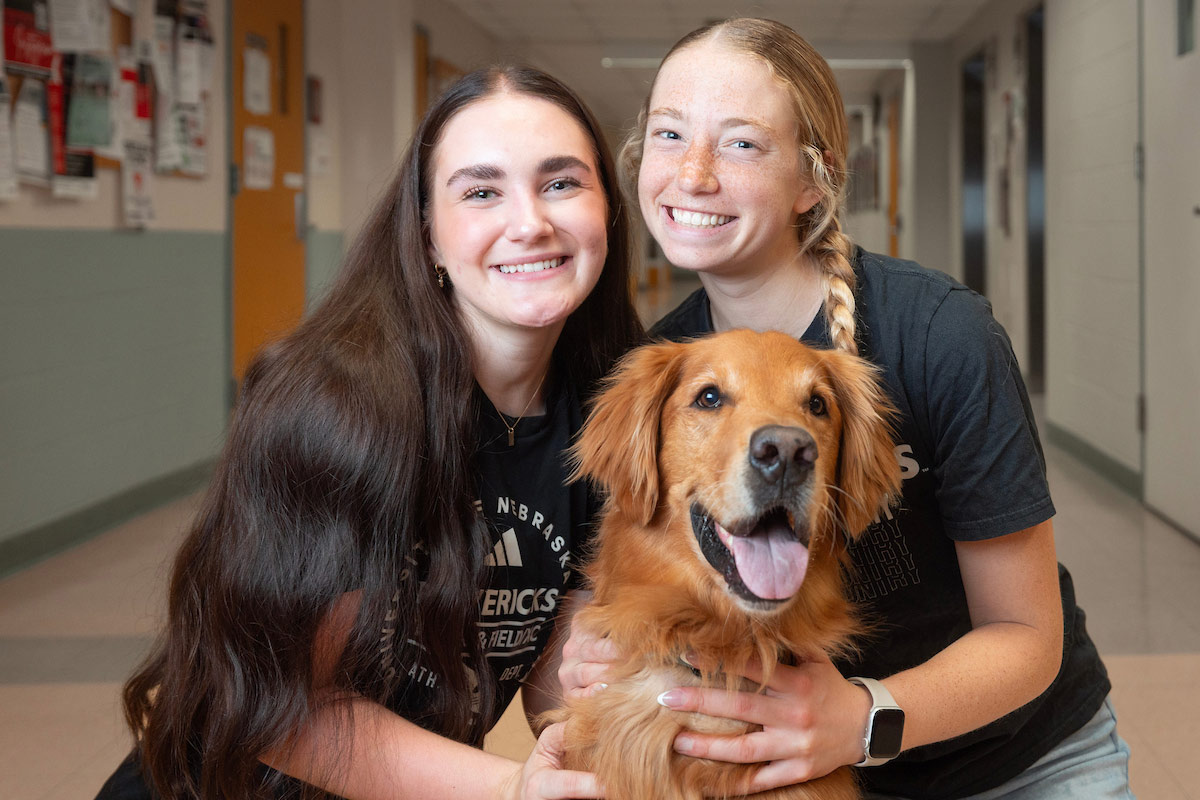
When beginning their studies at the University of Nebraska at Omaha (UNO), students Maya Bergstrom and Izzy Apel had no idea just how impactful hands-on research experiences would be to their education and future.
“I mean, nobody tells you when you start, you don't feel like you know what you're talking about,” says Bergstrom, a sophomore biology and chemistry student.
“The research process is one that was very new to me. I genuinely thought it was just the hypothesis, experiment, conclusion, discuss results. It is not that at all,” says Apel, a junior neuroscience and chemistry student.
The two students, who are also distance runners for UNO’s track & field team, had one of their first experiences with research when they joined Associate Professor Rose Strasser Ph.D.’s animal behavior lab.
For years, Strasser, who focuses on neuroscience and behavior, has studied things like pet-owner relationships, dog attachment bonds, and dog-owner hormone synchronization. Now, Strasser and her students are looking at how early life environments can influence a dog’s behavior and health. They examine dogs who came from both safe, healthy, and well-socialized backgrounds, as well as dogs who have come from adversity like hoarding, overcrowding, or neglect.
“So, how do those early life experiences change their behavior, and are there any other health consequences or behavioral consequences that exist when they come from that deprived environment early on?” Strasser explains.
As a branch of that research, students Apel and Bergstrom are hoping to learn more about if and how parenting and training styles can impact a dog’s cortisol levels, specifically cortisol stored in dog hair.
“For me, I'm interested in the fact that this could be maybe a translational model for humans, like human to either parent to child or just human to human in general,” Apel, who hopes to enter the medical field after graduating, says.
The students released an in-depth survey to pet owners gathering information about training and parenting styles, perception of their pets, and attachment levels or stress-related behaviors exhibited by their pet.
From there, the students will build out different pet profiles, and send cortisol kits to selected participants. Those pet owners will send back 100 strands of their pet’s hair for examination of cortisol levels in UNO’s bioanalytics lab.
“That's gonna be really, really exciting to get to that point,” Bergstrom says.
While the results are important, Strasser stresses that research opportunities like these are just as much about the educational process.
“Reading about research is wonderful, doing it is completely different, right? So the parts that you just cannot replicate unless you do it is the overall synthesis of information, the creativity of trying to think, okay, this is what we know, but what don't we know? You know, and coming up with those creative solutions of trying to find what's the next step in the research,” she says. “You just can't read about that. You have to be able to do that.”
For the students, that educational process is being felt, teaching them much more than just about dog health, behavior, and relationships.
“I think it makes you more confident,” Bergstrom says. “You can talk about okay, ‘we're looking at this, we're trying to find this, and this is why it's important,’ and that's something you don't get just from taking classes.”
“Being able to learn how to kind of synthesize large amounts of information, and then critically think and decide how, like, to extend on that information is really valuable in terms of being a good critical thinker, as well as being a contributing member to the world of research,” Apel adds.
Strasser, who has had hundreds of students pass through her labs over the years, says seeing student growth through research opportunities like these is incredibly satisfying.
“I can't even think of all the ways to emphasize how wonderful it is to have students in research, not just for my laboratory and being able to move the science forward, but for them to be able to think critically of information, I think applies to whatever they do in the future and in everyday life,” she says. “Being able to look at data available and solve problems applies to things across the board, not just a career goal.”
Inspired by the caregivers and medical staff that supported her family and her brother following his Autism diagnosis, Bergstrom’s goal is to one day became a physician’s assistant. She says this research opportunity has given her more than she imagined it would, getting her more excited for her future career.
“I think feeling like you are in some way making some sort of impact on science is really cool, because no matter what our result is, even if it says okay, there's no correlation. No is still an answer in science. It’s kind of fun to say I’m working on something that could help somebody in some way, or at least inform maybe further research about this.”
Apel, who graduated a year early from UNO at the May 2026 commencement, says she can already see how this will impact her future education and professional career as a medical provider.
“I think someday if I want to do research in medical school or beyond medical school, I'll have kind of the foundation of what it looks like to do so, which is gonna be really great,” she says.
“As I'm trying to make decisions and make sure that I'm being the best healthcare provider I can be, I think having the ability to think outside the box is going to be extremely valuable.”
Both students add that their growth, knowledge, curiosity, and success in the research opportunity wouldn’t be possible without the support and mentorship of Dr. Strasser.
📺 See more:
- Watch more on the dog hair research lab as highlighted by KMTV 3 News Now
🔎 Zoom in:
- In 2024-2025, UNO was awarded $40.7 million in research funding
- The Office of Research and Creative Activity (ORCA), awarded grants to 205 student researchers, totaling more than $624,000
⚡️What’s next:
- Visit the Office of Research and Creative Activity to learn more about student access to research and federal research grants
- Current student? Learn more about starting your own research project
- Have a research success story you’d like to share? Share it!
About the University of Nebraska at Omaha
The University of Nebraska at Omaha (UNO) is Nebraska’s premier metropolitan university, committed to innovating for the public good, advancing social mobility, powering workforce development, and serving as a hub for community engagement. Nearly 15,000 Mavericks choose UNO for its hands-on education experiences, nationally ranked online and graduate programs, military-connected student support, and innovative approaches to supporting lifelong learning. UNO holds the Carnegie Research Activity “R2” designation, securing more than $40 million annually in external research funding and counts its faculty among the world’s most cited scholars. Sixteen Omaha Athletics programs compete in NCAA Division I as members of the Summit League and National Collegiate Hockey Conference (NCHC).
Follow UNO on Facebook, Twitter (X), Instagram, LinkedIn, and YouTube.