
UNO Student Research on Jailbroken AI Was So Shocking, Lawmakers Invited Them to Washington, D.C. Twice.
It’s an experience only UNO students have had the opportunity to be part of.
- published: 2026/09/15
- contact: Marlo Larsen - UNO Office of Strategic Marketing and Communications
- email: unonews@unomaha.edu
When students head to college, most of them don’t expect to present their academic work or research to those outside the realm of academia. They certainly wouldn’t plan to talk to lawmakers about it. Right?
At the University of Nebraska at Omaha (UNO), however, never say never.
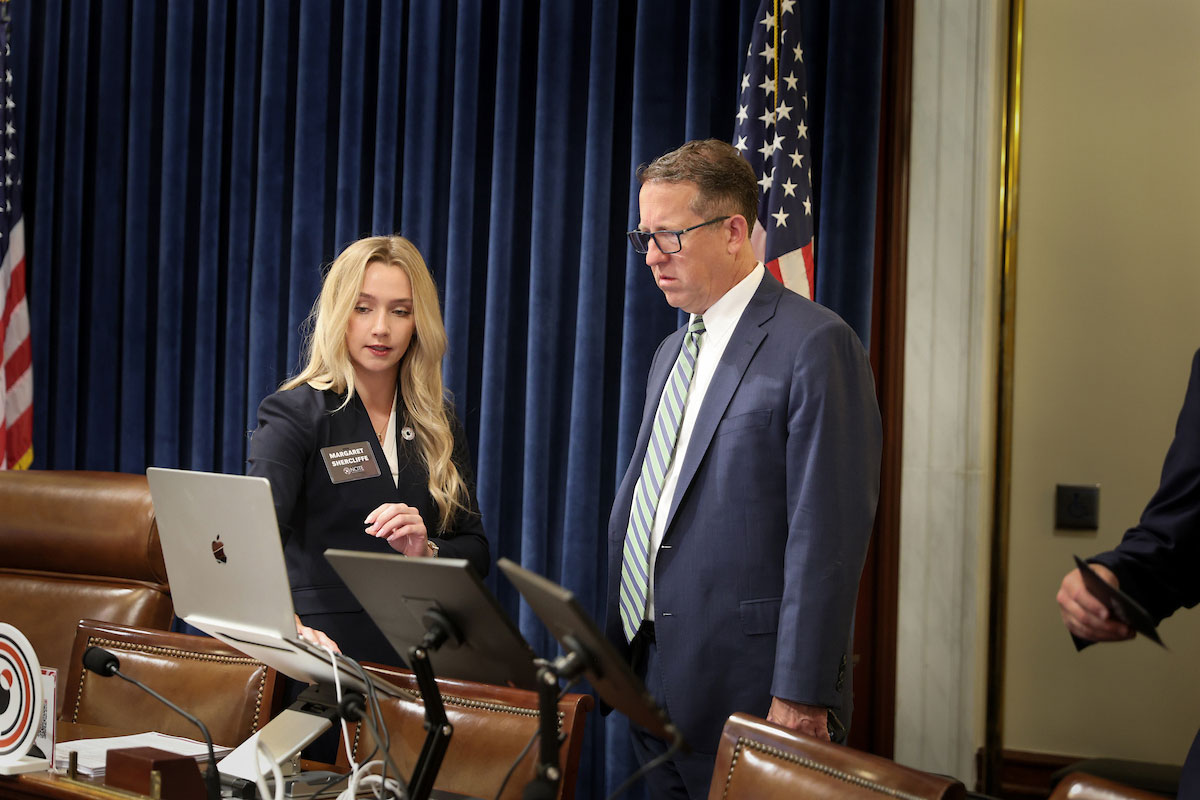
“Speaking face to face with representatives ... that's not a normal student experience by any means. That's not a normal experience for anyone, ever,” said Margaret Shercliffe after doing just that: presenting her research and knowledge — in person — to members of the U.S. House of Representatives in Washington, D.C.
Shercliffe is a graduate student in the Industrial and Organizational (I/O) Psychology program in UNO’s College of Arts and Sciences. The program, which examines human behavior in the workplace, is a common field for students who study and work with UNO’s National Counterterrorism Innovation, Technology, and Education Center (NCITE).
NCITE is the Department of Homeland Security’s Center of Excellence for terrorism prevention and counterterrorism research.
“This program, and especially doing counterterrorism research, I had no idea what to expect because I didn't have any background in it whatsoever,” admits Shercliffe about coming to UNO for her graduate studies after graduating from Concordia College in her home state of Minnesota.
But, it was the work of Sam Hunter, Ph.D., NCITE’s senior scientist and director of academic research, and a professor of I/O psychology, that drew Shercliffe in.
“I had read Dr. Hunter's work before coming here, and so I knew whatever we were doing, it would be great,” she adds. “I loved the research that he was doing on creativity and leadership. And I found out, through that, about the malevolent creativity work that he's doing."
She never expected that a short time later, she would be working alongside him, giving demonstrations about dangerous AI models to congressional members and their staffers.
Other students felt the same.
“No way, no. I thought maybe, at the very least, we'd help prep Sam to do it,” says I/O graduate student and Ph.D. candidate Alexis d’Amato. “You know, like gather information for him or help him with his slides. But no, never did I ever think that we would be there.”
d'Amato, of Omaha, was getting her undergraduate degree at UNO when the NCITE was awarded the DHS Center for Excellence contract. She had previously applied to work with Hunter when he was at Penn State University.
“Then when he came here, I was like, well, then I'll just stay at UNO so I can work with Sam and do research at NCITE, because I was really interested in all the projects and the creative side of what we do with counterterrorism,” she says. Now, d’Amato is a full-time research specialist for NCITE.
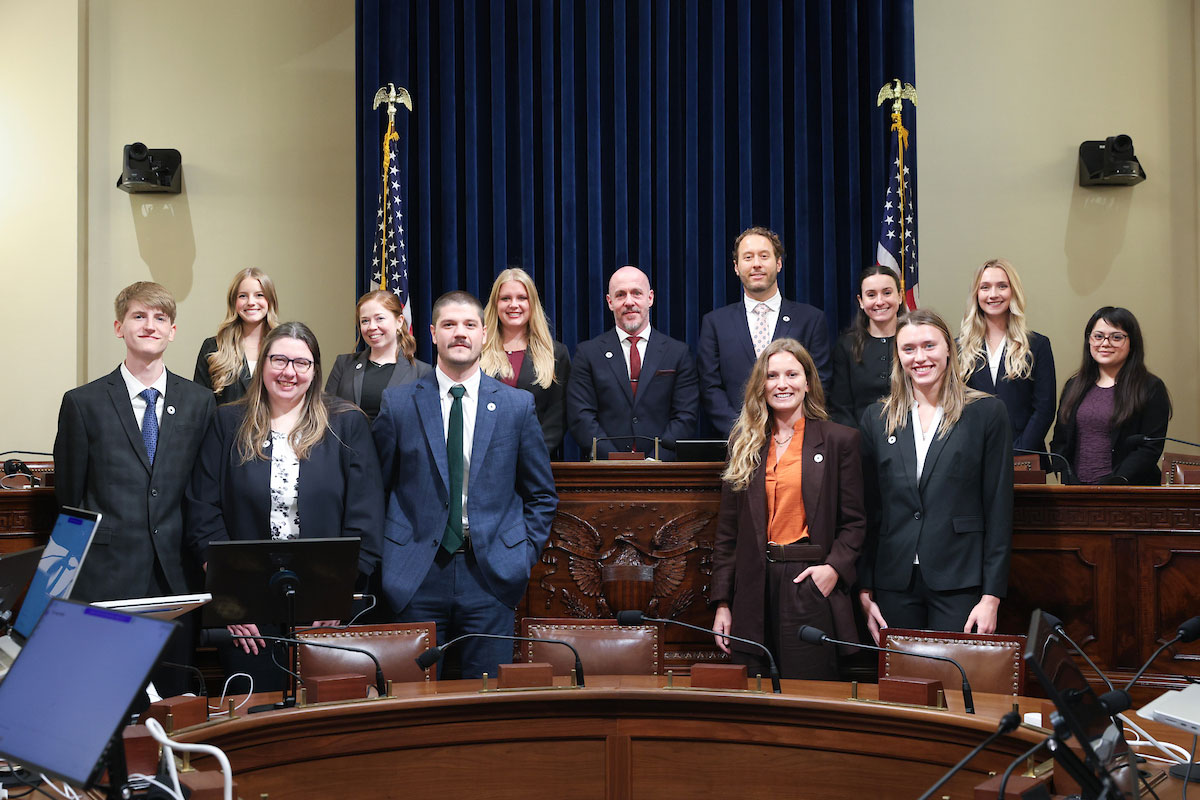
In April, Hunter and a small team of other NCITE researchers and students, including d’Amato and Shercliffe, were invited to present the capabilities of jailbroken and abliterated AI models to the Homeland Security Committee.
Abliterated AI models are completely unrestricted, meaning there are no safety measures in place to prevent users from asking about, planning, or potentially carrying out nefarious activity, like planning attacks or building weapons. The demonstrations of those frightening models showed how the tech is an emerging threat, especially in the hands of terrorists.
The presentation to congressmembers and their teams was so shocking and impactful that House Speaker Mike Johnson invited NCITE back, on an even larger scale, to demonstrate the AI tools to all House members. Shercliffe and d’Amato were among eight students and six researchers to make the second trip to D.C.
“Talking about the research that we're so familiar with to people that know nothing about it and might even be resistant to it, and us being able to translate it to a pretty broad audience — they're representatives and staffers, they all have their different backgrounds and opinions — that was definitely a good skill that I think we picked up,” says d’Amato about the experience.
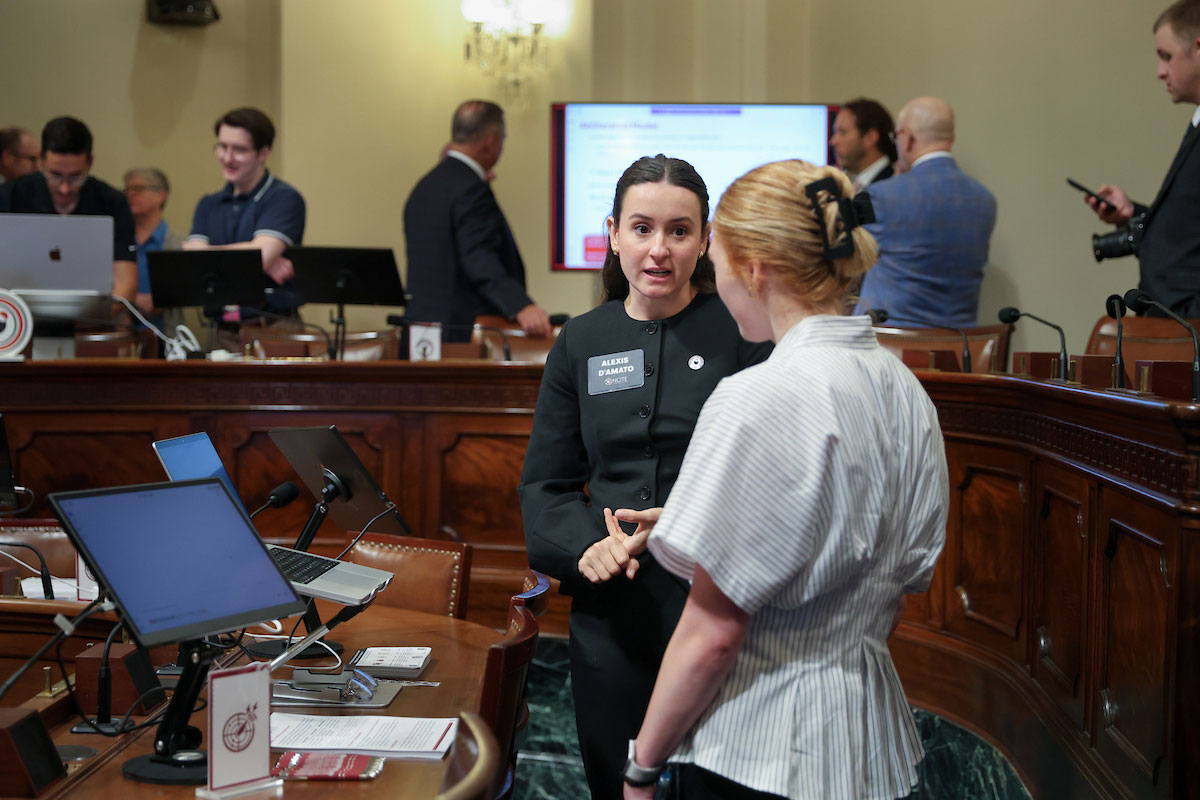
d’Amato and Shercliffe recognize the value of the visit not just as part of their academic and research growth, but as an experience that will surely help them in their future careers.
“If you told me two years ago that, one, this is the work I would be doing, and two, that I would be going to D.C. for a second time to be presenting it live in front of representatives. I would have laughed. I would not have believed you,” says Shercliffe.
“But as [d’Amato] said, it's a great opportunity, and it really forces us to take something that's highly technical for these members. It's very abstract; it's still hypothetical until they physically see it in front of them,” she adds.
The second visit to D.C. in September was part of a larger Homeland Security Committee demonstration day, showcasing how threats and technology have further developed since the terrorist attacks on 9/11. UNO was the only academic partner invited to participate.
Knowing they are quite literally the only students in the U.S. getting an experience like this, and knowing that it could eventually lead to helpful, actionable solutions, is surreal. But these students are humble.
“I just feel like I'm a cog within the larger wheel,” d’Amato says, giving credit to Hunter, Joel Elson, Ph.D., the director of information, science, and technology research initiatives at NCITE, and Gina Ligon, Ph.D., the director of NCITE.
“I'm so grateful to be a small part of it. I think it's fantastic that it could potentially be written into legislation, and I think it speaks to what NCITE does so well: the translation from science to practice,” Shercliffe says.
“I am just one little person in this giant army that's trying to solve this issue. But I think it's really important, and it's nice to see that the work that we do makes a real difference. And I think that's why we do it," she adds. “I'm very, very grateful for it.”
To NCITE leaders and researchers, while the work is critically important, the development of the student researchers and their experience is equally as relevant.
"There's nothing better than having students get to see the fruit of all their labor, come and make an impact, and inform Congress on how to take next steps and next action,” says Elson.
“One of the things that makes NCITE so unique is that we're always looking at the frontier and the horizon, and not just what's currently capable. So we're really eager to continue this work, pursuing past the current levels of technological capability, and to investigate embodied AI, physical AI, and the next frontier.”
Looking ahead to the future, d'Amato says the experience UNO has provided for her will set a standard for her future career as an educator.
“I'm incredibly grateful. I'm also really hopeful because I want to be a professor, I'm dreaming of my own students one day, and what kind of opportunities could I give to them that would even amount to this level of excitement and gratitude that I have while they're in grad school,” she says.
Learn more about NCITE’s latest visit to Washington D.C.
About the University of Nebraska at Omaha
The University of Nebraska at Omaha (UNO) is Nebraska’s premier metropolitan university, committed to innovating for the public good, advancing social mobility, powering workforce development, and serving as a hub for community engagement. Nearly 15,000 Mavericks choose UNO for its hands-on education experiences, nationally ranked online and graduate programs, military-connected student support, and innovative approaches to supporting lifelong learning. UNO holds the Carnegie Research Activity “R2” designation, securing more than $40 million annually in external research funding and counts its faculty among the world’s most cited scholars. Sixteen Omaha Athletics programs compete in NCAA Division I as members of the Summit League and National Collegiate Hockey Conference (NCHC).
Follow UNO on Facebook, Twitter (X), Instagram, LinkedIn, and YouTube.