
Thompson Learning Community: More Than Just a Scholarship Program
When Buffett Scholars join UNO, they’re greeted with much more than just academic support. They’re part of a built-in community.
- contact: Marlo Larsen - UNO Office of Strategic Marketing and Communications
- email: unonews@unomaha.edu
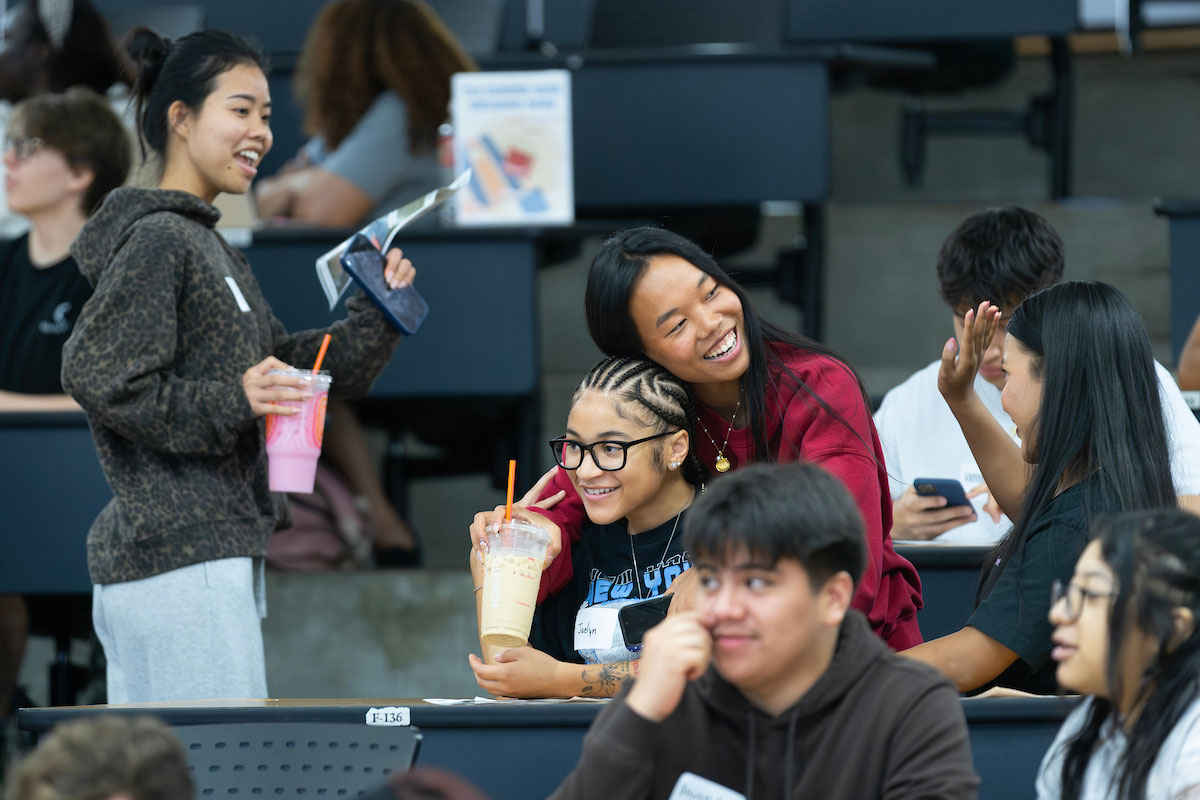
Sophomores in the Thompson Learning Community (TLC) meet in the College of Public Affairs and Community Service for a welcome-back event before the start of the fall semester at UNO on Wednesday, August 19, 2026. (UNO/Ryan Soderliln)
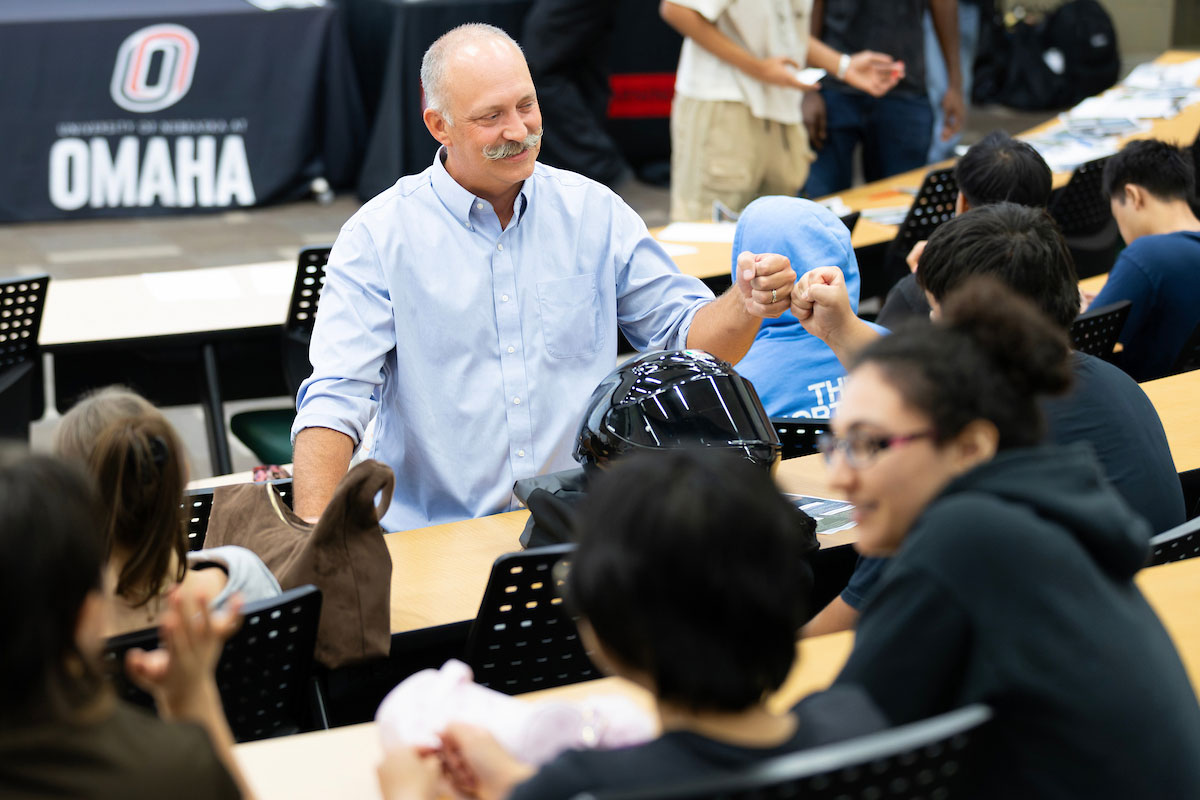
Dusten Crichton Ph.D., Director of the Thompson Learning Community, fist-bumps a student during a welcome back event before the start of the fall semester at UNO on August 19, 2026. (UNO/Ryan Soderlin)
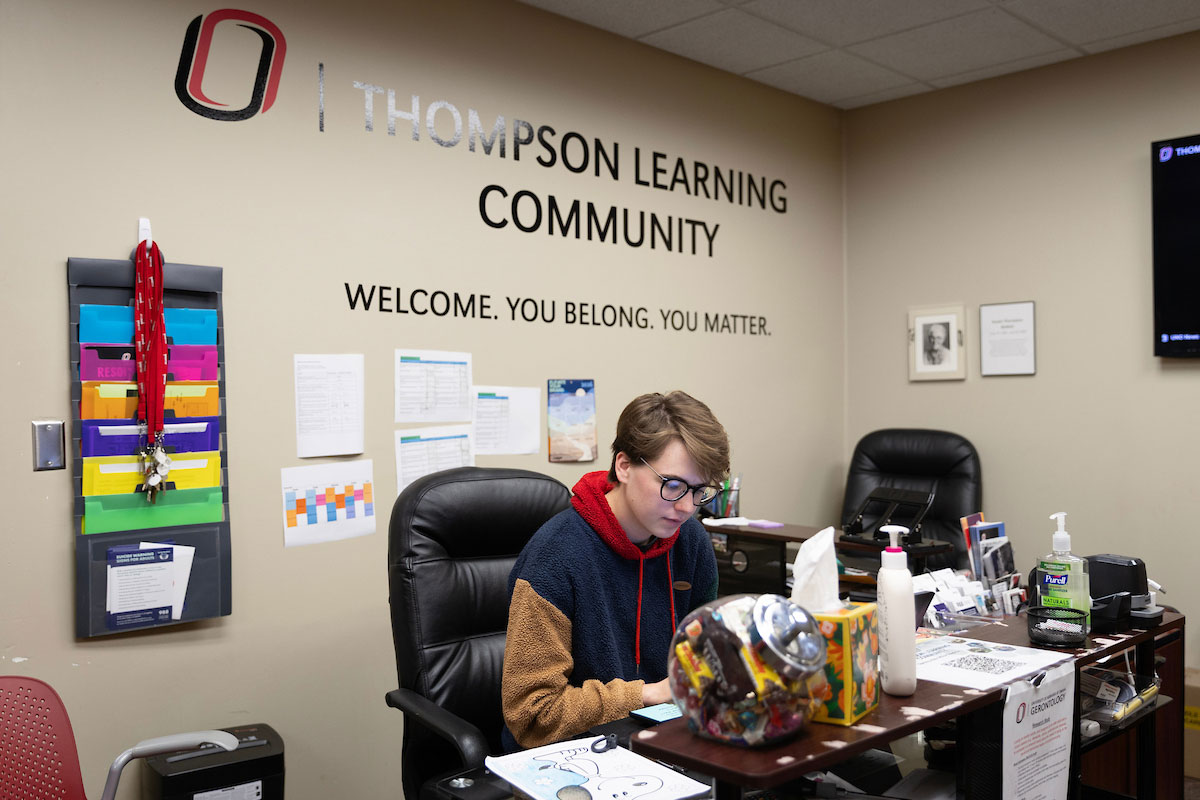
Student worker Jace Westphal in the offices of the Thompson Learning Community at UNO's Dodge Campus in Omaha, Nebraska, on August 3, 2026. (UNO/Ryan Soderlin)

Dutch Mill, a sophomore in the Thompson Learning Community (TLC) and an English major, studies on the third floor of Kayser Hall on UNO's Dodge Campus in Omaha, Nebraska, on Thursday, August 27, 2026. (UNO/Ryan Soderlin)
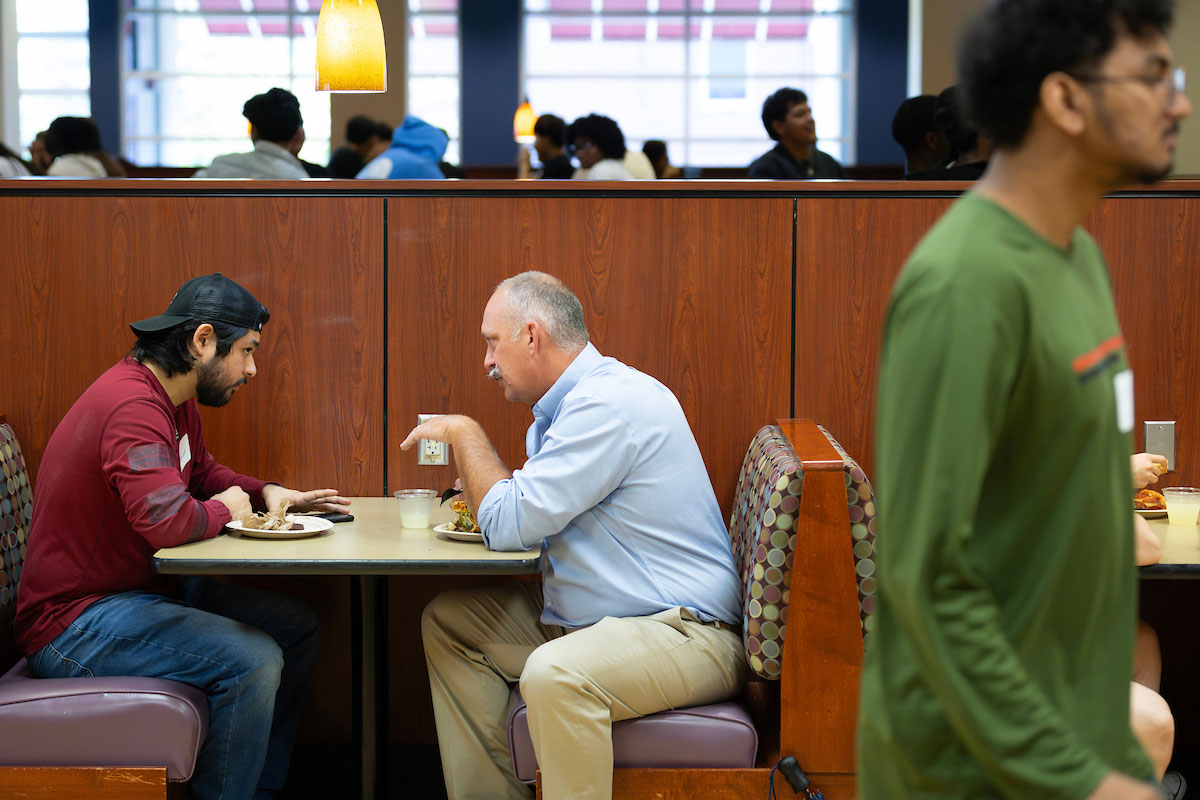
Dusten Crichton Ph.D., Director of the Thompson Learning Community, talks with a student during lunch at a welcome back event before the start of the fall semester at UNO on August 19, 2026. (UNO/Ryan Soderlin)
It may be an obvious statement, but when a student starts college, their life changes in a major way.
And there are many students who know exactly what to expect. They have a parent, relative, or friend who has explained what the college experience may be like on a personal, educational, and professional level.
These students have an understanding of what managing a class and workload will be like. Many are taught that college is an opportunity to begin building a professional network.
However, there are likely even more students who don’t know these things.
“A lot of young people from low-income, first-generation backgrounds don't always know if they belong in higher education,” says Dusten Crichton, the executive director of the Thompson Learning Community (TLC). “But they do belong,” he says.
The TLC is a support system dedicated to recipients of the highly competitive Susan T. Buffett Scholarship. The University of Nebraska at Omaha (UNO) program was established in 2008.
"It essentially is a comprehensive first- and second-year program,” Crichton says. “So, it's meant to help students as they transition into the university, and then help them through their first two years, because the first two years tend to be some of the most difficult, transitionally.”
For those first two years, TLC students have required courses, meetings, community and social events, mandatory weekly study hours, and GPA expectations. The program essentially ensures that Buffett Scholars have the support they need, socially and academically, to be successful throughout their college career and beyond.
But Crichton argues that TLC is so much more than an academic backbone for students. It’s a mini-universe built of specialists, educators, and other scholars that gives students a second home, and reminds them that they do, in fact, belong in higher education and can thrive in it.
Changes in a student, and often their success, begin when they understand that they matter, Crichton says. That’s why the program’s motto is “You Belong, You Matter.”
"It's wanting to know where that student comes from. Where did you grow up? What do you know? What's your major? Who are the people around you that matter? What are some of the difficulties you've had?” Crichton says.
“When we start to get into those, that mattering is where I think it really starts to sink in that you care, right? Belonging is a symbol. But the mattering is the caring part.”
“I have never come into this space and felt unwelcome,” says TLC student Jace Westphal about the program. Westphal, a fifth-year, is studying molecular biology, biomedical biology, and medical humanities.
Westphal distinctly remembers the first course he and his fellow Buffett Scholars were required to take together during their first semester, the university seminar.
“I was pretty thankful because I think for a lot of people, that transition to college is kind of scary because, for the first time, it's like, ‘oh, it's now all on me,’” he says. "The first thing they do is just kind of make you feel not stupid for having fear or if you don't know something."
Crichton describes the university seminar course as a ‘just-in-time' informational course that helps students navigate the transition into university life.
"The seminar classes were something I was not all into, but I think they really helped me get into college more my freshman year,” says TLC student Dutch Mill. Mill, a sophomore, is studying English and hopes to discover another passion so she can double major.
“Like, this is your first time doing this, and you never feel judged for that. And they are also there for you every step of the way,” Westphal adds. “The staff that was there was so welcoming and nice that it did give me that confidence of ‘oh, if I need help, I know where to go.”
In fact, TLC's university seminars have grown into a larger university initiative called the First Year Experience, which Crichton also leads. Now, the information, support, and resources that have helped TLC students successfully adjust to university life for so many years are offered to all first-year students at UNO.
For TLC students, though, the university seminar is just the first step. The next, Crichton says, is a much deeper dive.
“A class that's called autobiographical reading and writing. That class essentially helps people be vulnerable,” Crichton says.
“It helps students first start to learn about other people's stories who have overcome obstacles and issues and difficulties in their lives. And then our instructors start to teach them how to also tell that story of how they overcame obstacles and difficulties in their own lives. And as we do that, we create vulnerability, and as we create vulnerability, community starts to naturally happen because you trust the people around you.”
The class is often the initial foundation-building moment for the incoming members of the TLC universe.
“I think my biggest fear was, oh my gosh, I'm not going to have anyone that I can relate to,” Mill recalls. “But surprisingly, sometimes people have the same struggles as you or have the same life experience as you. And I think that's really nice,” she says.
As the leader of the Thompson Learning Community, Crichton has seen time and time again how creating a welcoming, relatable, reliable, and safe environment helps students succeed.
“TLC has helped me not just with feeling secure financially about college, but it's also just been something where I actually have people to talk to if something does happen,” Mill adds.
Importantly, TLC also instills the responsibility that comes with being a Buffett Scholar recipient.
“When you are in difficult circumstances, it can change everything when someone comes along and says, ‘You have value. We believe in you, and we know education can open doors that may otherwise have seemed impossible.’ But the real opportunities come at the end, when you take what education has given you and use it to open doors and change the world for others.” Crichton shares.
What he wants students to know and understand is that the community is not just a transaction. It’s a home base.
“This is really an opportunity to build a wealth of relationships beautifully,” he says.
“I can imagine [my experience] without TLC, but it's a lot more lonely,” says Westphal, who previously worked as a peer mentor for other TLC students.
“For an incoming student, if they were a little nervous about getting involved, I would just say trust the process, or it's okay to feel scared,” Westphal adds. “But, you're going to feel better once you do it. You know, it's putting yourself out there, being a part of a community.”
About the University of Nebraska at Omaha
The University of Nebraska at Omaha (UNO) is Nebraska’s premier metropolitan university, committed to innovating for the public good, advancing social mobility, powering workforce development, and serving as a hub for community engagement. Nearly 15,000 Mavericks choose UNO for its hands-on education experiences, nationally ranked online and graduate programs, military-connected student support, and innovative approaches to supporting lifelong learning. UNO holds the Carnegie Research Activity “R2” designation, securing more than $40 million annually in external research funding and counts its faculty among the world’s most cited scholars. Sixteen Omaha Athletics programs compete in NCAA Division I as members of the Summit League and National Collegiate Hockey Conference (NCHC).
Follow UNO on Facebook, Twitter (X), Instagram, LinkedIn, and YouTube.