

Waste to Water—Advancing Environmental Governance in Bangladesh
The Young South Asian Leaders Initiative (YSALI) is proud to see workshop alumni making impacts in their local communities. One example of local impact in the South Asian region, is the work of Taskin Habiba who started the Eco Steward initiative and recently held a webinar to explore the intersection of waste management, water security, and environmental governance in Bangladesh.
- published: 2026/04/20
- contact: Charity Stahl - International Programs
- phone: 402.554.2293
- email: world@unomaha.edu
A YSALI Alumna Leads on Environmental Dialogue
The Young South Asian Leaders Initiative (YSALI) is proud to see workshop alumni making impacts in their local communities. Through a variety of grassroots initiatives, YSALI alumni are empowered to solve shared challenges together. YSALI is implemented by the University of Nebraska’s Center for Afghanistan and Regional Studies in collaboration with the East-West Center and sponsored by the U.S. Department of State’s Bureau of South and Central Asian Affairs.
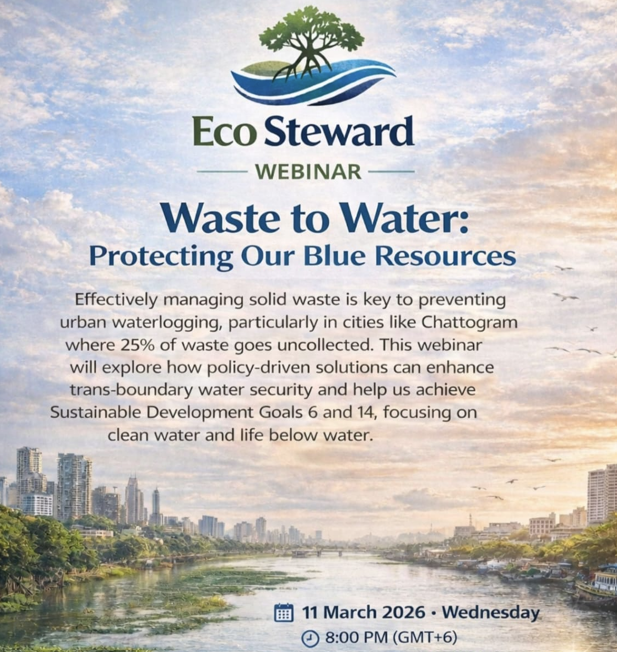
One example of local impact in the South Asian region is the work of Taskin Habiba, from Bangladesh. She participated in the YSALI regional workshop in Colombo. Since then, she started the Eco Steward initiative. On March 11, 2026, Taskin convened a timely and impactful webinar titled “Waste to Water: Protecting Our Blue Resources.” The session brought together young leaders, practitioners, and experts to explore the intersection of waste management, water security, and environmental governance in Bangladesh. Sher Jan Ahmadzai, Principal Investigator (PI) for YSALI and UNO’s Director of the Center for Afghanistan and Regional Studies, was a guest speaker.
Webinar Participants: 20
Understanding the Challenge: Waste and Water Are Connected
The webinar highlighted an urgent urban issue: in Chattogram, approximately 2,800 tons of waste is generated daily, with nearly 25 percent remaining uncollected. This gap extends far beyond sanitation.
As discussed during the session, uncollected waste enters drainage systems, clogs canals, and contributes to urban flooding. Over time, it flows into rivers and ultimately the Bay of Bengal—turning a local municipal issue into a regional environmental challenge.
Linking Local Action to Global Goals
The discussion emphasized the connection between Sustainable Development Goal (SDG) 6: Clean Water and Sanitation and SDG 14: Life Below Water. Participants explored how ineffective waste management directly impacts water systems and marine ecosystems.
A key insight was clear: urban waste governance is inseparable from water governance. Environmental systems are interconnected, yet governance structures often remain fragmented.
Key Insights: Governance Matters
The session highlighted three critical areas for strengthening environmental resilience:
- Coordination: Improving collaboration across agencies responsible for waste, water, and environmental protection
- Fiscal Sustainability: Ensuring reliable funding and accountability in waste management systems
- Data and Transparency: Using data to shift from reactive responses to preventive governance
These governance dimensions are essential to reducing flood risks, protecting fisheries, and safeguarding coastal ecosystems.
From Local Challenges to Regional Impact
The webinar also underscored how environmental issues transcend borders. Waste that enters waterways in one city can impact ecosystems across regions. This reinforces the importance of integrated, policy-driven solutions and regional cooperation.
Alumni Leadership in Action
Through this initiative, Taskin Habiba demonstrated the impact of YSALI alumni leadership in advancing meaningful dialogue on sustainability.
Taskin Habiba reflected:
The "Waste to Water: Protecting Our Blue Resources" webinar successfully bridged environmental research with high-level governance to address the escalating urban waste crisis. Guest speaker Sher Jan Ahmadzai, Director of the Center for Afghanistan and Regional Studies at UNO, provided vital insights into how these local failures manifest as trans-boundary water security challenges and emphasized the necessity of dynamic public-sector capabilities to protect shared blue resources. Participants engaged deeply with topics ranging from community dynamics to "Waste-to-Power" initiatives, ultimately recognizing that repairing water systems requires fixing the underlying governance frameworks. This dialogue underscored Eco Steward’s commitment to advancing water management through evidence-based policy and youth leadership. The webinar created a platform not only for discussion but for inspiration—encouraging participants to think beyond isolated solutions and toward systemic, collaborative change.
Looking Ahead
As YSALI continues to empower emerging leaders, initiatives like this highlight the importance of youth-led action in addressing complex challenges. By fostering dialogue, sharing knowledge, and promoting collaboration, YSALI alumni are helping shape needed solutions across the region of South Asia.