

We offer a Master of Science in Biomechanics and a Doctor of Philosophy in Biomechanics & Kinesiology with focus areas in Cardiovascular Biomechanics and Movement Biomechanics. Graduate students train in a highly interdisciplinary environment with access to advanced research facilities and state-of-the-art instrumentation supporting both experimental and computational biomechanics.
Master of Science in Biomechanics
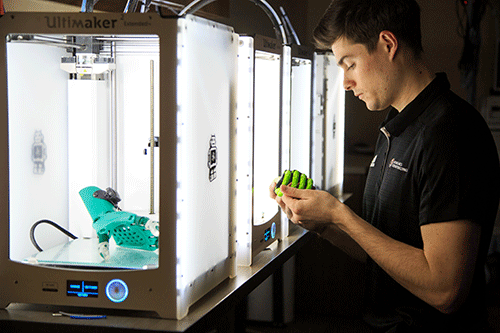
The Master of Science in Biomechanics provides rigorous training in the mechanics of biological systems, integrating principles from engineering, physiology, and applied mathematics. Students develop expertise in experimental methods (e.g., motion capture, force measurement, and soft tissue mechanical testing), data analysis, and computational modeling to study both human movement and cardiovascular systems.
The program emphasizes hypothesis-driven research and quantitative problem solving, with opportunities to work on projects spanning movement biomechanics, vascular biomechanics, and the development and evaluation of medical devices and biomaterials. Students gain experience translating fundamental mechanics to clinically and technologically relevant problems, including musculoskeletal injury, rehabilitation, vascular aging and disease, and device design.
Graduates are prepared for positions in research and development, the medical device and biotechnology industries, and clinical or applied biomechanics laboratories, as well as for continued study at the doctoral level.
The only nationally ranked MS program in Biomechanics.
Internationally ranked as one of the best universities in the United States for MS in Biomechanics*
For admission requirements, degree requirements, and course descriptions, please visit our catalog page.
Interested in scheduling a visit? For a general campus visit, view the Visit UNO page. For a tour of the Biomechanics Research Building, email unobiomechanics@unomaha.edu with as much advanced notice as possible.
Admission Criteria
Students interested in applying to the MS in Biomechanics are required to submit the following items:
- Written statement of goals and rationale for entering the graduate program
- Two letters of recommendation.
- Official transcripts from previous institutions
- GPA of 3.0 in the undergraduate program
- For applicants whose native language is not English, the minimum total score of 80 on the internet-based TOEFL, with at least 20 in all categories (listening, reading, writing, and speaking)
- Undergraduate deficiency courses**: Anatomy and Physiology I, Biomechanics, Calculus I***
**Students that have not completed these courses prior to admission may be required to enroll in undergraduate deficiency courses along with their graduate coursework
***(If Calculus I is identified as an undergraduate deficiency course the Math Department requires a 6 ALEKS translated score (76-100 ALEKS raw score) Quantitative Literacy General Education and the Mathematics Placement Exam)
The GRE is no longer a requirement for admission.
Program Forms and Resources
MS in Biomechanics Worksheet
Apply to the Master of Science in Biomechanics.
Application materials should be submitted by February 1 for consideration for a Graduate Assistantship.
Applicants are encouraged to upload unofficial documents when first applying and upload official documents upon admission.
Students are enrolled in thesis option once they identify a faculty mentorand submit the supervisory committee form
Policies related to Graduate Assistantships
The MS in Biomechanics has a STEM-designated CIP Code
*Internationally ranked (top 20) in MS in Biomechanics by GoUSA
Doctor of Philosophy in Biomechanics and Kinesiology
The Ph.D. in Biomechanics & Kinesiology is a joint program between the Department of Biomechanics and the School of Health and Kinesiology, designed to train independent researchers in the mechanics and control of human movement and biological systems. The program integrates biomechanics, physiology, motor control, and related disciplines to address fundamental and applied problems in human health and disease.
Within the biomechanics concentration, students pursue advanced study in both movement biomechanics and cardiovascular biomechanics. Research areas include human movement analysis, musculoskeletal function, and the mechanics of vascular aging and disease, as well as the design, development, and evaluation of cardiovascular devices and biomaterials. Training emphasizes experimental methods, quantitative analysis, and computational modeling, with a strong focus on hypothesis-driven and translational research.
Doctoral students work closely with faculty on externally funded research and develop the skills necessary for careers in academia, the medical device and biotechnology industries, and research-intensive clinical or government settings.
One of only two nationally ranked doctoral programs in Biomechanics.
For admission requirements, degree requirements, and course descriptions, please visit our catalog page.
Interested in scheduling a visit? For a general campus visit, view the Visit UNO page. For a tour of the Biomechanics Research Building, email unobiomechanics@unomaha.edu with as much advanced notice as possible.
Meet Our Alumni
Degree: Doctorate in Biomechanics and Kinesiology
Major: Biomechanics and Kinesiology with a Concentration in either Cardiovascular Biomechanics or Movement Biomechanics
Career options include:
Graduates of the Ph.D. program are prepared for research-intensive and leadership roles across academia, industry, and government. Common career paths include:
- Faculty positions at research universities and academic medical centers, with responsibilities in research, teaching, and mentorship
- Research scientist roles in federal agencies (e.g., NASA, National Institutes of Health, Department of Defense) and national laboratories
- Research and development positions in the medical device, biotechnology, and pharmaceutical industries, including the design and evaluation of cardiovascular devices, biomaterials, and diagnostic technologies
- Engineering and scientific roles in industries focused on human performance, rehabilitation technologies, wearable systems, and human-machine interfaces
- Leadership roles directing biomechanics, clinical research, or translational research laboratories in hospitals, universities, and private research organizations
Research in this area integrates experimental mechanics, imaging, and computational modeling to quantify tissue behavior and hemodynamics across multiple length scales. Areas of study may include arterial mechanics, endovascular interventions, and the development and evaluation of cardiovascular devices and biomaterials.
Students are trained in advanced experimental techniques (e.g., soft tissue mechanical testing, imaging-based analysis) and computational methods to address clinically relevant problems. The concentration emphasizes hypothesis-driven and translational research, preparing graduates for careers in academia, the medical device and biotechnology industries, and research-intensive clinical or government environments.
Movement Biomechanics
This concentration focuses on the mechanical and neuromuscular basis of human movement across healthy, aging, and clinical populations. Students develop expertise in the experimental measurement and quantitative analysis of movement using tools such as motion capture (laboratory and field-based systems), force platforms, electromyography, wearable sensors, and imaging modalities.
Research in this area integrates biomechanics, motor control, and physiology to understand how movement is generated, coordinated, and adapted in response to injury, disease, training, and environmental demands. Areas of study may include locomotion, balance, neuromuscular control, musculoskeletal loading, rehabilitation, and human performance.
Students are trained in hypothesis-driven research using advanced data analysis and computational approaches, with applications spanning injury prevention, rehabilitation, assistive and wearable technologies, and human-machine interaction. Coursework includes biomechanics, motor control, physiology, engineering, statistics, and data science.
Ph.D. applicants, please note:
Ph.D. in Biomechanics and Kinesiology Catalog Page
Applicants are encouraged to upload unofficial documents when first applying and upload official documents upon admission.
Applications are processed through UNO's Office of Graduate Studies
The TOEFL may be required for students without a degree from a U.S. institution.
View more information about International Studies and Programs at UNO.
The Ph.D. in Biomechanics & Kinesiology has a STEM-designated CIP Code.
The GRE is no longer a requirement for admission.