
Nagesh Palukuru: Learning in the City of Omaha
UNO student Nagesh Palukuru says Omaha made his graduate education possible. And it all started with two suitcases.
- contact: Marlo Larsen - UNO Office of Strategic Marketing and Communications
- email: unonews@unomaha.edu
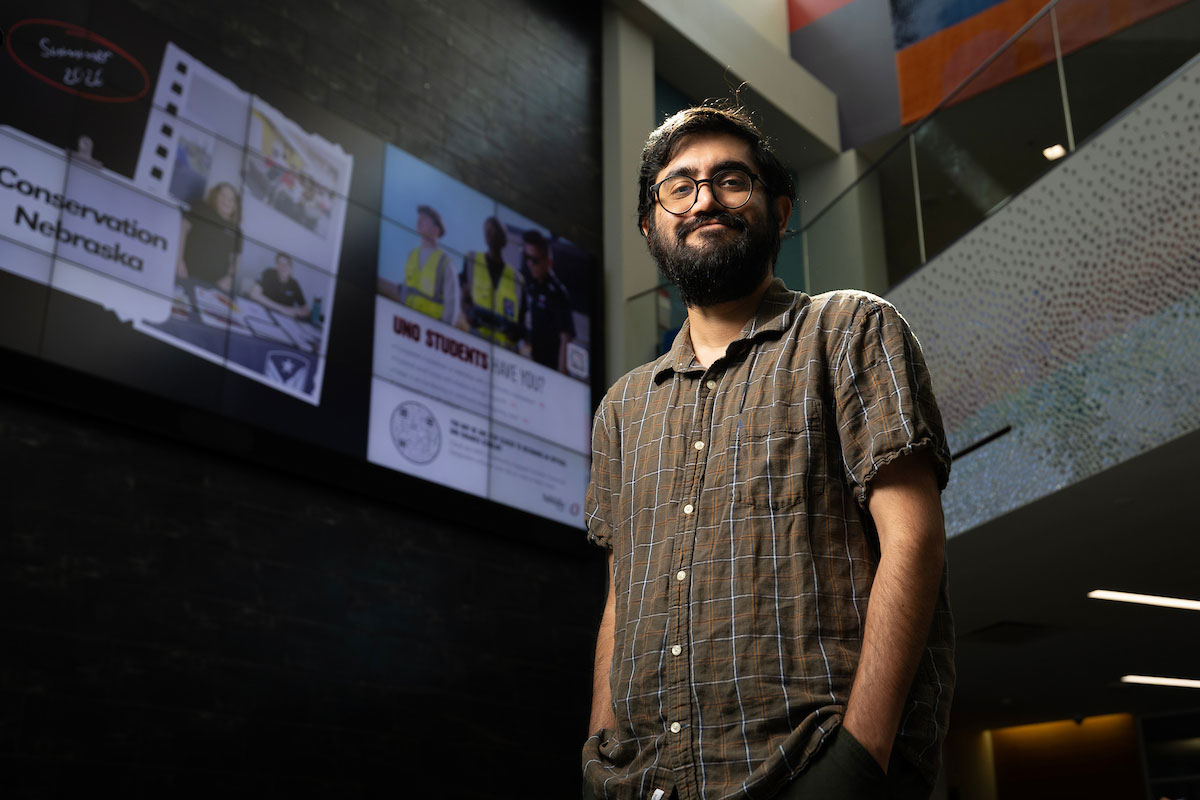
Nagesh Palukuru, a graduate student and graduate assistant in UNO's Service Learning Academy, has his photo taken in the Barbara Weitz Community Engagement Center at UNO on Tuesday, August 11, 2026. (UNO/Ryan Soderlin)
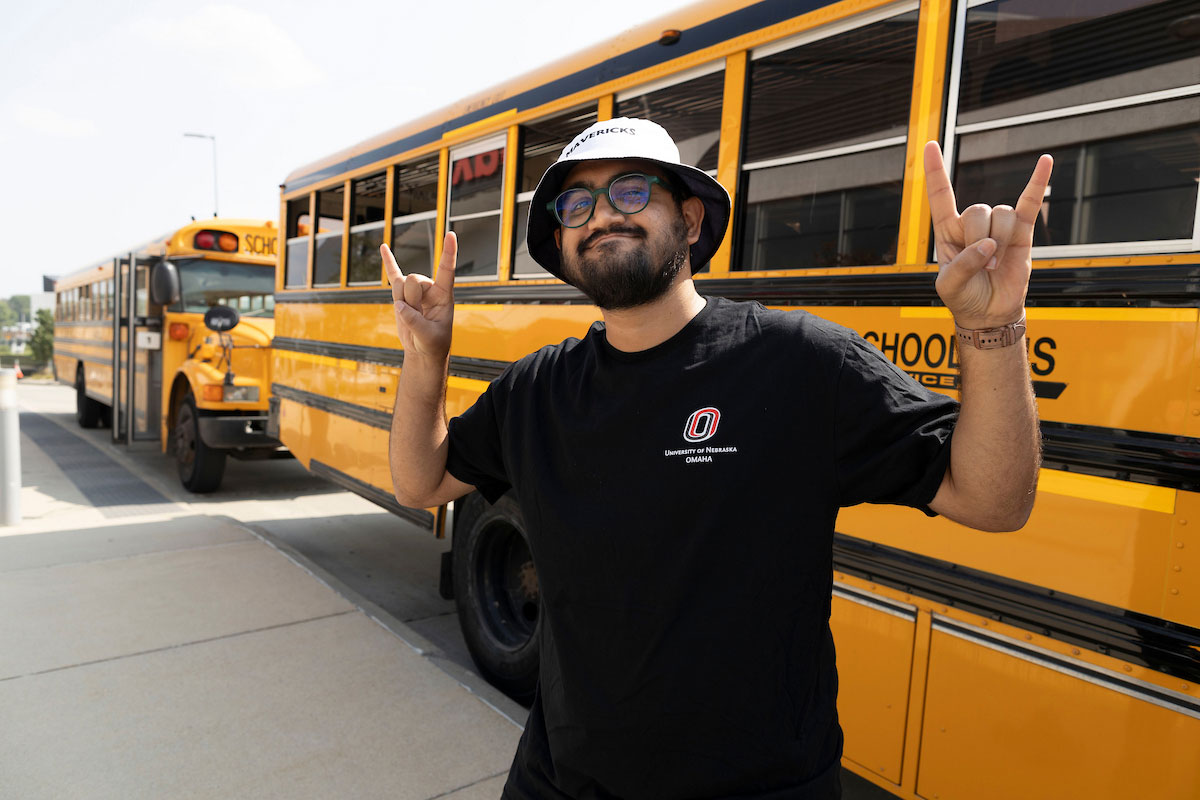
Nagesh Palukuru poses in front of school buses ahead of Volleyball Day in Nebraska in 2023. (UNO/Ryan Soderlin)
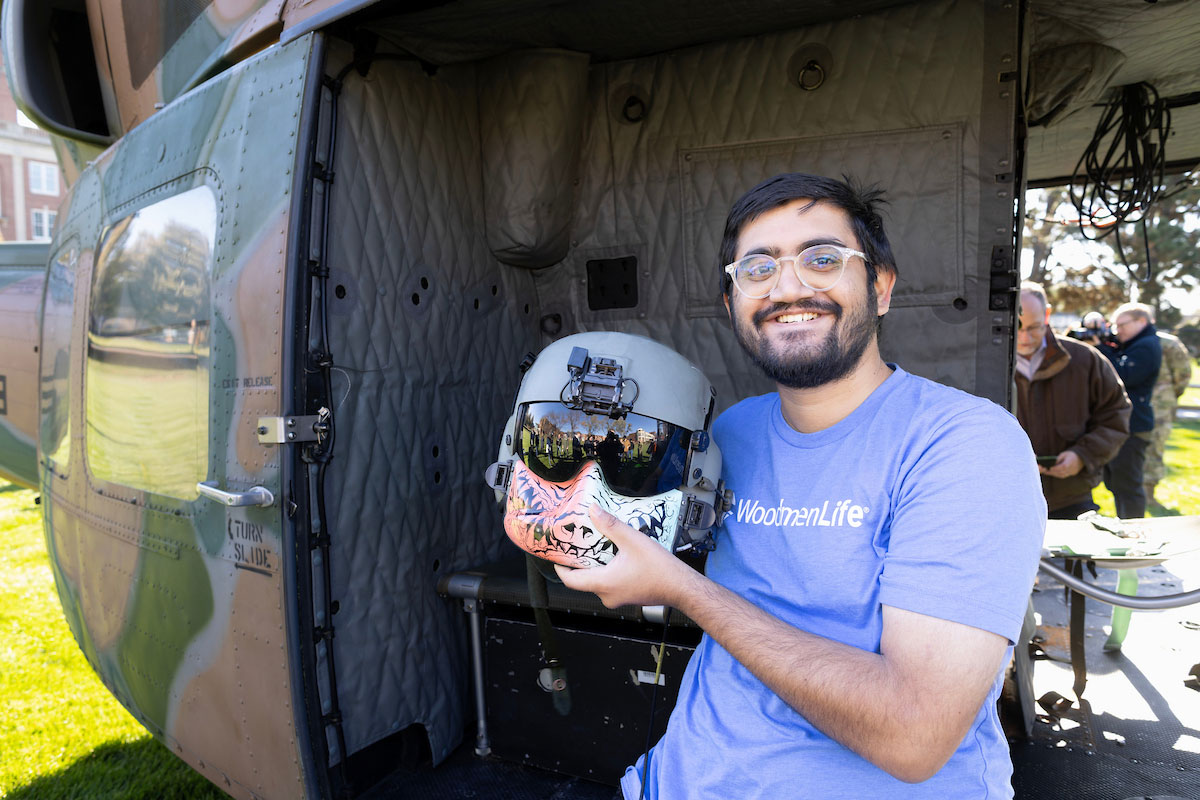
Nagesh Palukuru poses with a helicopter helmet after an ROTC helicopter landing at UNO’s Pep Bowl in 2023. (UNO/Ryan Soderlin)
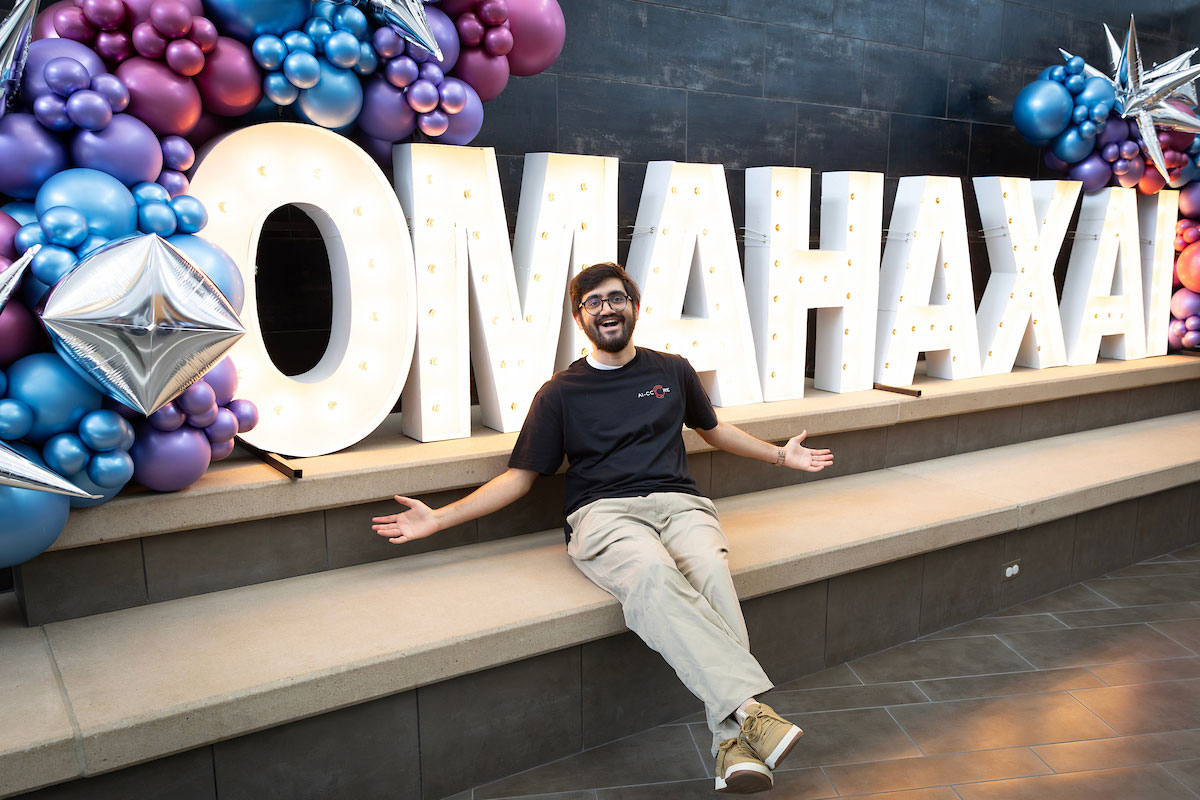
Nagesh Palukuru poses in front of the 2026 OMAxAI signs in the Barbara Weitz Community Engagement Center. Palukuru’s research often revolves around AI, and he works part-time in the new AI Lab. (UNO/Ryan Soderlin)
When graduate student Nagesh Palukuru moved to Omaha, he was taking a chance.
“I'd love to be honest and say I spent months researching, you know, why Omaha is better,” he says.
“But honestly, my friend started going to UNO, and when I reached out to him, saying ‘how is this university? Like, how can I just show up here?’ he made the best argument I ever came across. [He said], 'just show up with two suitcases, and I'll find you a place to stay.'”
So, he did. Palukuru packed up his life into two suitcases, said goodbye to his parents, his sister, and many friends, and journeyed across the world from Hyderabad in South India.
Omaha and Hyderabad couldn't be more different. For starters, Hyderabad has a population of just over 10 million people. But Omaha’s slower-paced, Midwestern lifestyle captured Palukuru.
“Coming into the city itself, it changed my whole perspective. I love the people here. I love the experiences, and you know, overall proud of the work I'm doing.”
Palukuru received his undergraduate degree in India in computer science. Before making the move to Omaha, he was employed at a corporation where he worked with data. That’s what sparked his curiosity and ultimately led him to the Big O.
At UNO, he received his first graduate degree in data science, and now, he’s just a few months away from his second graduate degree in information systems. But, he says it’s so much more than what it sounds like.
“When I started taking coursework, all I thought was, you do well in class, you get good grades, and you get a degree. That's how you graduate, right?”
But then he was introduced to UNO’s Service Learning Academy, and his ideas about education changed.
The center supports faculty members who collaborate with community organizations, businesses, governmental agencies, and more, allowing students to build partnerships, learn outside the classroom, and contribute in ways that have real impacts on the greater community.
“When I started looking at the Service Learning Academy as a student, I had a lot of questions, right? What am I getting out of this? And why, as the community partners, are they reaching out to us? You know, they can go to anyone,” he says.
“But it's a win-win. They are getting problems solved, and students are learning something. They're working together, and the kind of relationships that you build out of this- this is the amazing part.”
One of the projects that grew from Palukuru’s interest in applying the service-learning concept to community-engaged research was his work with local school districts.
He obtained data from the Nebraska Department of Education regarding student absences in Douglas County high schools and began identifying why students were absent or dropping out both before and during the COVID-19 pandemic. He developed predictive analytics for local school districts and later presented his research at the Office of Research and Creative Activity (ORCA) Fair, where he received a community-engaged research award.
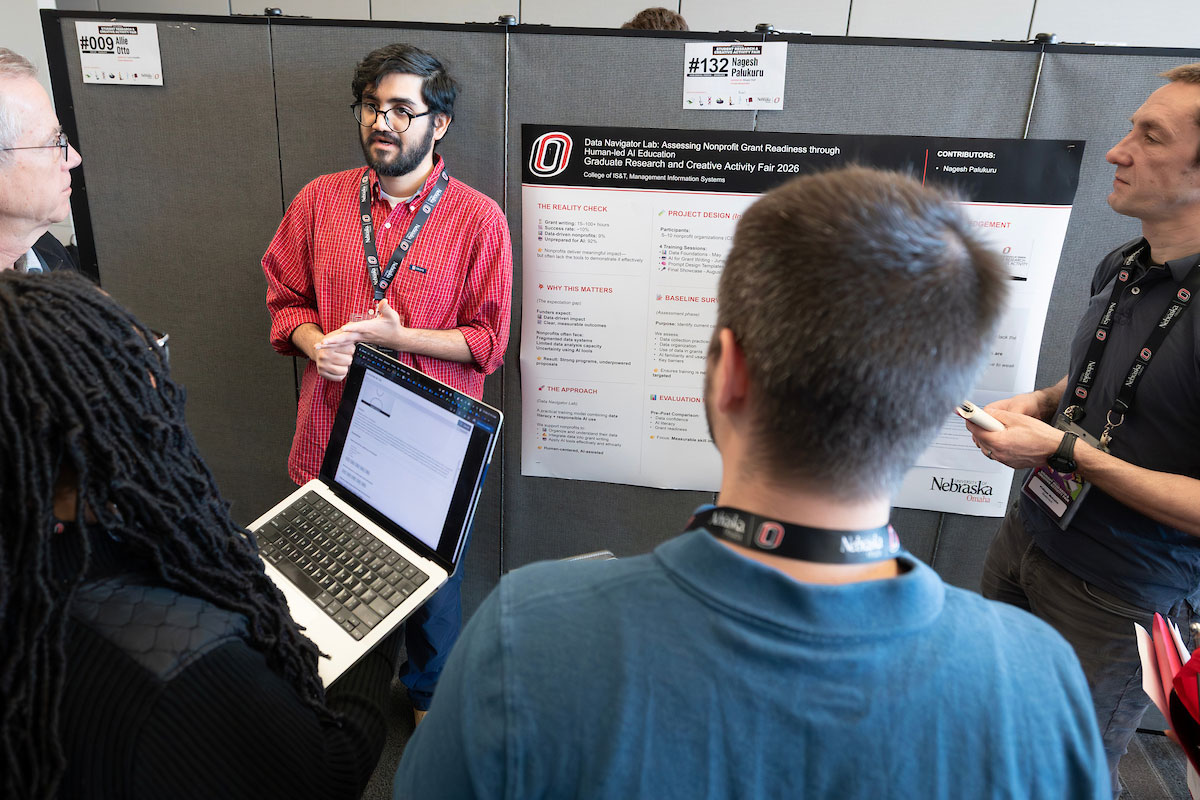
“It may not be the end of it all, but it's the start of something,” he says. “I may publish this paper, and some person at some school may read it and think, ‘oh, this actually helps me,’ you know? That makes me really happy.”
For Palukuru, UNO’s mantra, ‘Omaha is our campus,’ is real.
“Previously, I thought classrooms only existed in the university, but right now I believe the whole of UNO and Omaha are a classroom for me. I get to learn, I get to solve problems, I get to see the smiles,” he says.
Ahead of graduation, Palukuru’s latest community-engaged research pilot study hopes to support the good work and services that local nonprofits provide. The goal is to identify if structured, human-led education in data literacy and responsible AI use will help improve their grant readiness.
Palukuru was able to connect with area nonprofits in UNO’s Barbara Weitz Community Engagement Center. His study conducts a baseline survey and includes a four-session training intervention consisting of things like data fundamentals, AI-assisted grant research and writing, and prompt engineering. The study will also have a pre- and post- evaluation. Supporting the community that has so openly welcomed him is gratifying, he says.
While grades are important, he says what’s now a higher priority is building relationships, obtaining perspective, and working together to build solutions. That is the best coursework, he says.
“Omaha makes it possible,” he says. “You are as good as the connections you make, and this is a place where you can really network, where you can really solve problems, and you know people say yes and spend time with you.”
UNO and Omaha have not only made his education possible, but it’s given deeper meaning to the work he hopes to continue to do after he graduates in December.
Until then, Palukuru will continue his community-engaged research and working as a graduate assistant in the Service Learning Academy to help other students discover the possibilities that Omaha has to offer in their educational journeys.
“Omaha has really given me some amazing opportunities. You know, I put myself out there, I started talking to people. Sometimes I find the right connections to get something done, or you know, sometimes I have just found some really good friends.”
About the University of Nebraska at Omaha
The University of Nebraska at Omaha (UNO) is Nebraska’s premier metropolitan university, committed to innovating for the public good, advancing social mobility, powering workforce development, and serving as a hub for community engagement. Nearly 15,000 Mavericks choose UNO for its hands-on education experiences, nationally ranked online and graduate programs, military-connected student support, and innovative approaches to supporting lifelong learning. UNO holds the Carnegie Research Activity “R2” designation, securing more than $40 million annually in external research funding and counts its faculty among the world’s most cited scholars. Sixteen Omaha Athletics programs compete in NCAA Division I as members of the Summit League and National Collegiate Hockey Conference (NCHC).
Follow UNO on Facebook, Twitter (X), Instagram, LinkedIn, and YouTube.