
The Quiet Work of UNO Student Archivists
How on-campus employment at Criss Library and the Samuel Bak Museum is pointing students to their future careers.
- published: 2026/10/16
- contact: Marlo Larsen - UNO Office of Strategic Marketing and Communications
- email: unonews@unomaha.edu
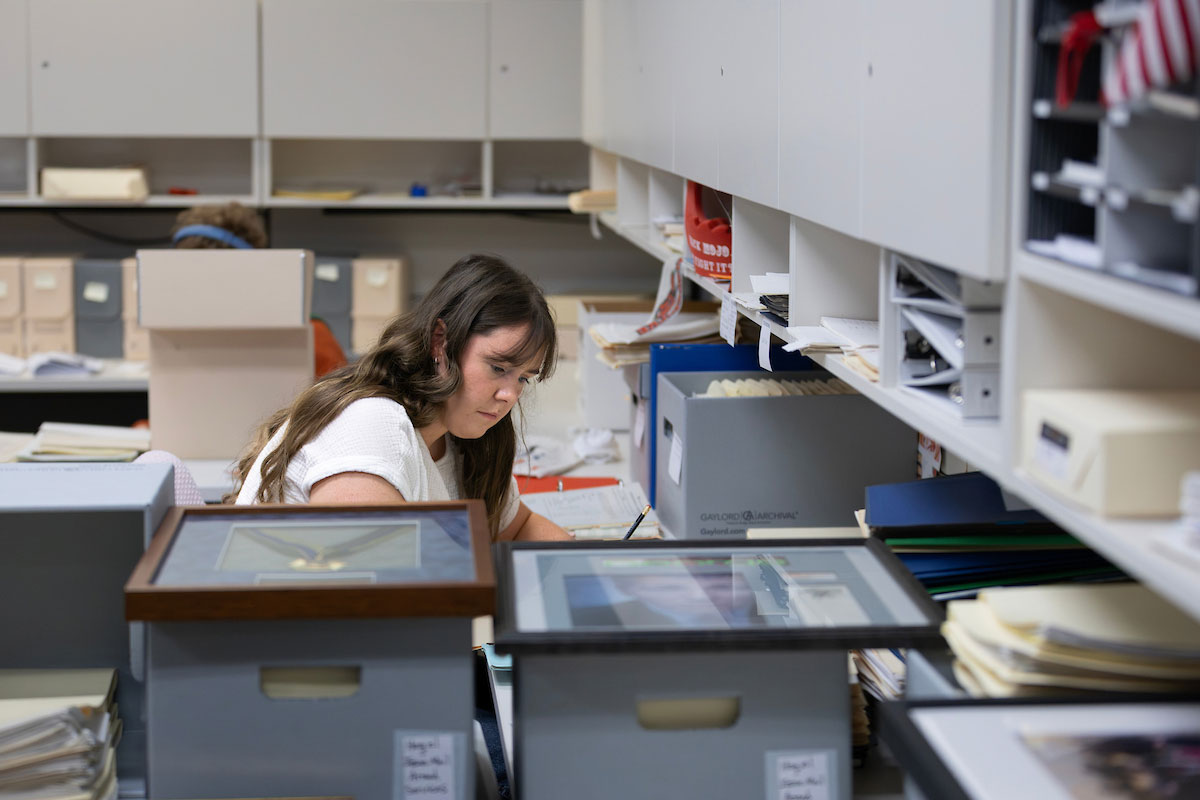
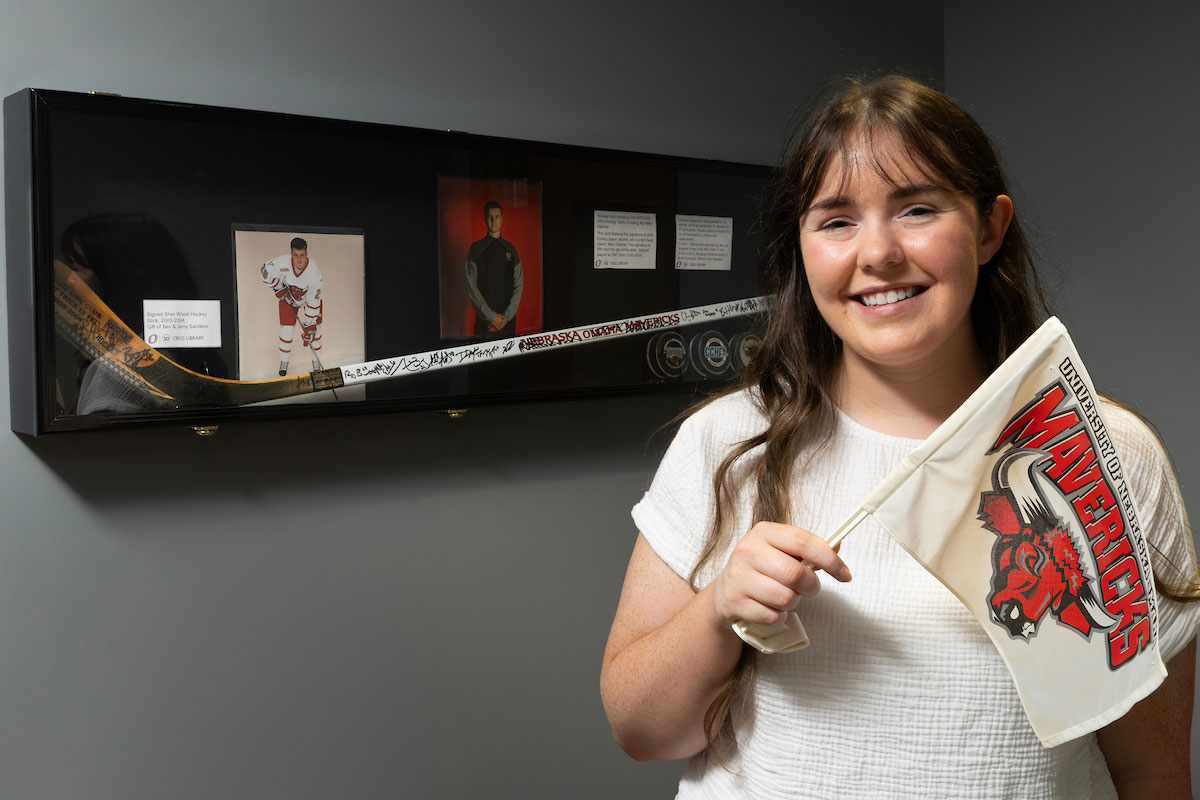
UNO graduate student Emma Mitchell works in the Archives & Special Collections in Criss Library on Tuesday, October 6, 2026. Mitchell is studying to get her master’s in history from UNO. (UNO/Ryan Soderlin)
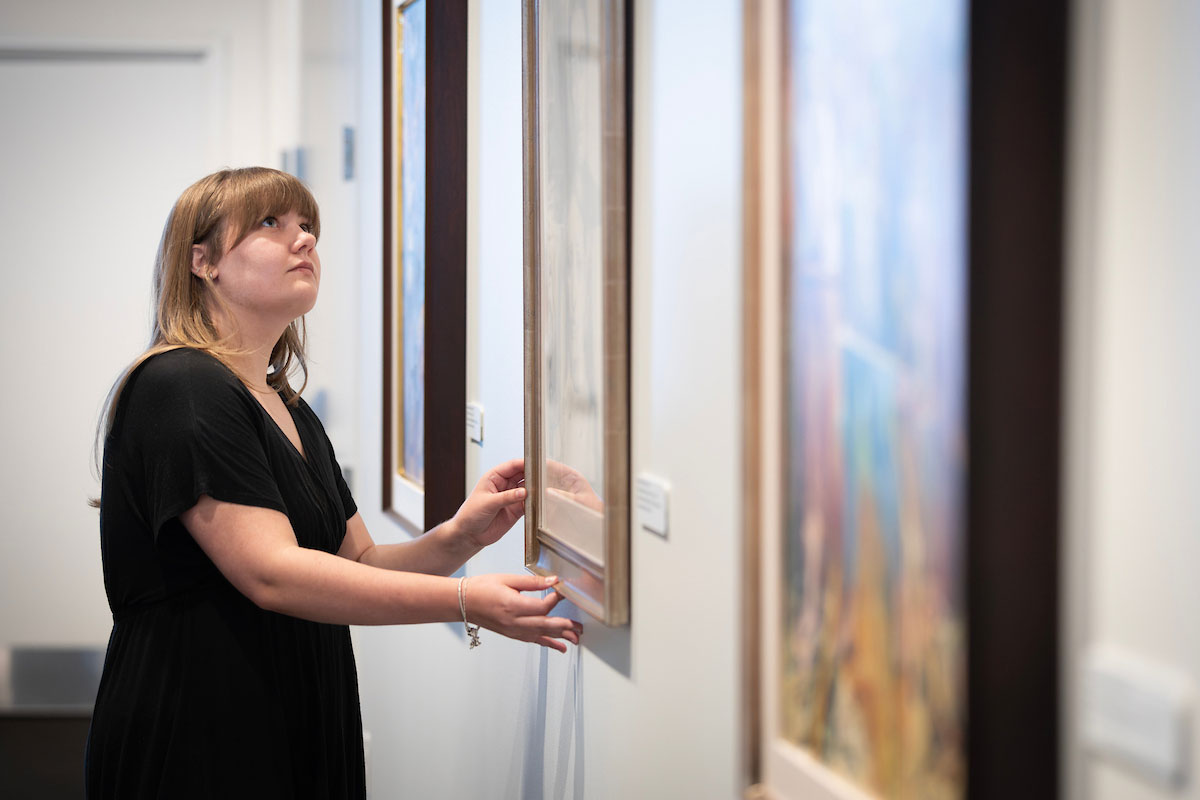
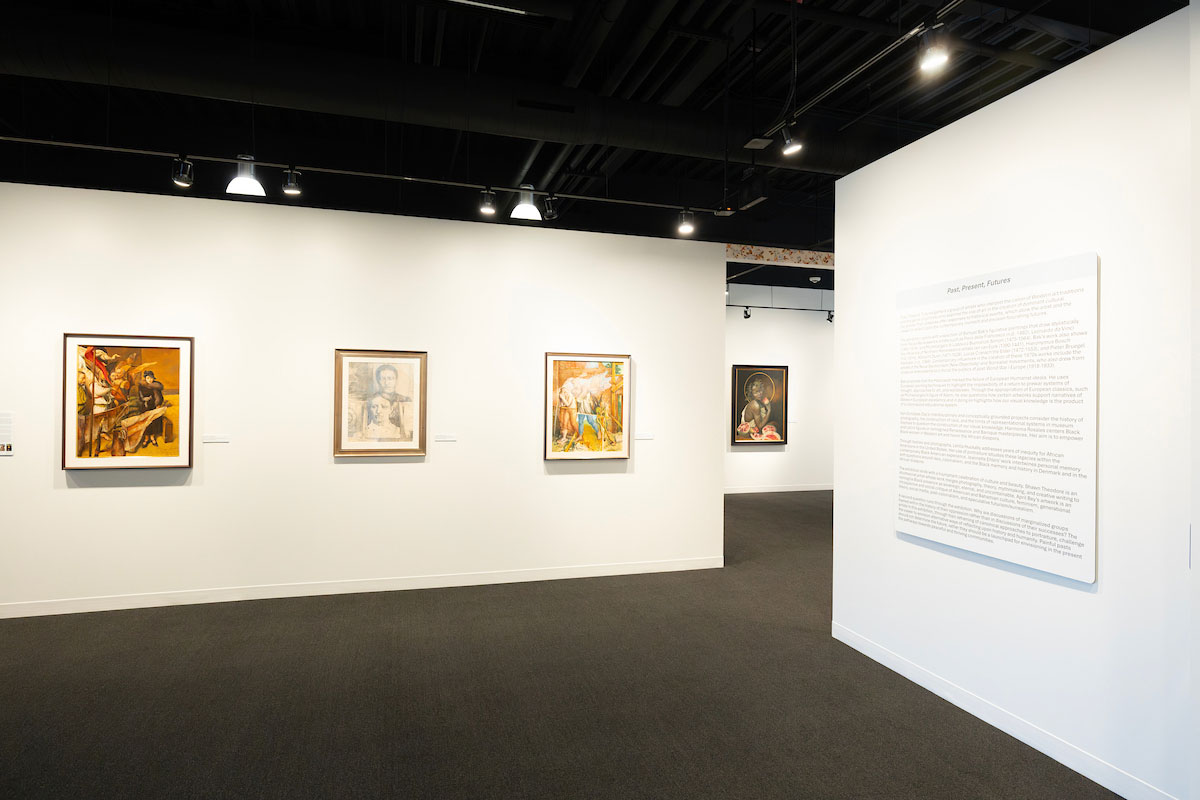
UNO undergraduate student Lauren Newton adjusts a painting on a gallery wall at the Bak Museum in Aksarben Village in Omaha, Nebraska, on Thursday, October 8, 2026. Newton is getting a bachelor’s degree in art history and library sciences. She will graduate in May of 2027 (UNO/Ryan Soderlin)
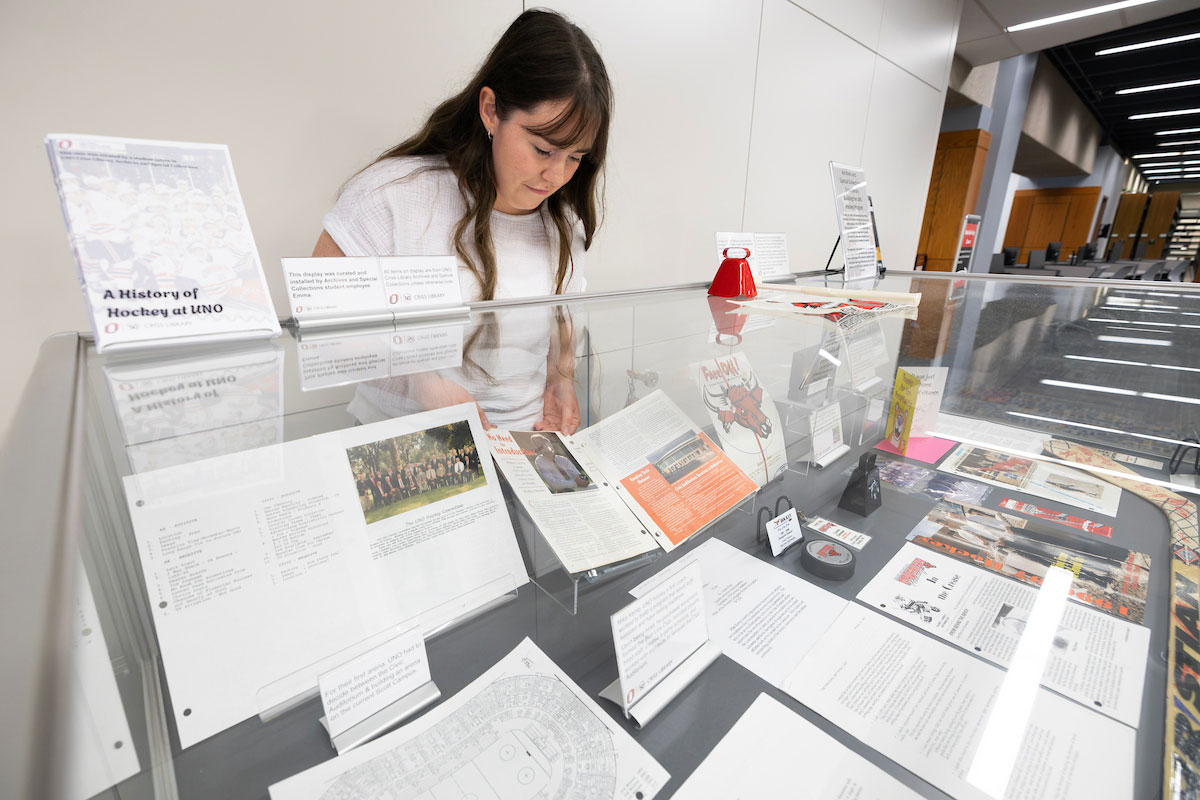
UNO graduate student Emma Mitchell works on a display about the history of UNO’s hockey program in Criss Library on Tuesday, October 6, 2026. Mitchell is studying to get her master’s in history from UNO. (UNO/Ryan Soderlin)
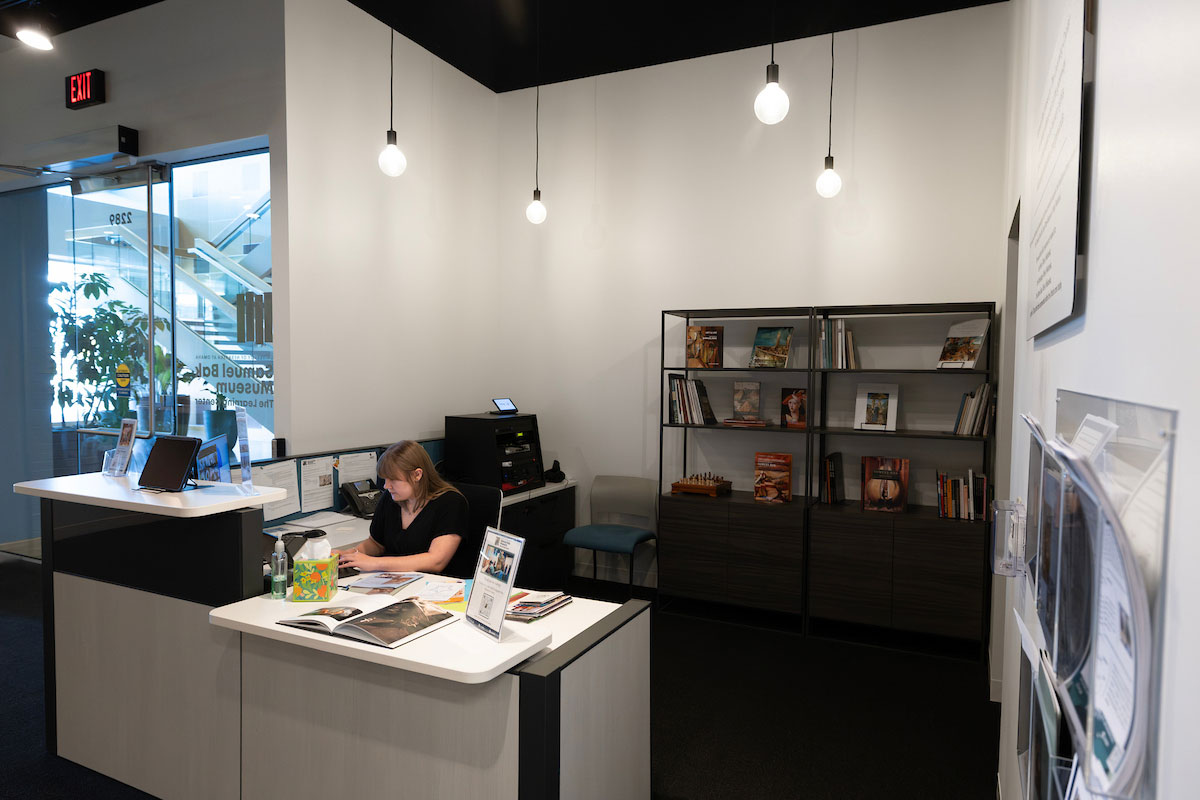
UNO undergraduate student Lauren Newton works at the Bak Museum in Aksarben Village in Omaha, Nebraska, on Thursday, October 8, 2026. Newton is getting a bachelor’s degree in art history and library sciences. She will graduate in May of 2027 (UNO/Ryan Soderlin)
You don’t have to be taking history classes in order to get a glimpse of the past.
At the University of Nebraska at Omaha (UNO), there are many opportunities to walk back in time, witness historical progression, and see personal stories.
The first is at the Samuel Bak Museum.
The gallery features art by Jewish-American writer and painter Samuel Bak, who has spent decades expressing his life, emotions, and society through paintings as a Holocaust survivor and refugee.
The other is the UNO Archives & Special Collections.
It’s the home of countless original and rare materials related to UNO’s founding and history, aspects of the greater Omaha community, and archives on regional, national, and worldly events.
Though the two spaces are vastly different, their themes are united: education through historical context. And it’s UNO students who help their operations.
“I was a little on the fence about working in archives because I just didn't know if it was something I would be interested in. I didn't know if I'd find it boring,” admits UNO first-year graduate student Emma Mitchell.
Mitchell, who received her undergraduate degrees in history and library sciences and is getting her Master’s in history, began working for the Archives & Special Collections thanks to an athletics grant, of all things.
Her job was to process materials related to the founding of UNO’s athletics department and the creation of different sports teams throughout the university’s history. She sorted through binders and boxes of documents to arrange, preserve, and share. She has researched and written research guides and zines.
Although it may sound mundane to some, to her, it was anything but.
“It kind of felt like I was experiencing the history with them,” she says. “It’s definitely very interesting.”
Her worry about the work being ‘boring,’ quickly dissipated.
Now, Mitchell is a student assistant in the department and has had a hand in the organization and preservation of many important documents and collections housed in the archives. She’s working on a collection documenting and timelining the history of UNO’s student government, and recently participated in a display for ROTC’s 75th anniversary.
It didn’t take long for Mitchell to see firsthand the value in preservation when she began her work in the archives.
“It's important. I mean, for historians specifically, it gives them primary sources to physically look at, and it makes it easier for them when it comes to research,” she says.
But it isn’t just for historians, she says.
“For people in the community, too. We have the Queer Omaha archives here, and people from that community come and look at the papers too. They come and reminisce and look back at photos, artifacts, and documents that they may have donated or remembered,” she says.
“It's important for everyone so that they can reminisce and look back.”
One of the primary goals for archivists is accessibility, argues UNO undergraduate Lauren Newton. The senior studying art history and library sciences works in the Bak Museum.
Much like Mitchell, her role at the museum started off as a temporary gig, an internship. Her first job was to listen to and transcribe dozens of hours of audio recordings of Samuel Bak talking about his works, which give insights into everything from Bak's artistic influences to how color palettes and art styles reflected different periods of time and emotions in his life.
“The more I started learning about Samuel Bak, the interest became: we have all this information that is recorded, but we have no access to actually, like, heavily research this information that he's talking about and the insight that he's giving,” she says.
“I think that once I got into it, I was really, really interested in how we can make that information more accessible to the curators, the staff that's there, as well as students at UNO.”
After 36 hours of listening came the editing, indexing, identifying key terms, and creating timelines; the initial steps to figure out how the information can be presented and accessible.
"I hope these materials can be preserved in the archives and made accessible to students, because it's not only an important resource for art history students, but it is important for the Holocaust studies and other academic research happening at UNO. I think there's a lot of other information to pull from that than just this is for art history.”
Students like Newton and Mitchell aren’t the direct curators of exhibits and public displays at the Bak Museum and in the Archives, although they do offer support to those roles. They are even further behind the scenes: the careful organizers and preservers of pieces of history and personal stories, which is critically important.
So important that Newton did her capstone project about it.
“’From archive to image: Samuel Bak’ was a study on how the archive influences research and interpretation. Working with the collection showed me that Bak revisits the same themes throughout his career, which changed the way I understand both his art and his creative process,” she explains.
Neither Mitchell nor Newton expected to find such passion in working in these environments.
Newton’s original plan as an art history major was taking her down the path of museum curation. She added library sciences to her studies once archives and special collections caught her eye.
“The preservation is what I’m more interested in. How are we preserving history? How are we keeping these items visible in our community?” she adds.
"It's important to keep items findable and in good condition so the next generation of researchers can look back on the insights that we have to share.”
For Mitchell, as a self-described ‘library kid’ and ‘bookworm,’ she came into UNO thinking she’d enter librarianship.
But the archives drew her in, too. She did her practicum in the archives before her undergraduate graduation.
"I did a lot of outreach work, and I thought I wouldn't like that because I'm not the most outgoing person, but I did enjoy it a lot. So yeah, I've enjoyed all the aspects that were in the archives so far.”
Her student employment has been essential in looking ahead to a future career.
“I'm really open to anything. But I think working here in the archives at Criss Library has really solidified that I enjoy working in archives,” she says.
For Newton, she's weighing the possibility of a graduate degree while keeping an open mind about potential future careers.
Either way, her student employment, too, has been pointing her in the right direction, she says.
“My goal is hopefully to end up in archives and special collections,” she says.
“I enjoy librarianship. I enjoy archival preservation and people's history, their stories,” she says. “We'll have to see what opportunities arise.”
About the University of Nebraska at Omaha
The University of Nebraska at Omaha (UNO) is Nebraska’s premier metropolitan university, committed to innovating for the public good, advancing social mobility, powering workforce development, and serving as a hub for community engagement. Nearly 15,000 Mavericks choose UNO for its hands-on education experiences, nationally ranked online and graduate programs, military-connected student support, and innovative approaches to supporting lifelong learning. UNO holds the Carnegie Research Activity “R2” designation, securing more than $40 million annually in external research funding and counts its faculty among the world’s most cited scholars. Sixteen Omaha Athletics programs compete in NCAA Division I as members of the Summit League and National Collegiate Hockey Conference (NCHC).
Follow UNO on Facebook, Twitter (X), Instagram, LinkedIn, and YouTube.