
From Research to Application: A Maverick’s Internship at Oak Ridge National Lab
Chemistry student Joe Conner earned a prestigious internship with the U.S. Department of Energy’s Oak Ridge National Laboratory.
- published: 2026/09/17
- contact: Jared Craig - UNO Office of Strategic Marketing and Communications
- email: unonews@unomaha.edu
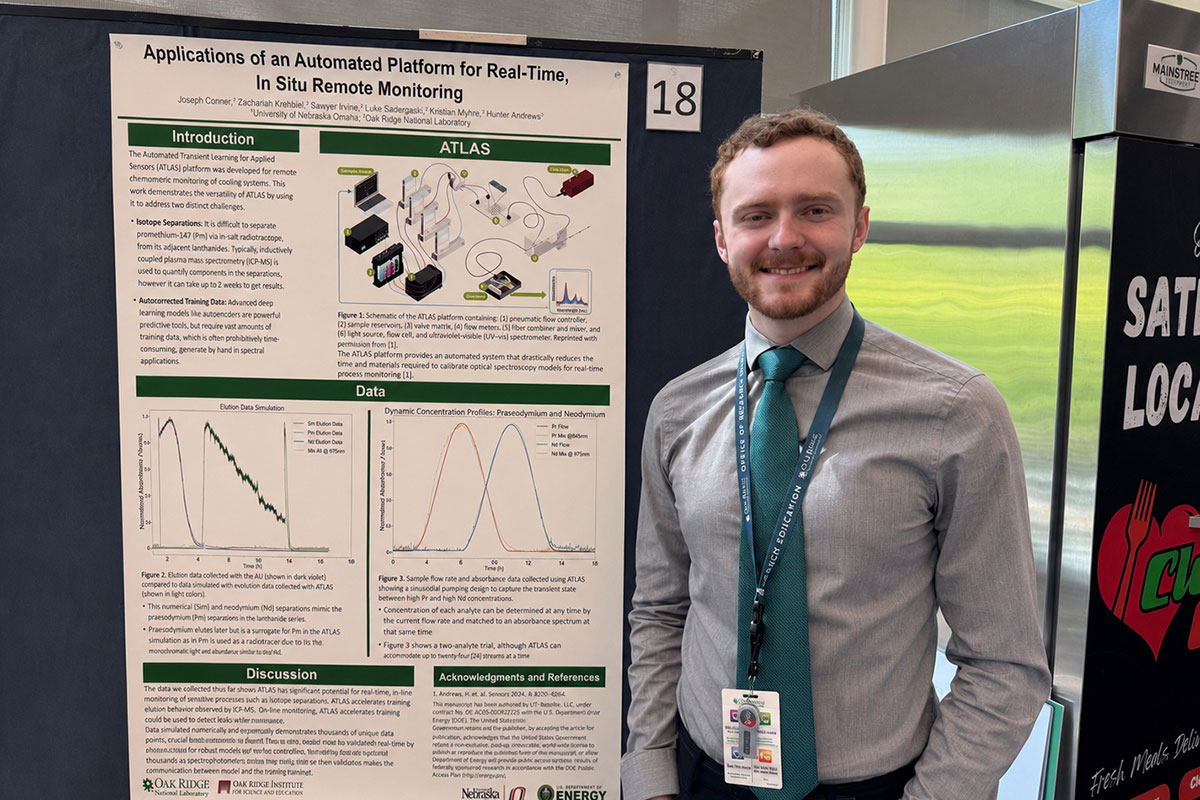
Joe Conner presents research during an end-of-summer presentation at Oak Ridge National Laboratory. (Photo courtesy of Joe Conner)
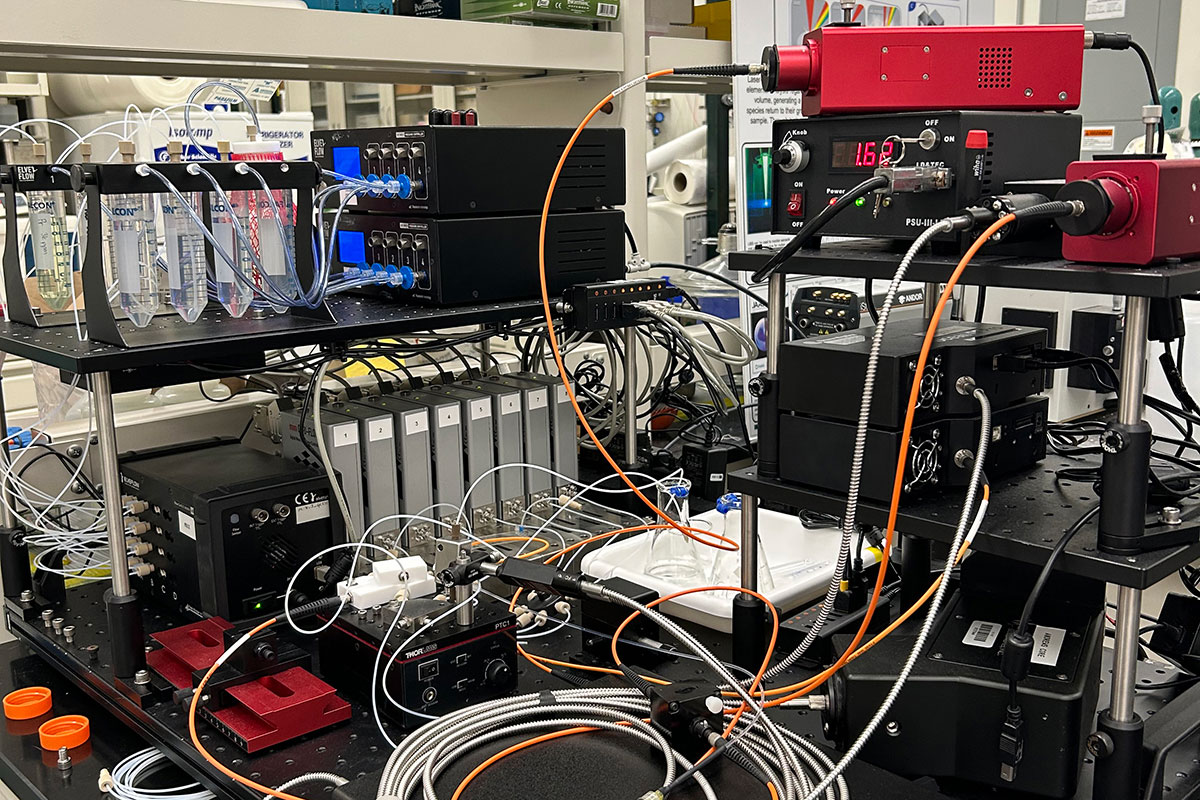
An ATLAS sensor platform that Conner used. (Photo courtesy of Joe Conner)
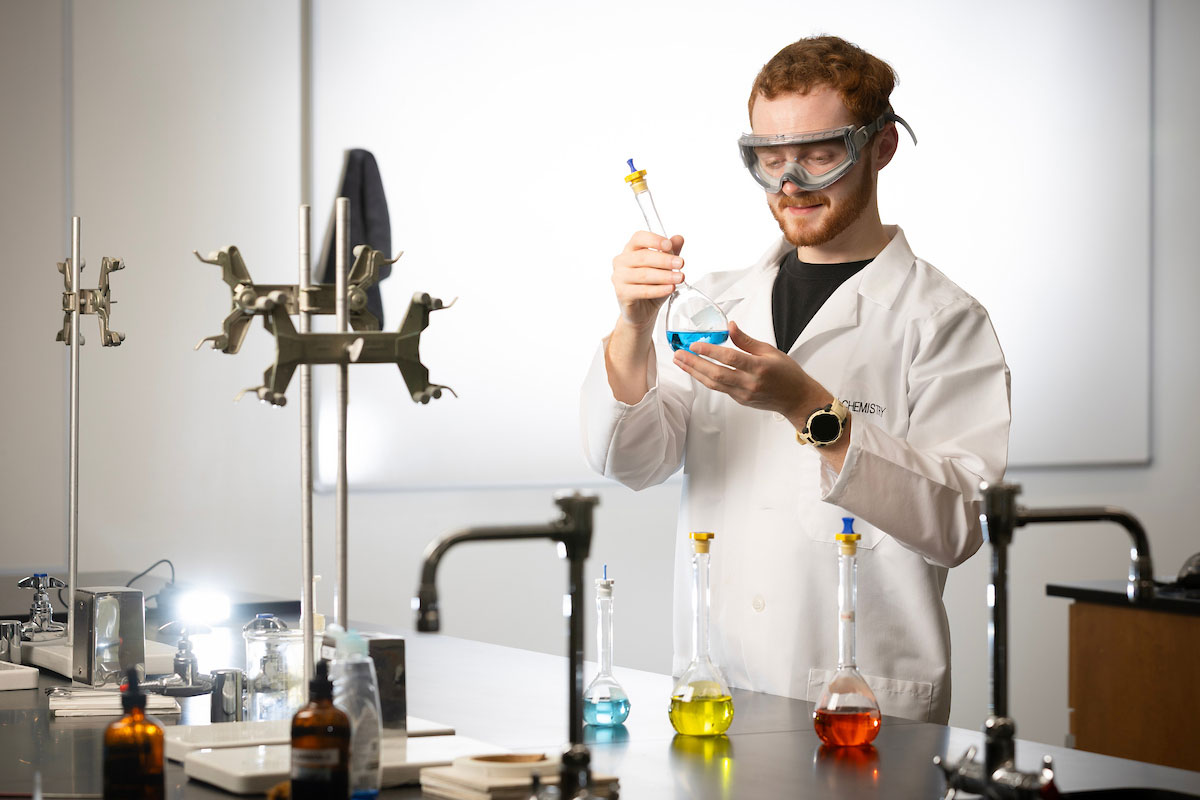
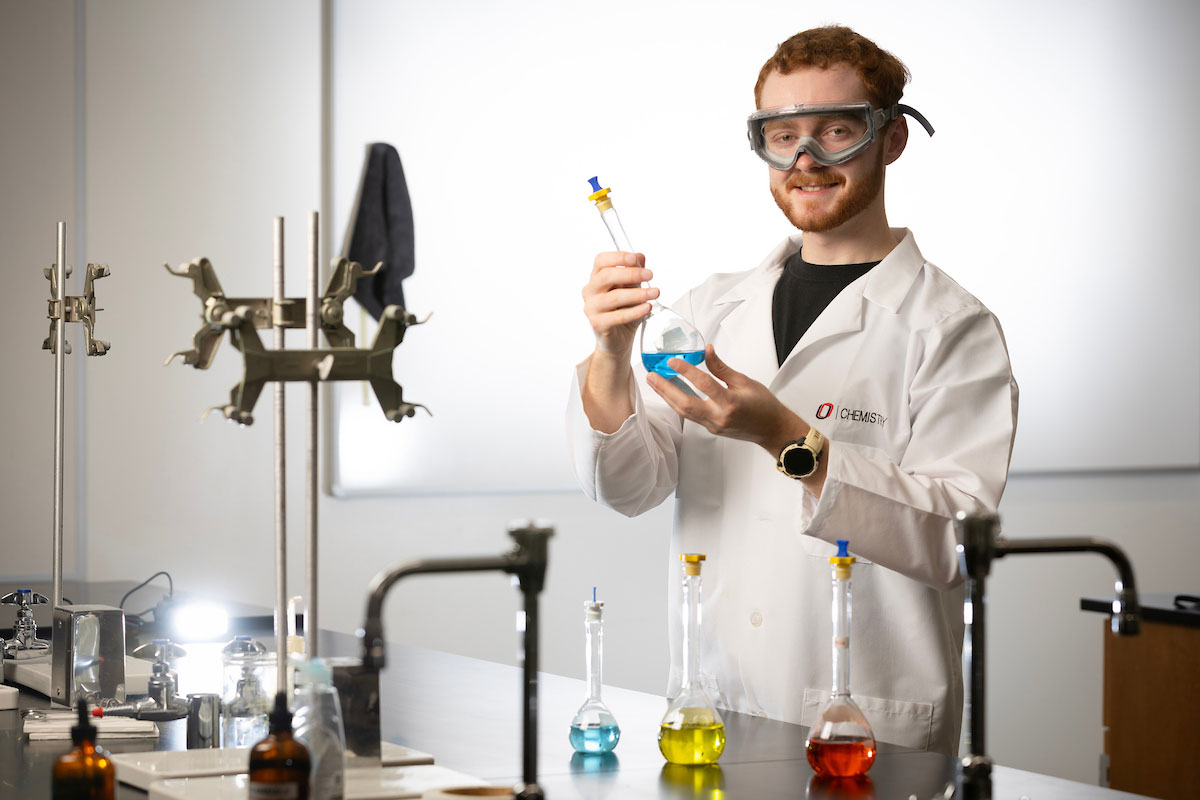
Junior chemistry student Joe Conner works in a UNO lab in Durham Science Center. (UNO/Ryan Soderlin)
Working at one of the most prestigious science labs in the country can be intimidating, especially when your summer project involves nuclear energy.
For Joe Conner, a junior at the University of Nebraska at Omaha (UNO) with a triple major in chemistry, physics, and history, interning at Oak Ridge National Laboratory was the opportunity of a lifetime.
Part of the U.S. Department of Energy, the Oak Ridge National Laboratory is the ultimate goal for aspiring nuclear scientists like Conner. It’s well funded and staffed by the top minds on the planet. The next energy revolution will likely happen there. It’s home to one of the world’s fastest supercomputers. And because of its origins during the Manhattan Project, physics experiments, and its rural East Tennessee surroundings, many point to it as the real-life inspiration for Hawkins Lab in Netflix’s Stranger Things.
And to get there, it was straighter forward than Conner imagined.
“I broadly applied to a ton of programs,” Conner said. “I sent out probably 15 to 20 applications to different research experiences, national labs, just trying to get something.”
After months of applications and summer getting closer, he created his own opportunity. Conner found Hunter Andrews, an Oak Ridge researcher whose work matched his interests, and reached out directly.
“I saw on Oak Ridge’s website that he had some cool research that I was interested in,” Conner said. “I emailed him and found a program that worked for both of us.”
Conner’s work is in analytical chemistry with a focus on nuclear energy. With Andrews, he helped address the problem of how scientists can watch complex chemical systems, be more efficient with waste, and reduce exposure time for researchers. More specifically, he worked on a team to develop a sensor platform that allows scientists to monitor complex systems remotely and automatically. This can be groundbreaking for nuclear systems, as it can allow scientists to make quicker adjustments, reduce the need to take samples, and decrease exposure time to harmful chemicals and radiation.
The platform is called Automated Transient Learning for Applied Sensors, or ATLAS. It’s a type of spectroscopy sensor that identifies what chemicals are inside a system by measuring light and looking for patterns. It’s almost like a fingerprint. But in complicated systems, those fingerprints can overlap, become difficult to read, and require complicated and time-consuming alterations.
ATLAS helps automate the calibration process, replacing weeks or months of scientists manually taking samples with a computer-controlled system that can do the work in hours or days.
“By automating that, it cuts down on what would take weeks to months for scientists to do,” Conner said.
Conner used ATLAS in work involving promethium-147, a radioactive isotope used in industry and electronics. The goal was to explore whether ATLAS could help researchers better control how promethium-147 is separated inside a nuclear reactor.
“We’ve gotten promising data from a simulation that we did using that with ATLAS,” he said.
For Conner, the internship was a major step toward the future.
It marked a major milestone as he moved away from home for the first time, relocating hundreds of miles away to Oak Ridge, away from his support system, family, and friends.
“It was a big experience to stand on my own two feet and go through all the first times, like figuring out how to cook for yourself,” he said. “But I feel like I’m closer to being a full adult now.”
In the future, he plans to apply to Ph.D. programs after graduation and said the Oak Ridge experience will strengthen his graduate school applications, help him pursue future research opportunities, and expand his network beyond Omaha.
With the fall semester here, he is continuing his research and work at UNO, collaborating with Alan Gift, an associate professor in the Department of Chemistry, on creating and finding uses for their 3D-printed spectrometer.
Conner’s academic interests also stretch beyond the lab. He said studying history has sharpened how he approaches science, especially when data does not have an obvious explanation.
“History is all about putting things into context,” he said. “That translates really well to science.”
Adding history as a major is only advancing his career as a scientist. Along with Oak Ridge, it’s all working together to make his goals feel more real.
“This internship has made my dreams feel a lot more achievable,” he said. “I feel a lot more secure and a lot more confident in my ability to get where I want to go.”
About the University of Nebraska at Omaha
The University of Nebraska at Omaha (UNO) is Nebraska’s premier metropolitan university, committed to innovating for the public good, advancing social mobility, powering workforce development, and serving as a hub for community engagement. Nearly 15,000 Mavericks choose UNO for its hands-on education experiences, nationally ranked online and graduate programs, military-connected student support, and innovative approaches to supporting lifelong learning. UNO holds the Carnegie Research Activity “R2” designation, securing more than $40 million annually in external research funding and counts its faculty among the world’s most cited scholars. Sixteen Omaha Athletics programs compete in NCAA Division I as members of the Summit League and National Collegiate Hockey Conference (NCHC).
Follow UNO on Facebook, Twitter (X), Instagram, LinkedIn, and YouTube.