
UNO Scientist Earns NIH Grant to Illuminate the Earliest Moments of Fertilization
A new imaging tool developed at UNO makes fertilized eggs in worms glow green, helping researchers uncover the biology behind infertility and early embryo development.
- published: 2026/08/25
- contact: Sam Peshek - UNO Office of Strategic Marketing and Communications
- email: unonews@unomaha.edu
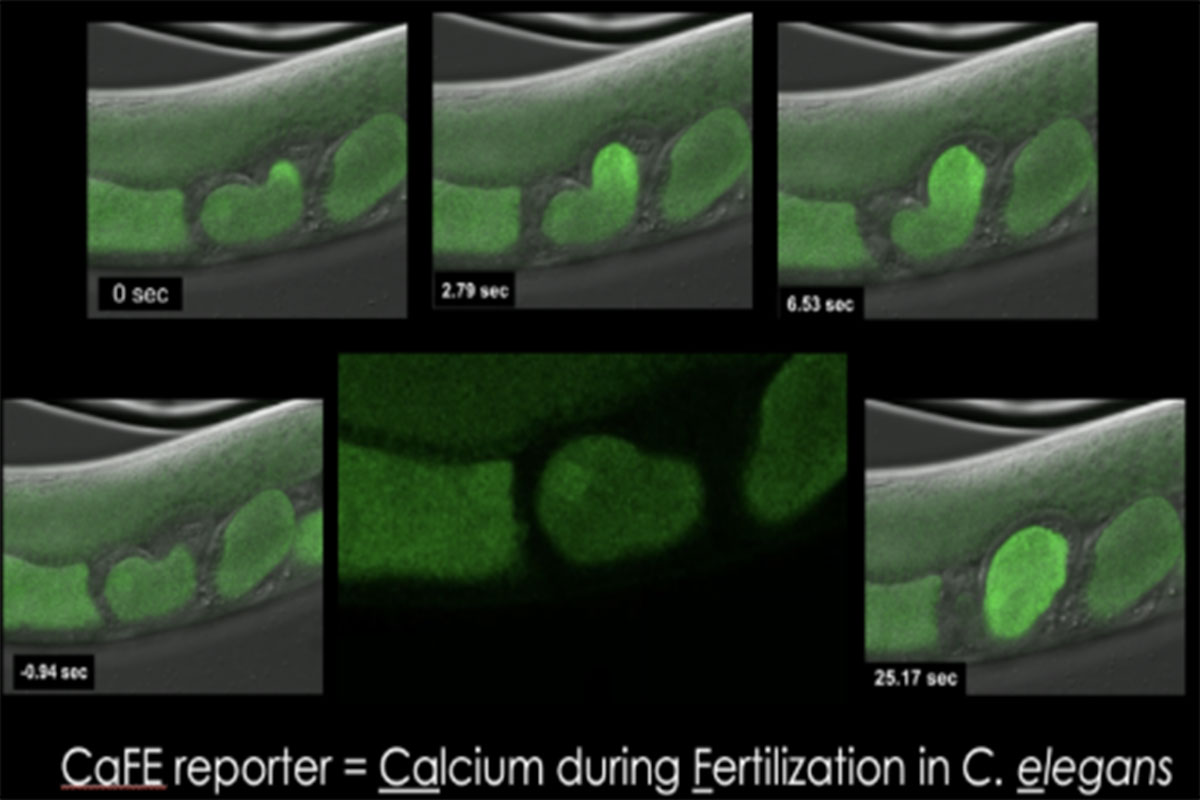
What if scientists could watch fertilization happen in real time? A University of Nebraska at Omaha (UNO) researcher has developed a new tool that does exactly that.
➡️ What’s new: Backed by a R15 National Institutes of Health (NIH) grant, research from Biology Assistant Professor Karen Kim Guisbert, Ph.D., allows scientists to visualize the precise moment an egg is fertilized, revealed by a flash of green fluorescence inside a living organism.
💡 Why it matters:
- Infertility affects approximately 11% of women and 9% of men. Problems during the transition from egg to embryo can also contribute to miscarriage.
- By revealing what happens in the first moments after fertilization, Kim Guisbert's research could deepen scientists' understanding of one of human biology's most fundamental processes.
- The grant also supports student research and course-based undergraduate research experiences.
🔎 Zoom in: At the center of the project is a new imaging system called the CaFE (Calcium during Fertilization in C. elegans) reporter, which makes eggs glow green when fertilization occurs.
- The research uses the microscopic roundworm Caenorhabditis elegans, a model organism widely used in genetics and developmental biology.
- Although the worms are only about one millimeter long, they share an important characteristic with humans: fertilization happens internally.
- Unlike humans, however, the worms ovulate approximately every 23 minutes, allowing researchers to observe many fertilization events in a short period of time.
- To create the glowing reporter, Kim Guisbert used CRISPR gene-editing technology to engineer the worms so the fluorescent marker is expressed in their reproductive cells.
- The imaging system captures the calcium signal that moves through the egg as fertilization unfolds.
🎤 What they’re saying:
- Karen Kim Guisbert, Ph.D., Assistant Professor of Biology: “Every pregnancy begins with a series of biological events that scientists still don't fully understand. By uncovering how fertilization is regulated at the cellular level, we're building knowledge that could one day help researchers better understand infertility, miscarriage, and other reproductive health challenges that affect millions of people around the world."
- Sara Myers, Ph.D., Associate Vice Chancellor for Research and Creative Activity: "An NIH R15 award is an investment in both scientific discovery and student success. At UNO, our students work alongside faculty to tackle questions that matter and can make a real difference in people’s lives. Awards like this show that impactful, nationally competitive research is happening right here in Omaha, and our students are helping lead it."
📌 Grant award info:
- Funding source: NIH NICHD
- Funding amount: $239,086
- Award number: R15HD111986
- NuRamp number: UNO-00068476
About the University of Nebraska at Omaha
The University of Nebraska at Omaha (UNO) is Nebraska’s premier metropolitan university, committed to innovating for the public good, advancing social mobility, powering workforce development, and serving as a hub for community engagement. Nearly 15,000 Mavericks choose UNO for its hands-on education experiences, nationally ranked online and graduate programs, military-connected student support, and innovative approaches to supporting lifelong learning. UNO holds the Carnegie Research Activity “R2” designation, securing more than $40 million annually in external research funding and counts its faculty among the world’s most cited scholars. Sixteen Omaha Athletics programs compete in NCAA Division I as members of the Summit League and National Collegiate Hockey Conference (NCHC).
Follow UNO on Facebook, Twitter (X), Instagram, LinkedIn, and YouTube.