
UNO Workshop Expands NSRI's Mission Focus Into Social Science
The National Security Social Science Seminar (NS4) was recently held at UNO and hosted by the Office of Research and Creative Activity (ORCA).
- published: 2026/07/30
- contact: Katelyn Ideus - National Strategic Research Institute (NSRI)
- email: kideus@nsri.nebraskaresearch.gov
From the National Strategic Research Institute (NSRI) — During the COVID-19 pandemic, the government, manufacturers and public health agencies accomplished record-breaking production of vaccines and personal protective equipment.
And then trust broke down.
Society was prepared to navigate the sometimes difficult medical and scientific pandemic challenges, but less so the social challenges — human challenges. According to social scientists, political scientists, engineers, public health experts and others attending a recent think-tank-style seminar on social aspects of national security, this is a common gap in addressing public incidents, whether they are intentional, accidental or natural.
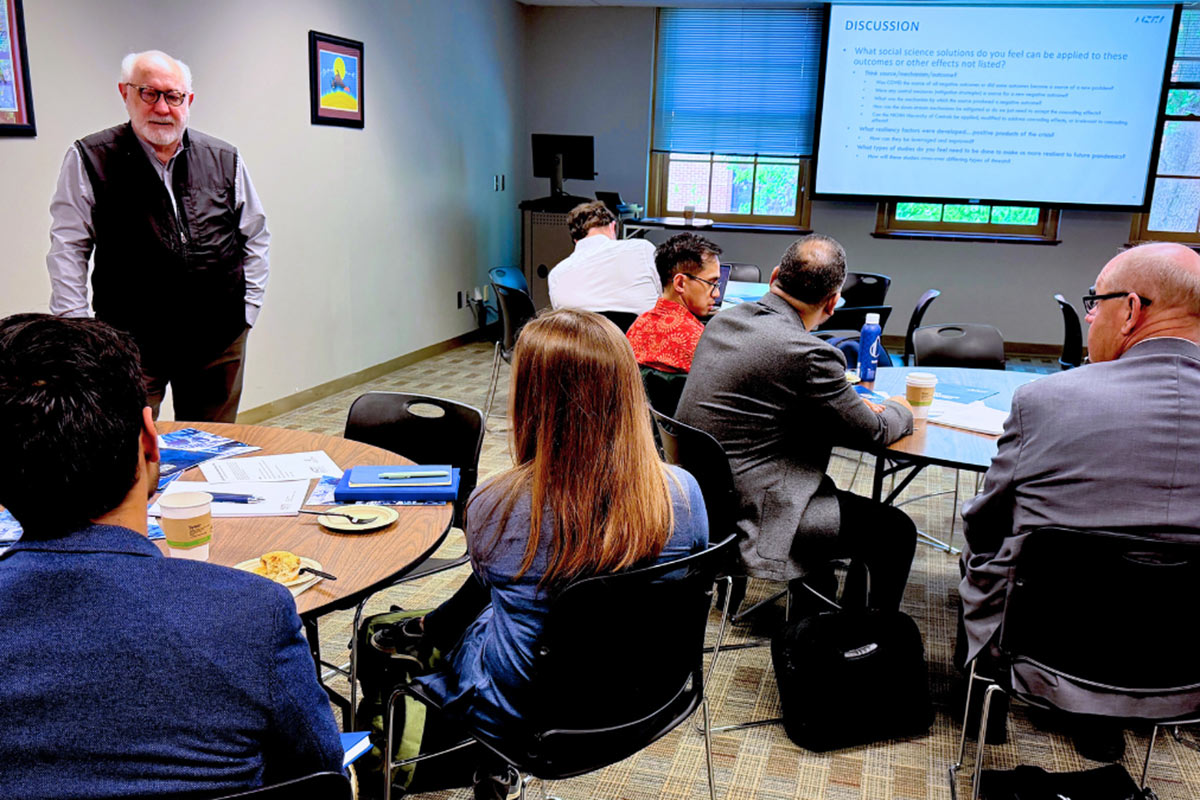
The National Security Social Science Seminar (NS4) was recently held at the University of Nebraska at Omaha (UNO) and hosted by the campus’s Office of Research and Creative Activity.
"We were excited to host NSRI and bring together such a wide range of expertise for the National Security Social Science Seminar (NS4),” said Dr. Sara Myers, UNO associate vice chancellor for research and creative activity. “This kind of cross-disciplinary collaboration is exactly what UNO's research enterprise is built to support — connecting our faculty's knowledge with the nation's most pressing defense and resilience challenges. We are grateful for our continued partnership with NSRI and look forward to the new opportunities ahead."
The seminar was led by Dr. Neal Woollen, associate executive director of countering weapons of mass destruction (CWMD) allied programs for the National Strategic Research Institute (NSRI) at the University of Nebraska (NU). The institute, sponsored by USSTRATCOM, is one of 15 University Affiliated Research Centers (UARCs) commissioned by the U.S. Department of War (DOW) to assist in solving deterrence and defense challenges.
NS4 was designed to ask for assistance in tackling social science aspects for strategic deterrence and CWMD — the two DOW missions NSRI addresses through research, development and training.
Through NSRI’s recently awarded $500 million indefinite-delivery, indefinite-quantity contract, researchers can fast-track funding and implementation of critical projects. NSRI matches researcher capabilities to DWW needs.
“The minds in this room hold vast knowledge related to this critical need — maybe in ways we don’t realize,” Dr. Woollen said. “Cascading effects and distractions surrounding national security, including social frameworks and economic issues, are just as important to resilience as the physical science of defense.”
In the past, the nation’s linear deterrence and defense model focused solely on intentional, physical threats. In 2018, U.S. security leaders shifted the mission, allowing more attention on accidental and natural events, as well cascading and distracting causes, vulnerabilities and effects.
“We have to recognize there will always be philosophical and political engagement and influence,” Dr. Woollen said.
The goal overall, he said, is to build our nation’s resilience and ability to “withstand and recover.”
Dr. Woolen shared a new threat mitigation model that is not linear but based on interconnected systems, with precipitating elements including desire and resources — and second- and third-order effects — all occurring at the intersection of “threat and vulnerability.” Social sciences solutions fit well into the system.
He also shared the government’s defined areas of “critical infrastructure,” many of which may benefit from social-science-related solutions. Workshop participants suggested adding to the list: people, communication, social media and misinformation.
Dr. Woollen opened the meeting to participant input:
- A medical and anthropology expert with Ebola experience suggested infrastructure should include the environment and public health.
- A social scientist said lessons learned from children’s pandemic isolation issues suggest mental health is a critical security concern.
- An opium addiction and fentanyl expert explained that lack of resources, fear of exposure and legal ramifications of solutions are all valid areas of concern.
- The group discussed the effects of stress on first responders as a point of potential risk.
- A political scientist pointed out anger can lead to harmful events, and the Ebola expert confirmed the importance of building trust early with communities.
- Several attendees noted the power of proper communication in addressing vulnerability — responders must be trained to communicate effectively.
- A social sciences graduate student stressed the importance of training an emerging workforce to successfully manage incidents.
The potential for social sciences to help build resilience and strengthen national security is great, and the possibilities are far reaching, encompassing disciplines such as cybersecurity and technology, rural studies, counterterrorism, compliance, conflict resolution, international studies, supply chains, leadership and more. The workshop only scratched the surface.
Dr. Woollen encouraged attendees to reach out to him with more ideas and consider joining the NSRI academic network to share expertise, take on challenges and make a difference in defense of the nation. NU faculty are welcome to connect with NSRI for these opportunities.
About the National Strategic Research Institute
The National Strategic Research Institute (NSRI) at the University of Nebraska helps ensure the United States' safety and preparedness against strategic threats through research and development. Established in 2012, NSRI is one of 15 University Affiliated Research Centers (UARCs) designated by the U.S. Department of War. The nonprofit institute is sponsored by United States Strategic Command and affiliated with the University of Nebraska System of four campuses. NSRI connects leading scientists and collegiate students with federal agencies to deliver novel research, technology, training and expertise for strategic deterrence and countering weapons of mass destruction. Read about our mission.