
Meet UNO’s First Co-Op Student
UNO’s first co-op student and Business Admin major Darian Mitchell finished an experience with Werner Enterprises, helping advance her career in the supply chain industry.
- published: 2026/03/26
- contact: Jared Craig - Office of Strategic Marketing and Communications
- email: unonews@unomaha.edu
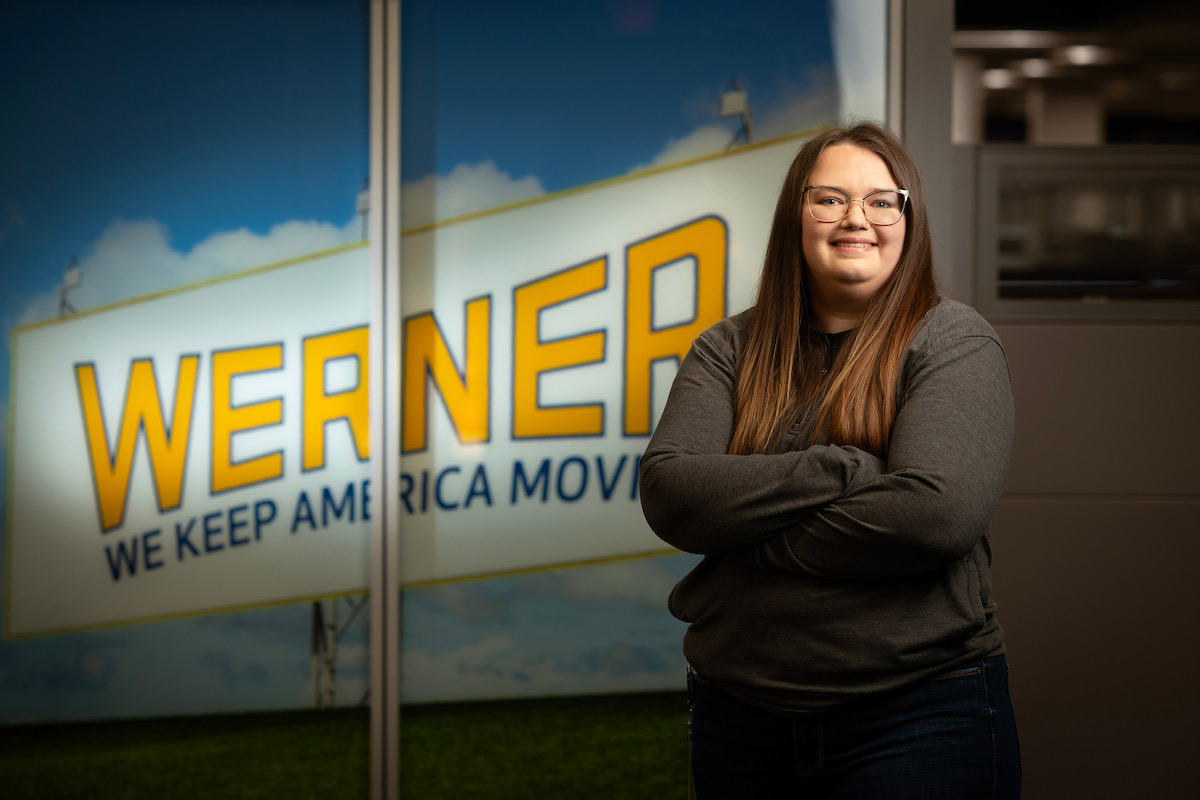
In her senior year, Darian Mitchell found herself breaking the mold of how students can use their time in college to advance their careers: by completing a co-op.
Unlike a traditional internship, the co-op, or co-operative education, allows students to divide the year between dedicated in-class instruction and full-time employment with a company in their chosen field. In some cases, students undergo several rotations of each, leading to a good amount of their college tenure in the co-op. A co-op differs from internships, which may be fewer hours per week, paid or unpaid, less structured, or only offered in the summer. Ultimately, the goal is to get the student hands-on experience working in the field before graduation.
Mitchell was already working full-time at Werner Enterprises, a trucking company based in Omaha, as a transportation manager when the opportunity was presented. Then she learned she would be the first student at the University of Nebraska at Omaha (UNO) to be in a co-op.
“It was so nerve-wracking,” said Mitchell, a business administration major concentrating in supply chain management. “The professor told me, ‘You’re the first one.’ And I was like, ‘Oh. Okay. Well, here’s my idea.’”
Mitchell has been at Werner since 2021. She works in truck recovery, a specialized area of transportation management that focuses on retrieving trucks when drivers have to leave their trucks on the road, sometimes on the far side of the country, either because they need to take medical leave, or the truck needs to be repaired. Her team coordinates transporting drivers to the truck and getting them back in service.
“It’s a lot of planning,” she said. “Where are we sending drivers? How fast can we get them there? And cost savings is critical because we ultimately don’t want to spend more than the revenue of the freight.”
Erin Pleggenkuhle-Miles, a professor of management at the UNO College of Business Administration, said that co-ops can provide “a thorough test-drive of a particular job,” more than an internship or job shadowing could ever be.
“Rather than a day in the life, they experience a full semester in the life," said Pleggenkuhle-Miles. “They also have a work project that they spearhead and that connects back to core learning objectives.”
For her co-op, Mitchell found an opportunity for professional growth, seeking to take on more responsibility, learn more, and gain more independence in her role.
“I wanted to see how I can rely less on my supervisory team and handle things myself,” she said. “Instead of escalating a problem, how can I solve it?”
As a senior graduating in May, she saw this opportunity to advance in her career.
She titled her project around transitioning from a transportation manager to a more dedicated logistics manager role — a shift that meant increasing her visibility across departments, building stronger connections, and taking greater ownership of decisions.
“By the end of her co-op, she was able to showcase improvements she'd made to processes, articulate those refinements, speak to new initiatives, and ultimately redefine and shape her role,” Pleggenkuhle-Miles said. “Given that Darian was our pilot—she not only took initiative but helped us navigate and improve the structure of the experience for those to come.”
One of her biggest focus areas was cost control. Because truck recovery doesn’t directly generate revenue, keeping expenses down is critical. She concentrated on areas she could influence immediately — including lowering hotel costs for drivers and fuel expenses for recovery vehicles.
Her team recently switched recovery vehicles to hybrids to reduce fuel costs. They also began stocking them with supplies, like mud flaps and airline connectors that can prevent expensive service calls on the road.
“You’d be surprised how many simple things go missing,” she said. “A road call can average around $500, and that’s before you add in wages and fuel.”
At the end of the semester, Mitchell presented her work to her supervisor, her supervisor’s supervisor, and her professor. For leaders who don’t see the day-to-day details of her job, the presentation offered a clearer picture of her growth.
“Sometimes I get an email, and I just take care of it, and nobody knows I did it,” she said. “It was nice to lay it all out — here’s where I started, here’s what I’m doing now, and here’s where I want to go.”
Gaining positive feedback from her leadership team, Mitchell says it was encouraging to hear that her added responsibilities had not gone unnoticed.
For students considering a co-op, Mitchell believes the experience is especially valuable for those who already understand their workplace and want to grow within it.
“This was the perfect chance to push myself,” she says. “It wasn’t just about doing my job. It was about making it better.”
About the University of Nebraska at Omaha
The University of Nebraska at Omaha (UNO) is Nebraska’s premier metropolitan university, committed to innovating for the public good, advancing social mobility, powering workforce development, and serving as a hub for community engagement. Nearly 15,000 Mavericks choose UNO for its hands-on education experiences, nationally ranked online and graduate programs, military-connected student support, and innovative approaches to supporting lifelong learning. UNO holds the Carnegie Research Activity “R2” designation, securing more than $40 million annually in external research funding and counts its faculty among the world’s most cited scholars. Sixteen Omaha Athletics programs compete in NCAA Division I as members of the Summit League and National Collegiate Hockey Conference (NCHC).
Follow UNO on Facebook, Twitter (X), Instagram, LinkedIn, and YouTube.