
Managing Discomfort: How Student Workers Are Supporting UNO’s Athletes
Behind UNO’s student-athletes, there is a team of student workers supporting their health – both mentally and physically.
- published: 2026/02/10
- contact: Jared Craig - Office of Strategic Marketing and Communications
- email: unonews@unomaha.edu
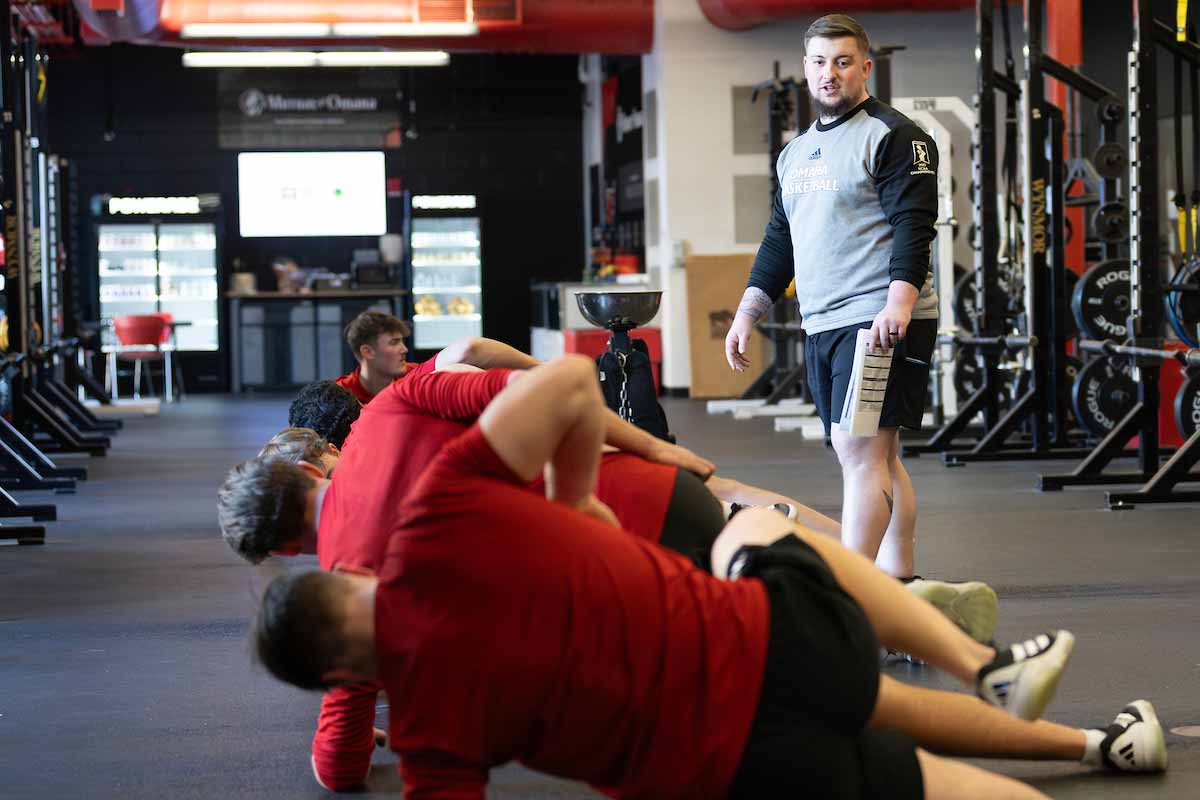
Coleton Dean, who is studying kinesiology, observes UNO baseball players during weight training at the University of Nebraska at Omaha’s Sapp Field House. Photo by Ryan Soderlin, UNO Strategic Marketing and Communications.
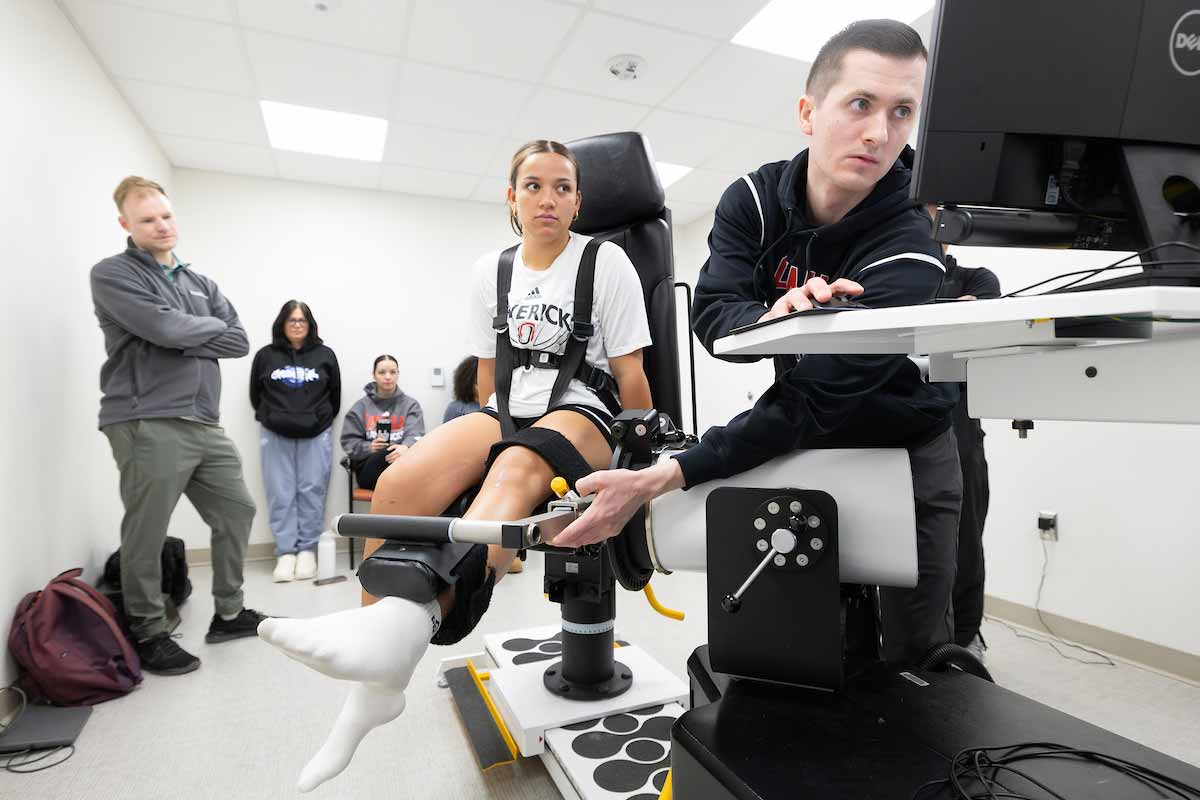
Cam Jensen, a PhD student in biomechanics, Billy Lozowski, UNO sports scientist, and Padon Collard, a master’s student in biomechanics, test women’s basketball player Tannika Leger-Walker’s leg strength at the University of Nebraska at Omaha’s Health Science Collaborative. Photo by Ryan Soderlin, UNO Strategic Marketing and Communications.
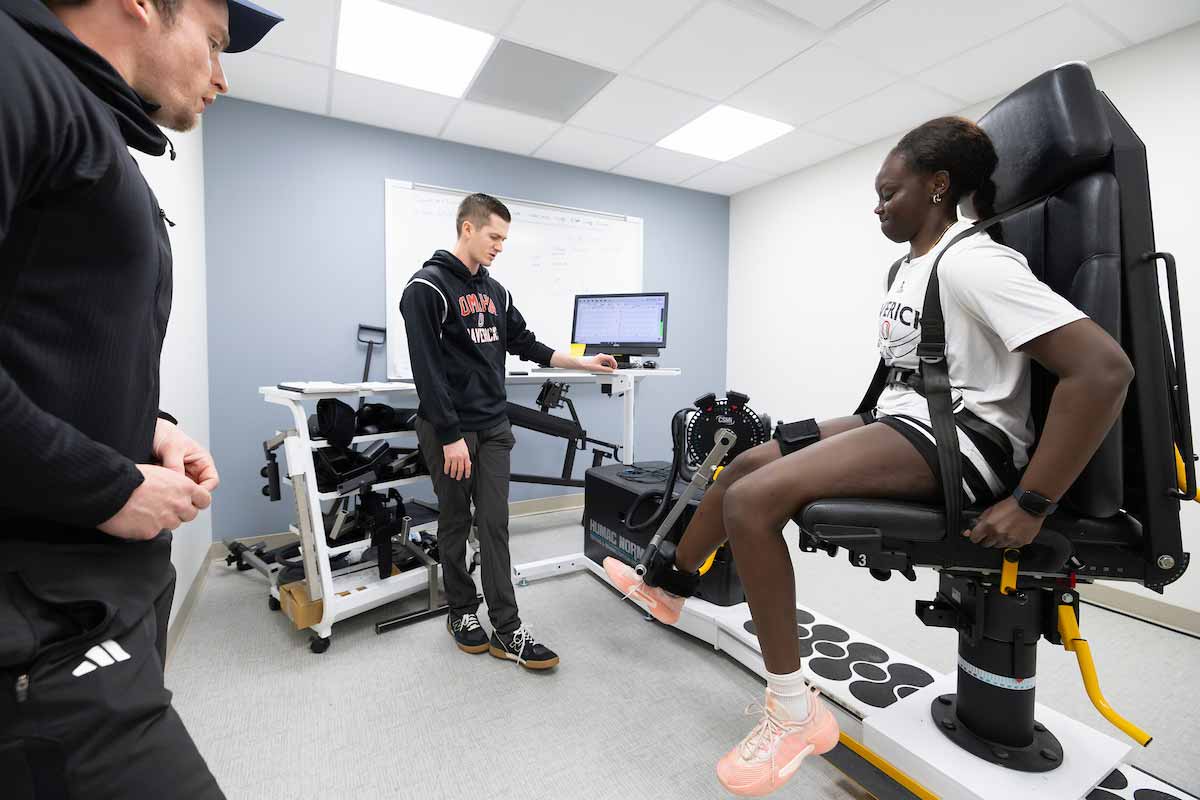
Padon Collard, a master’s student in biomechanics, and Cam Jensen, a PhD student in biomechanics, test women’s basketball player Aduke Ojullu’s leg strength at the University of Nebraska at Omaha’s Health Science Collaborative. Photo by Ryan Soderlin, UNO Strategic Marketing and Communications.
Supporting student-athletes requires far more than what fans see on game day. Behind every practice, competition, and comeback is a network of professionals and student workers dedicated to keeping athletes healthy — physically and mentally — throughout the demands of sports and college classes.
At the University of Nebraska at Omaha (UNO), that support takes shape holistically bringing together strength and conditioning, sports medicine, nutrition and mental health services. Like many areas of UNO, student workers play a vital role, providing hands-on care while gaining experience that shapes their own future careers.
For junior kinesiology major Coleton Dean, supporting student-athletes starts with meeting them where they are.
Dean works as a student intern in Athletics Strength and Conditioning, where he works alongside athletic trainers to boost performance. He is a regular presence around weight training sessions, as he helps student athletes train while using the right form and offers much needed encouragement between reps.
“It’s important that athletes know we want them here,” Dean says. “Keeping the energy high, recognizing effort, and just being present makes a big difference.”
As a student himself, Dean can offer support as a peer as much as a working professional.
“They see me outside of the weight room because I have several classes with a lot of athletes,” he adds. “That helps build a connection.”
That emphasis on caring for the whole athlete is important, as poor health in one area can affect others. Taryn Ninemire, executive associate athletic director in charge of athletic performance and physical therapy, oversees Omaha Athletics’ integrated performance model. This includes sports medicine and athletic training as well.
“We take a 360-degree approach,” Ninemire says. “We don’t compartmentalize. Physical health is just as important as mental health, sleep, nutrition, and stress management. Performance doesn’t exist without psychological safety. And recovery cannot happen without stress management.”
And the system works. Over half of student athletes use mental health services. But all students use other aspects of the program, such as hydration stations and recommended food menus provided by a nutritionist. Omaha Athletics also has opened access to the convenience of student athletes. Beginning in 2023, a food station at Scott Campus Housing also provides healthy food options for female athletes.
Athletes recovering from injuries work with sports scientists to test the progress of their recovery, a process that gives a quantitative measurement on the injured body part but also provides staff a chance to check in with how the athlete is feeling about their recovery.
On Jan. 12, while students returned to campus for the first day of classes of the spring semester, injured players of Omaha Women’s Basketball were also going through one of these assessments.
Seated in a chair like a workout machine, Billy Lozowski — one of the sports scientists — and biomechanics graduate students test how athletes’ injured muscles perform under strain by moving a mechanical bar connected to a computer. As the team’s athletic trainer took notes and asked questions, the graduate students encouraged the athlete to “push, push, push” and later “pull, pull, pull” the mechanical bar. The data is compared to a pre-season assessment, helping coaching staff to see how injured athletes are getting close to pre-injury performance.
Ultimately, the Department of Biomechanics and Omaha Athletics hopes that this will produce students who can conduct research and practice it.
Collaboration even extends to UNO’s sister university within the University of Nebraska System, where doctoral students from the University of Nebraska Medical Center (UNMC) complete eight or 10-week clinical rotations with Omaha Athletics.
Koby Brandenburg, a physical therapy doctoral candidate at UNMC, works closely with athletes recovering from surgery and serious injuries. Like other student workers and staffers, Brandenburg is a former student athlete and knows well the process of dealing with injuries, among them a broken collarbone on different occasions and torn shoulder labrums. He knows the physical strain of coming back from injury can be, as well as overcoming the vulnerability an athlete can feel during recovery.
“These athletes aren’t just rehabbing — they’re trying to get back to who they are,” Brandenburg says. “Empathy is huge, because their sport is often a big part of their identity.”
UNO clinical assignments are highly sought after by UNMC physical therapy students for their exposure to a wide range of athletic injuries. After working with athletes, it didn’t take long for Brandenburg to become invested in their success, as he often attends Omaha Women’s Basketball games to cheer them on.
Ninemire is especially pleased with how Omaha Athletics’ system prioritizes both performance and people. She points to how student workers have bought into the strategy.
Standing in the weight room, Dean is mindful that there are many reasons why an athlete is not reaching a goal.
“Sometimes it’s not physical,” Dean says. “If an athlete is having a tough week mentally, just talking to them, knowing their name, and encouraging them can really help.”
About the University of Nebraska at Omaha
The University of Nebraska at Omaha (UNO) is Nebraska’s premier metropolitan university, committed to innovating for the public good, advancing social mobility, powering workforce development, and serving as a hub for community engagement. Nearly 15,000 Mavericks choose UNO for its hands-on education experiences, nationally ranked online and graduate programs, military-connected student support, and innovative approaches to supporting lifelong learning. UNO holds the Carnegie Research Activity “R2” designation, securing more than $40 million annually in external research funding and counts its faculty among the world’s most cited scholars. Sixteen Omaha Athletics programs compete in NCAA Division I as members of the Summit League and National Collegiate Hockey Conference (NCHC).
Follow UNO on Facebook, Twitter (X), Instagram, LinkedIn, and YouTube.