
UNO TRAC Program: A Beacon of Hope for Social Mobility
UNO serves as a catalyst for positive change by offering access to higher education to incarcerated individuals. Founded on the principles of innovation for the public good and upwards social mobility, TRAC extends educational opportunities to those who are often overlooked by society through for-credit general education courses.
- published: 2024/10/02
- contact: Bella Lockwood-Watson - Office of Strategic Marketing and Communications
- email: unonews@unomaha.edu
- search keywords:
- TRAC Program
Redefining Education for Incarcerated Individuals
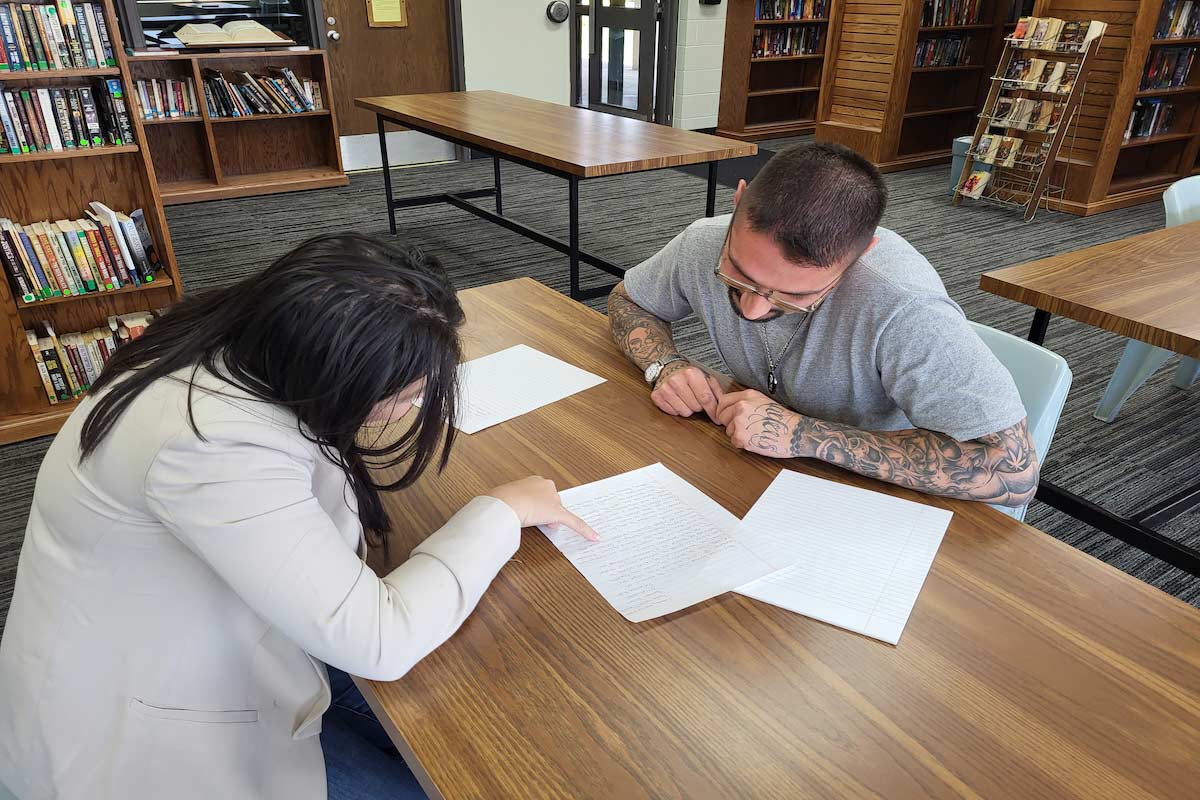
The University of Nebraska at Omaha (UNO) Transforming, Renewing, Achieving, and Connecting (TRAC) program is a donor funded program that provides accredited college-level courses taught by UNO staff and faculty to incarcerated individuals at the Omaha Correctional Center (OCC).
Education is a critical component to breaking the cycle of crime; participants develop a sense of purpose and find a goal within reach, something beyond what they may have imagined.
UNO’s TRAC program "benefits residents at OCC in many ways. They become part of the UNO community. When they’re taking courses offered through the TRAC program, they have a UNO student number, and their identity in the program is that of an UNO student,” said Sadaf Hashimi, Ph.D., director of TRAC and assistant professor in UNO’s School of Criminology and Criminal Justice. “Most commonly, we find that our students at OCC come to identify with a purpose when they enter the classroom. They're there to learn, to critically think and problem-solve, and to reflect. For those three hours in the classroom, their purpose is to do their best in the course."
With continued support from OCC and the Nebraska Department of Correctional Services, in addition to traditional classes, incarcerated individuals are also afforded a unique opportunity to participate in Inside-Out classes through the TRAC program. These courses, with their distinctive educational approach, see UNO students and incarcerated individuals sharing the same class, completing the same readings, assignments, and classroom activities. This not only breaks down barriers but also fosters a sense of mutual understanding. It creates a space for diverse perspectives and experiences, enriching the learning process, and underscoring the importance of equality and the shared pursuit of knowledge.
“My goal is to expose our students to a healthy prison climate, where they will lean on each other for help. Our students are encouraged to have discussions and to engage in respectful interactions with one another in and outside of the classroom. In the best-case scenario, some are going to step up as mentors, improving the experiences of their peers and hopefully their time at OCC because this is what we are likely to see in a college setting,” said Hashimi.
Advancing Social and Economic Mobility Through Education
The United States has the highest rate of recidivism globally. A staggering 76.6% of incarcerated individuals are rearrested within five years of their release. However, research indicates that participation in education programs correlates with a 43% lower chance of reincarceration, showing the critical role education plays in successful re-entry into communities.
A lack of credentials or having to disclose criminal history on an application makes finding employment upon release difficult.
By equipping incarcerated individuals with degrees and essential skills, these programs not only boost their employability but also empower them to make informed decisions and contribute positively to society upon release.
“We have learned from research, for example, reports conducted by the Urban Institute and RAND, that incarcerated individuals who take educational courses - beyond receiving their GED or participating in vocational training - and specifically those who receive post-secondary education in prison, are more likely to have a positive re-entry experience,” said Hashimi.
By supporting incarcerated people through education, the program provides them with the basic skills needed to better reintegrate into the community upon release. The TRAC program also addresses bigger societal issues related to incarceration and reentry.
TRAC also advocates for the incarcerated population in the community and raises awareness about the importance of higher education in prison and its importance in successful reentry into society.
“Most of these men will be released into the community someday, and their time at OCC or any correctional facility is crucial. With these opportunities, we can shape, and hopefully improve, how they may choose to spend their time incarcerated. Ultimately, if 'we are unable to support them in ways that improve their chances of successful re-entry, then our expectations of how we want them to navigate their time in the community may be unrealistic,” said Hashimi.
Paving the Way for a Brighter Future
UNO's initiatives have made strides in advancing social mobility through education. Programs like TRAC have demonstrated how the power of education can make a tangible impact on society by empowering individuals to take control of their lives and learn to thrive in an often difficult and complicated world.
By prioritizing education through programs like TRAC, UNO will continue its mission to make a positive impact on the lives of people locally, regionally, and nationally.
If you are interested in learning more about the TRAC program, or getting involved as an instructor, please email Sadaf Hashimi, Ph.D., at shashimi@unomaha.edu.