

UNO Lecture Explores Human Rights for Older Persons
Professor Israel “Issi” Doron shared the decades long movement toward a new international human rights convention for older persons during the Dr. Chuck Powell Memorial Lecture.
- published: 2026/09/14
- contact: Amber Evenson - College of Public Affairs and Community Service
- email: unocpacs@unomaha.edu
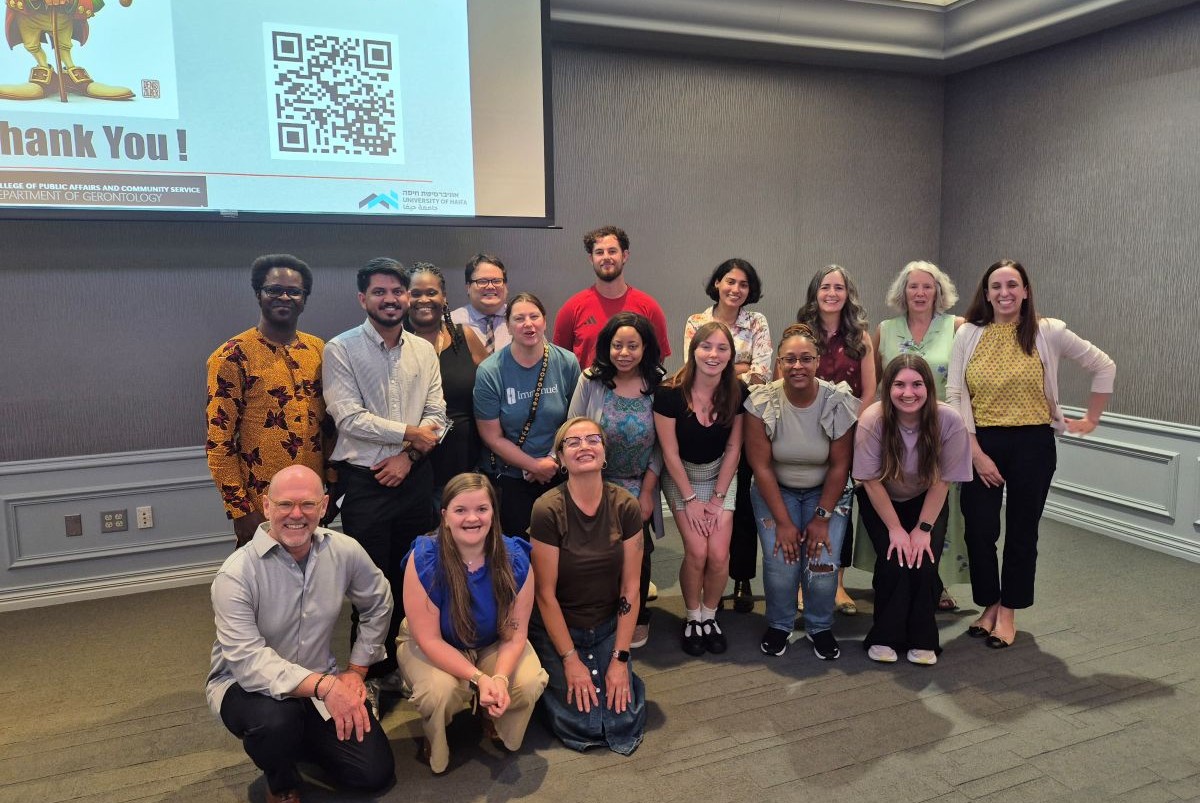
Aging is not a problem to solve. It is a human experience, and older people deserve to have their rights recognized as such.
That was the message at the University of Nebraska at Omaha’s Dr. Chuck Powell Memorial Lecture, hosted by the Department of Gerontology and featuring Professor Israel “Issi” Doron, a leading advocate for the human rights of older persons.
What’s new
Doron’s presentation examined the past, present and future of the global movement to establish an international human rights convention for older persons.
His work in ageivism, or aging activism, focuses on challenging negative perceptions of aging and recognizing the value older people bring through their lived experiences.
Doron also has been a champion of efforts to establish a human rights convention for older persons, working with colleagues in the United States, Europe and Israel. His lecture highlighted a major development in that effort: the United Nations Human Rights Council’s April 2025 decision to establish an intergovernmental working group tasked with developing a draft international legally binding instrument on the human rights of older persons.
💡 Why it matters
For decades, international protections for older persons were “soft-law rich and hard-law poor.”
Hard law consists of legally binding rules that can be enforced by courts or other authorities. Before 2010, protections for older persons under international hard law were fragmented, indirect or nonexistent. Unlike women, children and persons with disabilities, older persons were not recognized as a distinct rights-bearing category within most global human rights treaties, and there was no dedicated international human rights instrument for them.
At the same time, a range of soft-law measures emerged, including international principles, guidelines and policy frameworks focused on aging. While these measures could influence policy and behavior, they were not legally binding.
Doron noted that these measures also largely approached aging through a “social problem” paradigm rather than a human rights framework and ultimately failed to make a meaningful difference in the lives of many older persons.
A binding international convention, Doron said, could help shift that paradigm by recognizing older persons as rights-holders and establishing stronger protections for their human rights.
📈 By the numbers
- 140+ people RSVP’d for the hybrid event.
- 55 students, faculty and community members attended in person.
- Many more individuals from across Nebraska watched the lecture online.
🔎 Zoom in
The movement entered a new phase in April 2025, when the United Nations Human Rights Council adopted Resolution 58/13, establishing an intergovernmental working group to develop a draft international legally binding instrument on the human rights of older persons.
The working group held its first organizational meeting in February 2026, followed by its first substantive meeting July 13–17. The group is now focused on developing the convention’s key principles, structure and potential monitoring and enforcement mechanisms.
The goal is to produce a first full draft of the convention by the end of 2027, marking a significant step toward recognizing the rights of older persons through international human rights law.
🎤 What they’re saying
For Doron, the push for a convention is about more than creating a new legal instrument. It is about changing the way society understands aging and recognizing the value, dignity and rights of older adults.
That perspective also resonated with the legacy of the lecture series’ namesake.
Dr. Betty Foster, widow of the late Chuck Powell, shared a few words about Powell’s impact on the field of gerontology and the difference he made in the lives of others. Her reflections connected the evening’s focus on the value of older adults with Powell’s lasting influence on the field.
Doron emphasized that advancing the rights of older persons will require evidence and science, a strong civil society, an understanding of international politics, and the patience and perseverance to sustain the effort over time.
He also pointed to “The Journey to Ithaca” by Constantine Cavafy, a poem that reflects his belief that the journey itself, the relationships built, the lessons learned, and the progress made along the way, is an essential part of the work.
🌎 The big picture
The conversation reflects a broader effort to ensure that aging is understood not as a problem to be managed, but as a fundamental part of the human experience.
The lecture also reflects UNO’s focus on research and discovery that addresses complex challenges and contributes to the public good. Through the Department of Gerontology, the university brings together scholarship, education and community engagement around issues affecting aging populations locally and globally.
Doron’s discussion underscored the importance of collaboration across countries, disciplines and communities when addressing issues of social justice and human rights. It also connects to UNO’s mission to transform and improve quality of life locally, nationally and globally.
Recognizing the dignity and contributions of older adults is part of building communities where people can continue to learn, contribute and thrive throughout their lives, a goal reflected in UNO’s work to educate all learners, advance pragmatic research and discovery, and engage with communities.
⚡ What’s next
The international movement for a human rights convention for older persons is entering a new stage.
As governments, researchers and civil society organizations work toward a potential convention, Doron’s message is clear: Changing how society understands aging is part of changing how the rights of older persons are recognized and protected.
For gerontology scholars and students, the evolving convention offers an opportunity to help shape that future, one that recognizes aging not as a social problem, but as a fundamental part of the human experience.