University of Nebraska at Omaha logo University of Nebraska at Omaha
REQUEST INFO VISIT APPLY

MY UNO DIRECTORY
University of Nebraska at Omaha logo
College of Public Affairs and Community Service
REQUEST INFO VISIT APPLY
MY UNO DIRECTORY
  • About Us Backback to Main menu
    • About CPACS
    • Dean's Message
    • Directory
    • Awards and Recognition
    • Directions and Parking
    • News
  • Academics Backback to Main menu
    • Degree Programs
    • Minors
    • Certificates
    • Advising
    • Goodrich Scholarship Program
    • CPACS Undergraduate Student Grade Appeal Policy
    • CPACS Academic Amnesty
  • Professional Programs Backback to Main menu
    • Professional Programs
    • Nebraska CPM
    • Nebraska City County Managers
    • Certificate in Fundraising Management
    • Nebraska Municipal Clerk Institute and Academy
    • The Great Plains Government Finance Officers Association
    • Juvenile Justice Institute (JJI)
    • American Jail Association Jail Executive Institute (JEI)
    • Nebraska Victim Assistance Academy (NEVAA)
  • Community Engagement Backback to Main menu
    • Partnerships, Events, and Outreach
    • Meaningful Research
    • Labor Studies Institute
    • Alumni Awards
  • Support Us

College of Public Affairs and Community Service News

Saturday, May 02, 2026
  1. UNO
  2. College of Public Affairs and Community Service
  3. CPACS News
indextrue1777623315120systemNews RoomMavericks are making news. Follow the latest headlines to learn about our dedication to students, our national recognition for community engagement and Division I athletics, and the opportunities to excel in scholarship and research. Students, faculty, staff and alumni are changing the landscape of our community every day.The CPACS News Center is packed full of relevant information and hard-hitting news affecting our community, public affairs, and research. Student Coordinated Community Response Team Hosts Stalking Awareness Event /news/indexCPACSsite://CPACS/news/indexearenner14002525693874417885117773232659661760540400000
News ReleaseNoNoYesYes1777006800000The event brought together middle schoolers, college students, and older adults for a spring-themed celebration of connection and community.//news/2026/04/gero-prom-1.pngnavigationYessite://CPACS/news/2026/04/gero-prom-1.pngCPACSgero-prom-1.png2423511200800Four images showing multigenerational people dancing./news/2026/04/gero-prom-2.pngnavigationYessite://CPACS/news/2026/04/gero-prom-2.pngCPACSgero-prom-2.png93037019201080A flower wind spinner decoration with butterflies and people sitting and standing./news/2026/04/gero-prom-3.pngnavigationYessite://CPACS/news/2026/04/gero-prom-3.pngCPACSgero-prom-3.png104766419201080Two women singing karaoke./news/2026/04/gero-prom-4.pngnavigationYessite://CPACS/news/2026/04/gero-prom-4.pngCPACSgero-prom-4.png102368319201080Wall size paper banner with hand-drawn people, flowers, and trees./news/2026/04/gero-prom-5.pngnavigationYessite://CPACS/news/2026/04/gero-prom-5.pngCPACSgero-prom-5.png96992119201080College students and staff sitting at a table.YouTube

➡️ What’s new: The University of Nebraska at Omaha (UNO) Department of Gerontology and Service Learning Academy brought generations together this spring through a vibrant, student-led Senior Prom, showcasing the power of service learning and community partnership.

Hosted on UNO’s campus at the Thompson Alumni Center, the 2026 Senior Prom was made possible through collaboration with The Salvation Army, Trailblazers Afterschool Academy, and Lewis and Clark Middle School. The free event welcomed older adults connected to partner organizations, along with middle school and UNO students who worked side-by-side to design and deliver the experience.

💡 Why it matters: The event highlights UNO’s commitment to experiential learning and community engagement, giving students hands-on opportunities to build relationships across generations while addressing social connection and well-being for older adults.

📊 By the numbers:

  • Dozens of attendees from across Omaha’s community organizations
  • Three generations represented: middle school, college students, and older adults
  • Multiple interactive activities spanning decades of music and culture

📰 Driving the news: Planning for the Senior Prom began months in advance, with Lewis and Clark Middle School students visiting UNO’s campus to collaborate with gerontology students and Service Learning Academy staff. Together, they brainstormed and voted on a spring-themed concept, selected decorations, and developed engaging activities.

🔍 Zoom in: The result: a lively celebration complete with music, dancing, and shared experiences.

A DJ set the tone with hits from the 1970s, 1980s, and 1990s, while activities like music bingo and karaoke invited guests to engage with songs spanning generations. The dance floor quickly filled as participants showed off their moves during classic group dances and upbeat party songs.

Spring-inspired décor—featuring butterflies, flowers, and a balloon arch photo area—created a festive backdrop. Refreshments and snacks were available throughout the evening.

Middle school students welcomed guests at the door, helping create a welcoming environment from the moment attendees arrived. Throughout the event, students and older adults connected through conversation, laughter, and shared activities.

Prizes were awarded to winners of musical bingo, adding to the celebratory atmosphere.

📚 Expanding learning beyond the classroom: Students enrolled in GERO 4690: Working with Minority Elderly also attended the Senior Prom, applying course concepts in a real-world setting. The class focuses on culturally responsive care and engagement with diverse aging populations—an approach reflected in the event’s inclusive, community-centered design.

🌍 The big picture: The Senior Prom reflects UNO’s strategic focus on community engagement and student success, offering meaningful, real-world learning opportunities while strengthening ties across Omaha.

👏 Acknowledgements: The success of the event was made possible through the leadership and collaboration of faculty, staff, and students. Special thanks to Dr. Lyn Holley, professor in the Department of Gerontology; Lindsay Sanders, manager of the Service Learning Academy; Rosey Higgs, associate director of the Office of Engagement and Service Learning; and Wyatt Smith, graduate assistant in the Service Learning Academy, for their contributions in planning and executing the event.

⚡What's next: UNO continues to expand service learning and community-based experiences, creating more opportunities for students to engage, lead, and make an impact beyond the classroom.

UNO’s Senior Prom wasn’t just a celebration—it was a living example of how intergenerational partnerships can foster connection, learning, and joy for the entire community.

/
///No
/news/2026/04/gero-promdepartmentCollege of Public Affairs and Community Servicephoneemailunocpacs@unomaha.educategoryCollege of Public Affairs and Community Servicelocationevent-startsevent-endssite://CPACS/news/2026/04/gero-promCPACSgero-promUNO Gerontology Students and the Service Learning Academy Host Intergenerational Senior Prom with Omaha Community PartnersUNO Gerontology Students and the Service Learning Academy Host Intergenerational Senior Prom with Omaha Community PartnersThe student-led Senior Prom united middle schoolers, college students, and older adults through service learning, community partnership, and intergenerational connection.Amber EvensonService-learning collaboration brings together middle schoolers, college students, and older adults for a spring-themed celebration of connection and community.Apr 24, 2026 12:00 AM
News ReleaseNoNoYesYes1776142800000UNO’s Morgan Vogel, Ph.D., has been selected as a Harvard-based Strategic Data Project Fellow, advancing research to better understand and address Nebraska’s workforce challenges./news/2026/04/morgan-vogel.pngnavigationYessite://CPACS/news/2026/04/morgan-vogel.pngCPACSmorgan-vogel.png12759411200800Dr. Morgan Vogel in front of four business travelers.///YouTube

Morgan Vogel, Ph.D., assistant director at the University of Nebraska at Omaha’s Center for Public Affairs Research (CPAR), has been selected as a Strategic Data Project (SDP) Fellow, representing UNO through the SDP Nebraska Strategic Data Leadership Network.

Based at the Center for Education Policy Research at Harvard University, the Strategic Data Project’s mission is to transform the use of data in education to improve student achievement. The SDP Fellowship is a capacity-building program that equips data strategists with advanced training in measurement and analysis, leadership, and change management, while supporting the execution of an applied strategic data project within their institution. Through this two-year fellowship, Vogel joins a national network of data leaders working to apply rigorous analysis to real-world education challenges.

As part of the fellowship, Vogel will lead a capstone project on behalf of UNO focused on understanding Nebraska’s “brain drain” challenge in a new way. Vogel’s project will use a mixed-methods approach, combining quantitative data from UNO and the Nebraska Statewide Workforce and Educational Reporting System (NSWERS) with a longitudinal qualitative study of UNO students. This study will follow a cohort of juniors and seniors to better understand their postsecondary experiences, key decision points, and how their intentions to enter the workforce evolve during their final years of college. UNO CPAR is known for its research on brain drain and population trends, making the research center a trusted partner in understanding and addressing this challenge.

“This fellowship provides a unique opportunity to deepen our understanding of how students make decisions about their futures,” said Vogel. “By combining quantitative data with student voices and experiences, we will be better positioned to inform policies that strengthen connections between higher education and workforce opportunities in Nebraska. I am grateful to the Strategic Data Project and UNO for the opportunity to take a deep dive on such important work.”

Vogel’s selection underscores UNO CPAR’s commitment to producing applied, data-driven research on topics that impact the lives of Nebraskans. Josie Gatti Schafer, Ph.D., director of UNO CPAR, will serve as Vogel’s supervisor for the capstone project. Vogel will also work with a faculty advisor from Harvard University to help shape and accelerate the strategic data project.

/
///No
/news/2026/04/vogel-sdp-fellowdepartmentCollege of Public Affairs and Community Servicephoneemailunocpacs@unomaha.educategoryCollege of Public Affairs and Community Servicelocationevent-startsevent-endssite://CPACS/news/2026/04/vogel-sdp-fellowCPACSvogel-sdp-fellow[Article Heading]UNO CPAR Assistant Director Selected as Strategic Data Project FellowMorgan Vogel, Ph.D., has been named a Strategic Data Project Fellow through Harvard University, joining a national network of leaders using data to improve education outcomes.Morgan Vogel, Ph.D.Morgan Vogel, Ph.D., assistant director at UNO’s Center for Public Affairs Research, has been named a Strategic Data Project (SDP) Fellow through Harvard University, joining a national network of leaders using data to improve education outcomes.Apr 14, 2026 12:00 AM
News ReleaseNoNoYesYes1776920400000From pandemic disruption to AI-driven change, UNO convenes experts to examine what’s next for effective, ethical public service.//news/2026/04/spa-30-2.pngnavigationYessite://CPACS/news/2026/04/spa-30-2.pngCPACSspa-30-2.pngGroup of people sitting around decorated tables.Group of people sitting and standing talking.16429851200800Group of people talking./news/2026/04/spa-30-1.pngnavigationYessite://CPACS/news/2026/04/spa-30-1.pngCPACSspa-30-1.pngThree panelists sitting at a table in front of a conference room.12682131200800Panel of three people sitting in front of a conference room table./news/2026/04/spa-30-3.pngnavigationYessite://CPACS/news/2026/04/spa-30-3.pngCPACSspa-30-3.png16069201200800Group of people sitting and standing around decorated tables.YouTube

OMAHA, Neb. — The University of Nebraska at Omaha (UNO) is marking a major milestone: the 30th anniversary of its Ph.D. in Public Administration program—an initiative that has shaped leaders, advanced research, and strengthened public service since its founding in 1995.

For three decades, UNO’s doctoral program has prepared scholars and practitioners to not only understand public systems, but improve them—advancing evidence-based policy, strengthening democratic governance, and serving communities with integrity.

The anniversary celebration brought together faculty, students, alumni, and community partners under a timely theme:
“The Future of Public Administration in Turbulent Times—Understanding and Enhancing Public Service Amid COVID-19, Political Uncertainty, and AI Technologies.”

The event highlighted the people behind the program’s impact, including two faculty members from the program’s first graduating class—Dr. Rebecca Lutte, a tenured professor in UNO’s Aviation Institute, and Dr. Lyn M. Holley, Dr. Chuck Powell Professor in Gerontology—alongside alumni who traveled from as far as South Korea to attend. Attendees also recognized Dr. Chris Reed for sharing the program’s rich history and Dr. John Bartle for his foundational role in establishing the doctoral program, particularly in elevating its national and international reputation in budgeting and finance.

Additional participants included:
• Faculty driving forward-thinking research
• Students fueling innovation through curiosity and commitment
• Alumni leading across government, nonprofits, and academia
• Staff and partners ensuring meaningful, real-world impact

While the milestone honors past achievements, the focus is firmly on the future.

In recent years, public administration has faced unprecedented disruption:

  • The COVID-19 pandemic reshaped service delivery and government operations
  • Political polarization tested public trust and institutional stability
  • The rise of artificial intelligence (AI) is transforming decision-making, communication, and governance

These are not gradual changes. They are structural shifts redefining the field.

At its core, public administration serves as a bridge—connecting theory to practice, data to decision-making, and innovation to ethics. UNO’s doctoral program equips leaders to navigate that complexity with clarity and purpose.

Key questions driving the conversation:

  • How can public leaders navigate uncertainty while upholding democratic values?
  • How can AI and emerging technologies enhance—rather than undermine—equity and accountability?
  • How can institutions sustain public trust in a rapidly evolving information landscape?

Panel discussions during the celebration explored critical areas shaping the future of the field:

  • Technology in Public Administration: AI, digital governance, and data-driven service delivery
  • Turbulence in Practice: Crisis management, budget instability, and post-COVID governance
  • Applied Innovation: Using emerging tools and research methods to inform policy decisions
  • Future of Education: Preparing the next generation of public servants with a focus on technology, equity, and resilience
UNO’s Ph.D. in Public Administration program has spent 30 years evolving alongside a changing world. As new challenges emerge, its mission remains clear: to develop leaders and generate knowledge that strengthens public institutions and improves lives locally and globally.
/
///No
/news/2026/04/spa-phd-30-anniversarydepartmentCollege of Public Affairs and Community Servicephoneemailunocpacs@unomaha.educategoryCollege of Public Affairs and Community Servicelocationevent-startsevent-endssite://CPACS/news/2026/04/spa-phd-30-anniversaryCPACSspa-phd-30-anniversary[Article Heading]UNO Celebrates 30 Years of Ph.D. in Public Administration, Explores Future of Public Service in Turbulent TimesThe School of Public Administration celebrated this anniversary with a day of discussions.Amber EvensonThe University of Nebraska at Omaha (UNO) celebrates 30 years of its Ph.D. in Public Administration program by highlighting its impact on public service leadership and exploring how the field must evolve to address challenges like COVID-19, political polarization, and artificial intelligence.Apr 23, 2026 12:00 AM
News ReleaseNoNoYesYes1775019600000/news/2026/04/dr-carter-cyber-study.pngnavigationYessite://CPACS/news/2026/04/dr-carter-cyber-study.pngCPACSdr-carter-cyber-study.png14221691200800Dr. Carter and Dr. McNealy in front of a computer showing security icons.///YouTube

OMAHA, Neb. — New research from the University of Nebraska at Omaha (UNO) reveals a critical gap in how people approach online safety: most users fail to recognize visual warning signs of risky websites and are more motivated by convenience than cybersecurity—at least until their personal information is actually at risk of being stolen.

The study, led by UNO criminologist Travis Carter, Ph.D., in collaboration with Michigan State University researcher Rachel McNealey, Ph.D., was recently published in the Journal of Experimental Criminology. The findings offer new insight into why individuals remain one of the most vulnerable points in cybersecurity systems.

The Big Picture

Despite ongoing education and awareness efforts, users are not reliably identifying online threats—and often opt for ease of use over taking protective actions.

Inside the Research

The team conducted a conjoint survey experiment with a nationally representative sample of 1,006 U.S. adults. Participants were shown simulated utility websites with varying manipulated features such as shortened URLs, advertisements, font styles, privacy notices, and security indicators.

They were then asked to evaluate risk and decide whether or not to follow cybersecurity recommendations, such as enabling two-factor authentication.

Key Findings

  • Visual cues fall short: Common website elements like ads, font styles, privacy notices, and security icons had little effect on users’ perception of risk.
  • Convenience is king: The perceived time and effort required to follow a security recommendation had a greater impact on decision-making than the severity of the potential threat.
  • Context matters: When it is the individual’s personal information is at risk, they are more likely to choose security measures they believe are effective—even if they are less convenient—suggesting the usual “convenience trade-off” largely disappears in cybersecurity compliance.

Why it Matters

The study highlights a “convenience tax” in cybersecurity—when protective measures feel burdensome, users are less likely to adopt them. This behavioral pattern helps explain why, despite advances in technology and training, individuals continue to be a primary vulnerability in digital security systems.

“Our findings suggest that people are not always aware of what puts them at risk online,” Carter said. “If security measures are perceived as inconvenient, users may avoid them—even when the stakes are high.”

What’s Next

The research has practical implications for organizations, policymakers, and cybersecurity professionals. Designing systems that minimize user effort—and clearly communicate the effectiveness of security measures—may improve adoption and reduce risk.

Read the Study

The full, open-access article is available via DOI: https://doi.org/10.1007/s11292-025-09717-1

“Our findings suggest that people are not always aware of what puts them at risk online. If security measures are perceived as inconvenient, users may avoid them—even when the stakes are high.”UNO Criminologist Travis Carter, Ph.D. Left/
///No
/news/2026/04/cybersecurity-convenience-taxdepartmentCollege of Public Affairs and Community Servicephoneemailunocpacs@unomaha.educategoryCollege of Public Affairs and Community Servicelocationevent-startsevent-endssite://CPACS/news/2026/04/cybersecurity-convenience-taxCPACScybersecurity-convenience-taxUNO and Michigan State Researchers Find Cybersecurity Carries a Convenience Tax, Until Your Data Is Actually at StakeUNO and Michigan State Researchers Find Cybersecurity Carries a Convenience Tax, Until Your Data Is Actually at StakeNew research reveals a critical gap in how people approach online safety.Amber EvensonNew research from the University of Nebraska at Omaha (UNO) reveals a critical gap in how people approach online safety.Apr 1, 2026 12:00 AM
Impact Stories
News ReleaseNoNoYesYes1774501200000Advancing access for military-connected learners, UNO’s Offutt AFB testing center will be honored as a top CLEP site at the 2026 national awards in San Antonio./news/offutt-test-center.pngnavigationYessite://CPACS/news/offutt-test-center.pngCPACSoffutt-test-center.png16292831200800Military students taking a test in the test center with a stationary historic airplane in the background.///YouTube

A Longstanding Commitment at Offutt AFB

The University of Nebraska at Omaha has been present on Offutt Air Force Base since 1950. In partnership with the Offutt AFB Education Office, UNO offers a wide array of services to increase educational opportunities for active-duty military, veterans, reserve and guard members, retirees, and dependents.

Among these opportunities, the UNO Offutt AFB CLEP test center stands out as a key resource for students seeking flexible, accelerated pathways to degree completion. By providing access to credit-by-examination in a supportive, high-quality testing environment, the center plays a vital role in helping military-connected learners translate prior knowledge into academic credit—an impact reflected in its recognition as one of the top CLEP test centers in the nation.

Expanding Access to College Credit

Earning credit for prior learning is a critical pathway for military-connected students, allowing them to turn real-world experience, training, and previous coursework into measurable progress toward a degree. By recognizing what students already know, institutions can reduce both the time and cost required to graduate.

One of the most effective ways to earn credit for prior learning is through the College-Level Examination Program® (CLEP)—the most widely trusted credit-by-examination program, accepted at more than 3,000 colleges and universities. CLEP offers eligible service members the opportunity to earn college credit by taking introductory-level exams offered by College Board. These exams assess knowledge gained through prior coursework, professional experience, and military training, and are comparable to final undergraduate course exams. With 34 subjects available and practice resources to support success, students who pass CLEP exams can earn credit that applies directly to their degree requirements.

At the University of Nebraska at Omaha (UNO) Offutt Air Force Base (AFB) location, CLEP exams are offered as part of a broader commitment to maximizing credit for prior learning. UNO also provides free transcript evaluations and accepts transfer credit from most regionally accredited, nationally accredited, and international institutions.

This flexible approach is especially valuable for students pursuing the Bachelor of Multidisciplinary Studies (BMS), allowing them to apply a wide range of prior coursework and experience. In many cases, students can apply up to 30 credit hours of exam credit toward the BMS degree—accelerating their path to graduation while reducing overall cost.

Award Winning Center

University of Nebraska at Omaha – Offutt AFB CLEP test center has received the 2026 CLEP® Honors Military Achievement Award, recognizing it as one of the top CLEP test centers nationwide based on exams administered from January 1 through December 31, 2025. The testing center will be recognized at the CLEP Honors Awards Reception in San Antonio, Texas, on June 10, 2026.

The CLEP Honors Military Achievement Award is an annual College Board program recognizing test centers that administer high volumes of CLEP exams and expand access to college credit opportunities. Through this work, institutions help students save time and money as they work toward their degrees.

“We work diligently with the Offutt AFB community and the base education center to provide a welcoming CLEP testing center,” said Nate Jackson, site coordinator and test administrator for UNO at Offutt Air Force Base. “We administer many tests each month to help airmen, their families, and other military-connected students obtain credit by examination. These completed tests are applied to degrees at UNO and the Community College of the Air Force (CCAF). I would also like to recognize our test proctor, Cindy Saylor, who creates a welcoming environment and supports each tester’s success. We look forward to continuing this legacy of excellence.”

Driving Affordability and Degree Completion

By offering CLEP testing and robust credit-for-prior-learning pathways on base, UNO helps military-connected students turn experience into academic progress—reducing both time to degree and overall cost. This national recognition reflects UNO’s continued investment in accessible, flexible education that supports student success and workforce readiness.

Visit http://www.unomaha.edu/offutt-testing for information on CLEP testing on Offutt AFB.

/
///No
/news/2026/03/clep-honors-awarddepartmentCollege of Public Affairs and Community Servicephoneemailunocpacs@unomaha.educategoryCollege of Public Affairs and Community Servicelocationevent-startsevent-endssite://CPACS/news/2026/03/clep-honors-awardCPACSclep-honors-award[Article Heading]UNO Offutt AFB Testing Center Earns 2026 CLEP Honors Military Achievement AwardThe award is based on exams administered in 2025, and honors centers that expand access to college credit while helping students save time and money. The center will be recognized at a reception in June.Amber EvensonThe University of Nebraska at Omaha (UNO) Offutt Air Force Base (AFB) CLEP testing center has received the 2026 CLEP® Honors Military Achievement Award, recognizing it as one of the top CLEP test centers in the nation.Mar 26, 2026 12:00 AM
News ReleaseNoNoYesYes1773982800000//news/clerks-50years.jpgnavigationYessite://CPACS/news/clerks-50years.jpgCPACSclerks-50years.jpg4868241200800Group of clerks wearing blue 50 years t-shirts./news/2026/03/clerks-1.jpgnavigationYessite://CPACS/news/2026/03/clerks-1.jpgCPACSclerks-1.jpg2881821200800Group of clerks sitting in a classroom./news/2026/03/clerks-2.jpgnavigationYessite://CPACS/news/2026/03/clerks-2.jpgCPACSclerks-2.jpg3683341200800Group of clerks posed, dressed as characters from Three's Company./news/2026/03/clerks-3.jpgnavigationYessite://CPACS/news/2026/03/clerks-3.jpgCPACSclerks-3.jpg3193961200800Clerks sitting at tables in a classroom setting.YouTube

OMAHA, Neb. — The University of Nebraska at Omaha (UNO) welcomed municipal clerks from across Nebraska for the 2026 Nebraska Municipal Clerks Institute and Academy, held March 15–20 in La Vista, marking the program’s 50th year. With over 220 participants and over 26 vendors and sponsors in attendance, this year’s event reflected the program’s strong reach and continued importance to communities across the state, while also ranking as the second largest Municipal Clerks Institute and Academy in the country.

Why it matters:
Municipal clerks play a critical role in local government, ensuring transparency, compliance, and effective public service. For five decades, this program has strengthened communities across Nebraska by equipping clerks with the skills, certifications, and professional networks needed to serve with excellence.

A 50-year legacy of impact

Established in 1976 through a partnership between UNO’s then-Department of Public Administration, the League of Nebraska Municipalities, and the Nebraska Municipal Clerks’ Association (NMCA), the Institute has long served as a cornerstone of professional education for municipal clerks.

Today, the program is operated by UNO’s CPACS Continuing Professional Education Programs, continuing its legacy while expanding access to high-quality training and development opportunities.

The Institute is accredited by the International Institute of Municipal Clerks (IIMC) and supports participants pursuing the Certified Municipal Clerk (CMC) or Master Municipal Clerk (MMC) designation.

Kellie Crowell, Region 8 Director and Clerk for the City of Ravenna, said the association and its partnership with UNO have played a vital role in advancing the profession.

“Over the past 50 years, the Nebraska Municipal Clerks Association has served as a vital resource for municipal clerks by encouraging a strong network of support, advancing standards of performance, and enhancing the knowledge, efficiency, and effectiveness of clerks serving Nebraska cities and villages,” Crowell said.

“Continuing education is the foundation of excellence in the municipal clerk profession. In a role that connects citizens to government, a municipal clerk’s commitment to lifelong learning ensures stronger communities. Nebraska clerks are fortunate to have the strong support of NMCA and UNO to help us advance our knowledge in all aspects of our roles.”

Crowell, who has been involved with NMCA for more than 25 years, added that the organization’s impact continues to shape communities across the state.

Training that grows with professionals

The program includes both the Institute, designed for clerks building foundational knowledge, and the Academy, which provides advanced training for experienced professionals who have already earned their CMC designation.

Institute highlights include:

  • Educational sessions focused on core municipal operations
  • Networking events, including an evening social
  • Vendor exhibits and interactive activities
  • The NMCA business meeting and annual awards banquet

The Academy focuses on:

  • Advanced professional development and leadership growth
  • New perspectives on governance and public administration
  • Continuing education credits toward recertification or the Master Municipal Clerk (MMC) designation

Supporting access through scholarships

Scholarship opportunities—made possible through sponsor support—help ensure access to the program for clerks across Nebraska. Awards prioritize participants earlier in their professional journey, reinforcing UNO’s commitment to workforce development and public service excellence.

Strengthening communities across Nebraska

Beyond professional development, the Institute and Academy foster a strong network of municipal leaders dedicated to improving local government.

Events such as a Celebration of Clerks flag ceremony, networking receptions, and the annual awards banquet highlight the contributions of clerks and build lasting connections across communities.

The bottom line:
For 50 years, UNO has played a leading role in advancing municipal leadership through the Nebraska Municipal Clerks Institute and Academy—empowering public servants with the skills, credentials, and connections needed to strengthen communities across the state.


Explore More Professional Development Opportunities at UNO

Beyond the Institute and Academy, UNO’s CPACS Continuing Professional Education Programs offers a range of professional development opportunities designed to strengthen public service and leadership across Nebraska. Programs include the Nebraska Certified Public Manager (CPM) program, Nebraska City/County Management Association trainings, the Certificate in Fundraising Management, and partnerships with the Great Plains Government Finance Officers Association—all aimed at equipping professionals with the skills and connections needed to lead and serve their communities effectively.

/
///No
/news/2026/03/nebraska-clerks-2026departmentCollege of Public Affairs and Community ServicephoneemailcategoryCollege of Public Affairs and Community Servicelocationevent-startsevent-endssite://CPACS/news/2026/03/nebraska-clerks-2026CPACSnebraska-clerks-2026[Article Heading]UNO Celebrates 50 Years of the Nebraska Municipal Clerks Institute and AcademyCPACS Continuing Professional Education Programs leads milestone annual training advancing leadership, professional growth, and community impact for municipal clerks across Nebraska.Amber EvensonUNO welcomed municipal clerks from across Nebraska for the 2026 Nebraska Municipal Clerks Institute and Academy, held March 15–20 in La Vista, marking the program’s 50th year.Mar 20, 2026 12:00 AM
News ReleaseNoNoYesYes1772604000000A UNO study finds that adapted dance classes, like the Across the Floor program, help adults with intellectual and developmental disabilities build social skills, confidence, and meaningful connections through movement and creativity.//news/dancing-5-1.pngnavigationYessite://CPACS/news/dancing-5-1.pngCPACSdancing-5-1.png20006841200800Group of adults dancing on a dance floor with a headshot of Dr. Heidi Rueda featured in front of it./news/dancing-1.jpgnavigationYessite://CPACS/news/dancing-1.jpgCPACSdancing-1.jpg7009841200800Adult working on a craft project with an instructor./news/dancing-3.jpgnavigationYessite://CPACS/news/dancing-3.jpgCPACSdancing-3.jpg2949121200800Crayon drawing of two people./news/dancing-2.jpgnavigationYessite://CPACS/news/dancing-2.jpgCPACSdancing-2.jpg6916141200800Woman dancing on dance floor./news/dancing-4.jpgnavigationYessite://CPACS/news/dancing-4.jpgCPACSdancing-4.jpg4425251200800Crayon drawing of four people dancing.YouTube

At the A.V. Sorenson Community Center, music fills the room and a group of dancers moves with confidence, laughter, and purpose. For many adults with disabilities, this isn’t just a weekly activity—it’s a space to make friends, practice communication, and discover new confidence.

A new study led by Heidi Rueda, Ph.D., John E. Christensen Community Chair in Child Welfare at the University of Nebraska at Omaha’s (UNO) Grace Abbott School of Social Work, shows that dance can be a powerful and joyful way for adults with intellectual and developmental disabilities (IDD) to strengthen social and relationship skills.

The study was conducted with support from the Weitz Family Foundation of Omaha through an endowed gift to the University of Nebraska Foundation. Dr. Rueda worked closely with WhyArts Inc., which adapted its dance classroom to meet the needs of participants with disabilities and provided the program to adults in the community by partnering with Ollie Webb Center, Inc.

Proudly housed at UNO’s Barbara Weitz Community Engagement Center, WhyArts Inc. strengthens its partnership with the university while connecting professional teaching artists with local organizations to make inclusive arts education accessible. In line with its commitment to equity and access, WhyArts never charges participants a fee. Together with Ollie Webb Center, Inc.—which provides programs and advocacy for children, adolescents, and adults with IDD and their families—the collaboration laid the foundation for a study rooted in community, inclusion, and opportunity, and placed people with disabilities at the center of the research.

Rueda was joined by graduate student Chandler Misselt, a first-year Master of Social Work student, who helped observe classes and hear directly from participants through interviews and focus groups. Their goal: to explore how an adapted dance curriculum could spark empathy, encourage cooperation, and strengthen relationship skills, showing how research, partnership, and the arts can make a real difference.

The program, called Across the Floor, ran for 10 weeks at the A.V. Sorenson Community Center and the Hot Shops Art Center. Each class became a hub for creativity and connection, with participants sharing their thoughts and feelings not just through conversation, but also through writing, drawing, emotion charts, and dance itself.

Thirteen adults with disabilities between the ages of 25 and 42 were participants in the study. Dr. Rueda and Misselt also spoke with nine parents or caregivers and five staff members, including the dance instructor, to capture a full picture of the program’s impact.

For many dancers, the class quickly became the highlight of their week. One participant described it as “a good stress reliever,” while another said it helped create “connection, compassion, and tolerance with other people.”

One of the most meaningful lessons focused on courtesy and respect, including learning how to ask someone to dance. During interviews, a couple participants demonstrated this skill with pride. One shared, “I learned to ask someone if you can have this dance,” explaining that the experience helped them grow not only as a dancer, but as a person.

Participants also spoke about feeling energized and proud after each class. One dancer described feeling “awesome” and “more alert,” saying the sessions felt like a workout while also introducing her to different dance styles. Each participant was given time to shine in the center of the circle, a moment many looked forward to. As one participant put it, “I really adored everything…like, when I was standing right in the middle of the circle. That was one of my favorite things.”

Caregivers and staff noticed powerful changes as well. Early on, some dancers were hesitant to work with certain peers. Over time, those barriers disappeared. Participants became more open, cooperative, and comfortable with one another. By the final performances, the room was filled with smiles, applause, and a shared sense of accomplishment.

Dr. Rueda said the excitement was unmistakable during the final sessions, as participants took pride in how much they had learned and how far they had come.

The study concluded in December 2025 after 10 weeks of classes, and the results suggest that programs like Across the Floor can do much more than teach dance steps. They can support emotional well-being, spark friendships, and help adults with disabilities build meaningful social connections.

“I really adored everything…like, when I was standing right in the middle of the circle. That was one of my favorite things.”Study Participant/
///No
/news/2026/03/dancing-into-connectionsdepartmentCollege of Public Affairs and Community ServicephoneemailcategoryCollege of Public Affairs and Community Servicelocationevent-startsevent-endssite://CPACS/news/2026/03/dancing-into-connectionsCPACSdancing-into-connectionsDancing Into New Connections: Dance Program Brings Confidence and Community to Adults with DisabilitiesDancing Into New Connections: Dance Program Brings Confidence and Community to Adults with DisabilitiesA UNO study finds that adapted dance classes, like the Across the Floor program, help adults with intellectual and developmental disabilities build social skills, confidence, and meaningful connections through movement and creativity.Giselle MirandaA new study led by Dr. Heidi Rueda, shows that dance can be a powerful and joyful way for adults with intellectual and developmental disabilities (IDD) to strengthen social and relationship skills.Mar 4, 2026 4:00 PM
News ReleaseNoNoYesYes1770652800000/news/policing-ai.pngnavigationYessite://CPACS/news/policing-ai.pngCPACSpolicing-ai.png15057941200800Lieutenant Matthew Barter from the Manchester, New Hampshire, Police Department presents on Policing & AI.Lieutenant Matthew Barter from the Manchester, New Hampshire, Police Department presenting to classroom of police officers.///YouTube

Artificial intelligence is rapidly transforming nearly every profession, and law enforcement is no exception.

The University of Nebraska at Omaha’s (UNO) College of Public Affairs and Community Service (CPACS) recently hosted a two-day intensive course on Policing and Artificial Intelligence, bringing together local law enforcement professionals to explore how emerging AI technologies are reshaping modern policing — and how to use them responsibly.

The course was led by Lieutenant Matthew Barter of the Manchester, New Hampshire, Police Department, who guided participants through the fundamentals of AI, its current and future applications in policing, and the ethical and legal considerations that must inform its use.

“AI is exploding everywhere,” Barter said. “It’s being discussed in all fields, and everything comes back to AI.”

Understanding AI’s Role in Policing

The course introduced participants to what AI is — and what it isn’t — emphasizing practical, real-world uses rather than theoretical concepts. Topics included:

  • Fundamentals of artificial intelligence in law enforcement
  • Types of AI currently used in policing
  • Research applications and data analysis
  • Ethical considerations and legal frameworks shaping AI policy
  • Appropriate and inappropriate uses of AI tools

A key focus was risk management, particularly with high-stakes technologies such as facial recognition software.

Participants discussed potential consequences of false identifications and the importance of human review and oversight when AI tools are used in policing decisions.

“Use of AI needs to be thought through,” Barter emphasized. “It can’t replace human judgment.”

What Research Reveals

The course also explored current research on AI’s effectiveness in policing. Barter and his team’s research showed a notable finding: AI is not necessarily speeding up police report writing, despite common assumptions.

Where AI shows greater promise, Barter said, is in data analysis and review — particularly with body-worn camera footage.

“Less than 5% of bodycam footage is ever viewed,” Barter said. “AI can help review that footage to identify areas of growth potential as well as highlight positive police actions, increasing transparency and accountability. Recent research shows promise in this application of AI."

Hands-On Learning and Future Applications

Participants engaged in hands-on exercises using free, open-source AI tools tailored to law enforcement scenarios. Officers learned how to:

  • Write effective prompts for AI tools
  • Explore custom, reusable AI applications
  • Understand “vibe-coding,” or using AI tools to help build simple software solutions
  • Evaluate how AI could support future policing tasks

Throughout the course, Barter emphasized that AI adoption should never be one-size-fits-all.

“Use of these tools is going to be different for each community,” he said. “You need to do assessments and create policies that fit your local area.”

Preparing Public Servants for Emerging Technology

By convening law enforcement professionals for applied learning and critical discussion, CPACS continues to support UNO’s mission to prepare public servants for complex, evolving challenges — balancing innovation with ethics, accountability, and community trust.

As AI continues to expand across industries, courses like this help ensure that public safety professionals are equipped not only with new tools, but with the knowledge and judgment needed to use them responsibly.

“AI is exploding everywhere. It’s being discussed in all fields, and everything comes back to AI.”Lieutenant Matthew BarterLeft/
///No
/news/policing-aidepartmentCollege of Public Affairs and Community ServicephoneemailcategoryCollege of Public Affairs and Community Servicelocationevent-startsevent-endssite://CPACS/news/policing-aiCPACSpolicing-ai[Article Heading]How AI Is Shaping the Future of Policing: CPACS Hosts Two-Day Intensive CourseThe course focused on policing and artificial intelligence, bringing together local law enforcement professionals to explore how emerging AI technologies are reshaping modern policing.Amber EvensonThe University of Nebraska at Omaha’s College of Public Affairs and Community Service (CPACS) recently hosted a two-day intensive course on Policing and Artificial Intelligence, bringing together local law enforcement professionals to explore how emerging AI technologies are reshaping modern policing — and how to use them responsibly.Feb 9, 2026 10:00 AM
News ReleaseNoNoYesYes1771005600000//images/amanda-randall.pngnavigationYessite://CPACS/images/amanda-randall.pngCPACSamanda-randall.png11013821200800Dr. Amanda RandallHubert Locke Distinguished Service Award Recipient Dr. Amanda Randall pictured with Dean Gaylene Armstrong and Dr. Susan Reay/images/william-wakefield.pngnavigationYessite://CPACS/images/william-wakefield.pngCPACSwilliam-wakefield.png10560521200800Dr. William WakefieldHubert Locke Distinguished Service Award Recipient Dr. William (Bill) Wakefield pictured with Dean Gaylene Armstrong and Dr. B.J. Reed/images/sonia-carbonell.pngnavigationYessite://CPACS/images/sonia-carbonell.pngCPACSsonia-carbonell.png11991241200800Sonia CarbonellJerry and Patricia Deichert Staff Award Recipient Sonia Carbonell pictured with Dean Gaylene Armstrong and Jerry Deichert/images/tara-grell.pngnavigationYessite://CPACS/images/tara-grell.pngCPACStara-grell.png13908501200800Tara GrellJerry and Patricia Deichert Staff Award Recipient Tara Grell pictured with Dean Gaylene Armstrong and Jerry DeichertYouTube

The University of Nebraska at Omaha’s College of Public Affairs and Community Service (CPACS) recognized four exceptional members of its community at the annual Celebrating CPACS awards ceremony, honoring leadership, service, and impact across the college.

This year’s award recipients include:

  • Dr. William (Bill) Wakefield – Hubert Locke Distinguished Service Award
  • Dr. Amanda Randall – Hubert Locke Distinguished Service Award
  • Sonia Carbonell – Jerry and Patricia Deichert CPACS Staff Award
  • Tara Grell – Jerry and Patricia Deichert CPACS Staff Award

The celebration also highlighted departmental achievements from the past year and previewed initiatives that continue to strengthen CPACS’ role in advancing public service, research, and community engagement.


Honoring a Legacy of Public Service

Hubert Locke Distinguished Service Award

Established in 2002, the Hubert Locke Distinguished Service Award recognizes individuals who demonstrate exemplary commitment to public service through their professional work, community involvement, and philanthropy.

The award is named for Dr. Hubert Locke, CPACS’ first permanent dean (1972–1976), whose distinguished career set the standard for civic leadership and community impact.

Dr. William (Bill) Wakefield

Dr. Wakefield served as a professor at UNO from 1974 to 2023, dedicating nearly five decades to teaching, research, and community service.

During his tenure, he taught undergraduate and graduate students while serving as Director of Outreach for the School of Criminology and Criminal Justice, strengthening partnerships between the university and the broader community.

Prior to joining UNO, Wakefield held faculty positions in sociology and social work at Dana College in Blair, Nebraska, and South Dakota State University in Brookings, South Dakota.

His longstanding commitment to applied research and public engagement reflects the core values of CPACS — preparing students to lead and serve in their communities.

Dr. Amanda Randall

Dr. Amanda Randall is a nationally respected social work leader, educator, and clinician with more than 30 years of experience in mental health services, higher education, consultation, and organizational leadership.

She served more than two decades at the University of Nebraska at Omaha’s Grace Abbott School of Social Work (GASSW), including seven years as director from 2013 to 2020. During her tenure, she expanded community partnerships, strengthened interdisciplinary collaboration, and launched the school’s online Master of Social Work (MSW) program — increasing access to graduate education and advancing workforce development across Nebraska and beyond.

Her career reflects a deep commitment to ethical practice, inclusive systems, and preparing future social work professionals, exemplifying the ideals of the Hubert Locke Distinguished Service Award and CPACS’ mission of community impact.


Recognizing Excellence in Staff Leadership

Jerry and Patricia Deichert CPACS Staff Award

The Jerry and Patricia Deichert CPACS Staff Award honors outstanding CPACS staff members annually for exceptional performance in customer service, problem solving, leadership and mentoring, extra duties, and self-improvement.

Sonia Carbonell

Sonia Carbonell serves as the Student Services Associate for the Grace Abbott School of Social Work, providing essential behind-the-scenes support to students, faculty, and staff.

She takes great pride in contributing to the school’s success and finds deep satisfaction in supporting its academic community through her customer service, project management, and creative skills.

Her dedication ensures students receive timely support and faculty operations run smoothly — a critical foundation for academic excellence.

Tara Grell

Tara Grell has served with the Center for Public Affairs Research (CPAR) since August 2017. As CPAR’s public communications and creative coordinator, she designs infographics, reports, and visual materials that clearly communicate research findings to broad audiences.

She manages the CPAR website and LinkedIn accounts and plans and coordinates the CPAR Data and Research Series for Community Impact. In addition, she supports other CPACS units with graphic design, website updates, and email marketing initiatives.

Her work strengthens the visibility and accessibility of CPACS research, ensuring data-driven insights reach community partners and decision-makers.


A Year of Impact Across CPACS

In addition to recognizing award recipients, CPACS departments and units shared highlights and milestones from the past year. From community-based research and student success initiatives to public service partnerships, the college continues to prepare the next generation of leaders in public affairs, criminal justice, and social work.

The annual celebration reinforces CPACS’ commitment to service, leadership, and community impact — central pillars of the University of Nebraska at Omaha’s strategic framework.

Congratulations to all award winners for their outstanding contributions to UNO and the communities it serves.

/
///No
/news/celebrating-cpacsdepartmentCollege of Public Affairs and Community ServicephoneemailcategoryCollege of Public Affairs and Community Servicelocationevent-startsevent-endssite://CPACS/news/celebrating-cpacsCPACScelebrating-cpacs[Article Heading]Celebrating CPACS Highlights Distinguished Service and Staff Excellence at UNOHubert Locke Distinguished Service and Jerry and Patricia Deichert Staff Award recipients recognized for leadership, service, and impactAmber EvensonHubert Locke Distinguished Service and Jerry and Patricia Deichert Staff Award recipients recognized for leadership, service, and impactFeb 13, 2026 12:00 AM
News ReleaseNoNoYesYes1765486800000Municipal fiscal health is critical for local governments as they plan, prioritize services, and maintain long-term stability./news/craig-maher1.pngnavigationYessite://CPACS/news/craig-maher1.pngCPACScraig-maher1.png12089191200800Dr. Craig Maher///YouTube

Dr. Craig S. Maher, Fellow, National Academy of Public Administration ,and his co-authors Sungho Park, Bruce McDonald III, and Steven Deller, have received the Best Book Award from the Association for Budgeting and Financial Management (ABFM) for his book Understanding Municipal Fiscal Health: A Model for Local Governments in the USA.

The book is the culmination of more than 15 years of Maher’s research and teaching on municipal fiscal health in UNO’s Master of Public Administration program.

Understanding Municipal Fiscal Health

Municipal fiscal health is critical for local governments as they plan, prioritize services, and maintain long-term stability. However, officials often lack accessible, research-backed tools to fully understand the pressures that influence their fiscal condition. Dr. Maher’s book addresses this gap by offering a framework that is both academically rigorous and practical, reflecting UNO’s mission to produce research that strengthens communities and supports evidence-based public service leadership.

Key Contributions

ABFM praised the book for its clarity in distinguishing commonly confused financial concepts—such as fiscal health, fiscal stress, fiscal trends, and fiscal condition—and its relevance for policy development. Its analysis of how municipalities and states respond to fiscal stress is particularly insightful for current government officials. The book examines fiscal conditions as the result of both external pressures and local fiscal decisions, providing a holistic understanding of the drivers of financial stability.

The book is particularly timely for local officials who are navigating financial challenges resulting from national and state policies, as well as broader economic uncertainty. Through its case studies, it provides practical examples of how local leaders can effectively manage operations during periods of fiscal turmoil.

Dr. Maher’s Insights on the Book

“It is one of the few books that considers fiscal condition as a function of both the environment in which the local governments operate and local fiscal decisions. The case studies focusing on medium-small cities effectively illustrate the different ways in which environmental factors can affect municipal fiscal conditions.”

Dr. Maher’s book offers valuable insights into local officials navigating fiscal challenges, and its recognition by the Association for Budgeting and Financial Management underscores its impact. Congratulations to him and his co-authors on this achievement.
/
///No
/news/2025/12/maher-best-book-awarddepartmentCollege of Public Affairs and Community ServicephoneemailcategoryCollege of Public Affairs and Community Servicelocationevent-startsevent-endssite://CPACS/news/2025/12/maher-best-book-awardCPACSmaher-best-book-award[Article Heading]Dr. Craig S. Maher Wins Best Book Award for Research on Municipal Fiscal HealthMaher and his co-authors Sungho Park, Bruce McDonald III, and Steven Deller, received the award for Maher's book "Understanding Municipal Fiscal Health: A Model for Local Governments in the USA."Giselle MirandaDr. Craig S. Maher and his co-authors Sungho Park, Bruce McDonald III, and Steven Deller, have received the Best Book Award from the Association for Budgeting and Financial Management (ABFM) for his book "Understanding Municipal Fiscal Health: A Model for Local Governments in the USA."Dec 11, 2025 3:00 PM
News ReleaseNoNoYesYes1762448400000/images/aviation-safecon-flight-team.jpgnavigationYessite://CPACS/images/aviation-safecon-flight-team.jpgCPACSaviation-safecon-flight-team.jpg1141141200800UNO students flight team standing in front of an airplane.///YouTube

Omaha, NE — October 20, 2025 — The University of Nebraska at Omaha (UNO) Flight Team, known as the Flying Mavericks, again demonstrated elite performance by capturing 2nd place overall at the 2025 Region VI SAFECON and securing their 17th consecutive bid to the national championship of the National Intercollegiate Flying Association (NIFA).

Held October 13–18 at St. Louis University – Parks College, the Region VI competition brought together premier collegiate aviation teams from across the Midwest, including University of North Dakota,  Kansas State University – Salina, Minnesota State University–Mankato, University of Central Missouri and University of Dubuque.

UNO’s Flying Mavericks excelled across both the flight and ground events:

  • 2nd Overall in the Region VI SAFECON – 545 points
  • 2nd in Ground Events – 233 points
  • 2nd in Flight Events – 312 points
  • Winner of the Competition Safety Award

The 2025 team roster comprised 14 dedicated students who earned travel spots and competed with focus and professionalism. Team Captains Tyler Thieman and Trevor Denker led the squad, which included: Cullen Leitner, William Skradski, Chloe Schrick, Thomas Reid, Samantha Stojanov, Connor Grell, Alex Duman, Shay Sinnard, Izzie Peetz, Tyler Suing, Zach Nanfito, and Shoichi Yasui.

“Region VI is one of the toughest in the country,” said senior and captain Tyler Thieman. “To place second overall and earn the Safety Award speaks volumes about our commitment to excellence.” Senior pilot Thomas Reid, the team’s top-scoring competitor, added: “This year’s competition was intense, but our preparation paid off. I’m proud of how we worked together and stayed focused under pressure.”

Scott Vlasek, Director of UNO’s Aviation Institute, commented: “This team continues to impress with their dedication, professionalism and competitive spirit. Region VI is one of the toughest in the country, and earning second place overall is a testament to the hard work of our students and coaches.”

Head Coach, Skip Bailey, said: “I’m extremely proud of the way this team performed this week. All 14 members of the team competed very well and I’m excited to see what they can do against the competition at the National SAFECON in May.”

Bailey and Associate Coach Alison Adams guided the Flying Mavericks through months of preparation, blending classroom instruction with rigorous flight training. Their leadership continues to support UNO’s reputation as one of the premier collegiate aviation programs in the nation.

Event Highlights

  • Preflight Inspection: Tyler Thieman 2nd; Zach Nanfito 6th
  • Power-Off Landings: Thomas Reid 3rd; Cullen Leitner 7th; Thieman 12th
  • Short-Field Landings: Team had four top 10 finishes including Leitner 4th; Trevor Denker and Thieman tied for 6th; and Alex Duman 8th
  • Unlimited Navigation: Thieman & Shoichi Yasui 6th; Reid & Duman 7th
  • Message Drop: Leitner & William Skradski 2nd
  • Computer Accuracy: Thieman 3rd; Duman 4th; Leitner 7th; Skradski 8th
  • Aircraft Recognition: Connor Grell 6th; Tyler Suing 7th; Denker 8th
  • Ground Trainer: Reid 2nd; Skradski 12th
  • Simulated Comprehensive Aircraft Navigation (SCAN): Reid 3rd; Chloe Schrick 5th; Shay Sinnard 7th

Looking Ahead

Already setting their sights on the next level, the Flying Mavericks now turn their focus to the 2026 National SAFECON, scheduled for May 18–23, 2026 at the Quad Cities International Airport in Moline, IL. There they will compete against the best collegiate aviation teams in the country.

About UNO’s Aviation Institute & Flying Mavericks

A key element of this success story is the robust program at the UNO Aviation Institute. Since 1990, the institute has propelled students into aviation careers through top-tier flight training and comprehensive academic preparation. The Bachelor of Science in Aviation degree at UNO offers concentrations in Professional Flight, Air Transport Administration and Uncrewed Aircraft Systems (UAS).

The Flying Mavericks are sponsored by Jet Linx Aviation and compete annually in NIFA events.

Media Contact

For more information about the Flying Mavericks Flight Team, please contact Skip Bailey at lbaileyjr@unomaha.edu or 402.554.7271. A complete list of results from the 2025 Region VI SAFECON are available on the NIFA website.

/
///No
/news/2025/10/safecon-flightteamdepartmentAviation InstitutephoneemailcategoryCollege of Public Affairs and Community Servicelocationevent-startsevent-endssite://CPACS/news/2025/10/safecon-flightteamCPACSsafecon-flightteamUniversity of Nebraska at Omaha Flight Team Soars to New Heights at 2025 Region VI SAFECONUniversity of Nebraska at Omaha Flight Team Soars to New Heights at 2025 Region VI SAFECONThe UNO Flight Team captured 2nd place overall at the 2025 Region VI SAFECON and secured their bid to the national championship of the National Intercollegiate Flying Association (NIFA).Scott VlasekThe UNO Flight Team captured 2nd place overall at the 2025 Region VI SAFECON and secured their bid to the national championship of the National Intercollegiate Flying Association (NIFA).Oct 29, 2025 11:00 AM
News ReleaseNoNoYesYes1769803200000/news/stalking-awareness-news-story-picture.jpgnavigationYessite://CPACS/news/stalking-awareness-news-story-picture.jpgCPACSstalking-awareness-news-story-picture.jpg7682431200800From left to right: Student CCRT Vice President Payton Miller, Assistant Director for Undergraduate Programs for the UNO School of Criminology and Criminal Justice Kim Retzlaff, Student CCRT President Emilie Whitehouse.Emilie Whitehouse, Payton Miller, and Kim Retzlaff standing in front of the presentation slideshow.///YouTube

On January 21, the Student Coordinated Community Response Team (CCRT) hosted the University of Nebraska at Omaha’s first Stalking Awareness Event, engaging students in important conversations about stalking on college campuses. The event was held in recognition of National Stalking Awareness Month, as designated by SPARC (Stalking Prevention, Awareness, and Resource Center). 

The event was led by CCRT President Emilie Whitehouse and Vice President Payton Miller. Emilie is a student and graduate assistant in the Criminology and Criminal Justice PhD program, and Payton is a Graduate Assistant at UNO and an Enhanced Advocate at the Heartland Family Service. Their roles reflect the organization’s student-led approach to advocacy and education. 

Guest speaker Kim Retzlaff—a retired Omaha Police Department (OPD) sergeant, UNO alumna, and current Assistant Director of Undergraduate Programs in the School of Criminology and Criminal Justice—shared her expertise through the unique perspective of both a former law enforcement officer and a university administrator. 

Retzlaff’s presentation focused on breaking down common misconceptions about stalking and highlighting data on the populations most impacted by it. By walking students through a real-life case study, she helped attendees identify warning signs of stalking behavior and emphasized the importance of taking early action and involving authorities and support services when safety is at risk. 

In addition to the presentation, the event included a “Sparkle for Stalking” activity funded by the Office on Violence Against Women Campus Grant. Participants created bracelets in honor of Peggy Klinke, whose life was taken by her stalker and who is remembered for her vibrant personality. In the wake of her death, a “bring back the sparkle” movement emerged to raise awareness about stalking and honor its victims. Refreshments and snacks were provided by the School of Criminology and Criminal Justice. 

Some campus resources were also present to support students, including UNO’s Counseling and Psychological Services (CAPS), the Office of Civil Rights Compliance, and Advocacy Services. Representatives shared information about available support offered through the university. 

As the home of the School of Criminology and Criminal Justice, UNO’s College of Public Affairs and Community Service (CPACS) continues to support student-driven initiatives like the CCRT. Events such as this one highlight CPACS’s commitment to preparing future professionals to address pressing public safety issues through research, community engagement, and advocacy. 

Get Involved 

Students interested in joining Student CCRT can email President Emilie Whitehouse at ewhitehouse@unomaha.edu or Vice President Payton Miller at paytonmiller@unomaha.edu. Follow them on Instagram @unostudentccrt for updates. 

Next Meeting: 
February 3, 1:00–2:00 P.M. in CPACS Room 208 

Upcoming Event: 
Curling and Consent in April for Sexual Assault Awareness Month. More details will be announced soon. 

/
///No
/news/stalking-awareness-eventdepartmentphoneemailcategoryCollege of Public Affairs and Community Servicelocationevent-startsevent-endssite://CPACS/news/stalking-awareness-eventCPACSstalking-awareness-event[Article Heading]Student Coordinated Community Response Team Hosts Stalking Awareness Event On January 21, the Student Coordinated Community Response Team (CCRT) hosted the University of Nebraska at Omaha’s first Stalking Awareness Event, engaging students in important conversations about stalking on college campuses.Giselle MirandaOn January 21, the Student Coordinated Community Response Team (CCRT) hosted the University of Nebraska at Omaha’s first Stalking Awareness Event, engaging students in important conversations about stalking on college campuses.Jan 29, 2026 12:00 AM
Student Success
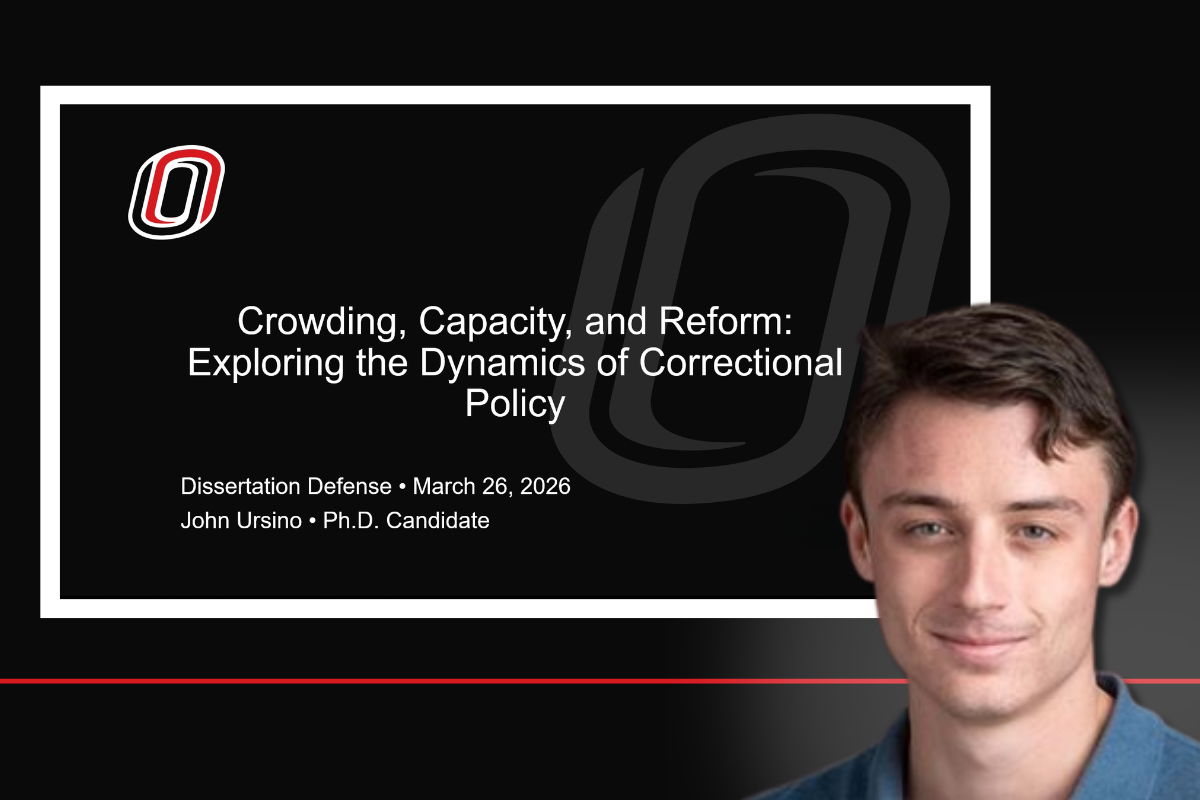
News ReleaseNoNoYesYes1777266000000/news/2026/04/j-ursino.pngnavigationYessite://CPACS/news/2026/04/j-ursino.pngCPACSj-ursino.png2840561200800John Ursino in front of a presentation slide from his Ph.D. dissertation. ///YouTube

John Ursino, who recently defended his dissertation and completed all requirements for the Ph.D. in the School of Criminology and Criminal Justice, has been named a recipient of the Helen Hansen Outstanding Graduate Student Award. The honor is awarded annually to two graduate students who exemplify academic excellence, leadership, and a commitment to making a difference. 

“John’s recognition with the Helen Hansen Award is a tremendous achievement and a testament to his dedication to criminal justice research,” said Gaylene Armstrong, Ph.D., dean of the College of Public Affairs and Community Service. “Awards of this caliber highlight the very best of our students and the difference they are prepared to make.”

For Ursino, the recognition is both humbling and motivating. “Receiving this award is very meaningful to me,” he said. “It reassures me that the work I’m passionate about can make a real impact in the community. This recognition reflects not only my efforts, but also the mentorship and support I’ve received along the way.” 

Ursino’s passion for the justice system is deeply rooted in his upbringing. Surrounded by family members working across all facets of the field—from law enforcement to public defense, corrections, and reentry—he developed an early understanding of the system’s complexities. 

“Hearing those different perspectives helped me see how closely connected policing, courts, corrections, and reentry are,” he explained. “It also showed me how differences in goals at each stage can create tension within a system that ultimately shares the same broader purpose—improving justice, accountability, and public safety.” 

That perspective has shaped Ursino’s academic journey and research focus. His work centers on risk-need assessments, correctional policy, prison and jail crowding, correctional programming, and reentry—areas critical to improving outcomes within the justice system. Through his role in the Advancing Research in Correction (ARC) Lab, Ursino has contributed to high-impact projects across the country. 

His work spans the development of a pretrial risk assessment tool for King County, Washington, an evaluation of prison overcrowding in Nebraska, and outcome assessments of correctional programs. More recently, he has focused on advancing decarceration strategies for both jails and state prison systems. 

Ursino’s contributions to the field have already led to publications in leading journals such as Justice Quarterly, Crime & Delinquency, and the Journal of Criminal Justice—an impressive accomplishment for a doctoral student. 

His research initiatives culminated on March 26 with the successful defense of his dissertation, Crowding, Capacity, and Reform: Exploring the Dynamics of Correctional Policy. Drawing on work conducted in Washington, Lancaster County, and with the Nebraska Department of Correctional Services, this three-paper project—the first of its kind in the program—demonstrates his ability to manage complex, large-scale analyses. 

Beyond his research, Ursino has demonstrated a strong commitment to collaboration and leadership. He has served as a peer mentor within the program, frequently assisting fellow graduate students with statistical analysis and research design. 

Faculty members describe Ursino as operating at the level of an early-career professor. His work with state agencies, including the Washington State Department of Corrections, has already influenced policy discussions and contributed to ongoing efforts to reduce prison populations through data-driven strategies. 

For Ursino, however, the ultimate goal extends beyond publications and accolades. 

“I am motivated by the idea that research should not just advance knowledge or inform policy,” he said. “It should be conducted with the intention of improving the personal outcomes of individuals you likely will never meet.” 

That philosophy continues to shape his future plans, as Ursino aims to pursue a career in academia where he can conduct meaningful research and mentor the next generation of scholars. 

His journey has also been shaped by formative moments in the classroom. One early experience—being asked not just for the correct answer, but to explain why—shifted his entire approach to learning. 

“That moment pushed me to think more deeply,” he reflected. “It changed how I approach problems and ultimately how I conduct research today.” 

As Ursino continues his work at UNO, his contributions exemplify the mission of the university’s College of Public Affairs and Community Service: to advance knowledge, serve communities, and prepare leaders who drive meaningful change. 

Through his research, mentorship, and commitment to improving justice outcomes, John Ursino is not only a deserving recipient of the Helen Hansen Outstanding Graduate Student Award—he is helping shape the future of criminal justice policy and practice.

/
///No
/news/2026/04/helenhansen-award-jursinodepartmentCollege of Public Affairs and Community Servicephoneemailunocpacs@unomaha.educategoryCollege of Public Affairs and Community Servicelocationevent-startsevent-endssite://CPACS/news/2026/04/helenhansen-award-jursinoCPACShelenhansen-award-jursino[Article Heading]From Research to Recognition: John Ursino Wins Helen Hansen AwardJohn Ursino has received the Helen Hansen Outstanding Graduate Student Award, recognizing his academic excellence, leadership, and commitment to impactful research.Giselle MirandaJohn Ursino, a University of Nebraska at Omaha criminology and criminal justice Ph.D. graduate, has received the Helen Hansen Outstanding Graduate Student Award, recognizing his academic excellence, leadership, and commitment to impactful research.Apr 27, 2026 12:00 AM
News ReleaseNoNoYesYes1777266000000/news/2026/04/j-adrian.pngnavigationYessite://CPACS/news/2026/04/j-adrian.pngCPACSj-adrian.png5388711200800Jack Adrian next to the UNO "O".///YouTube

Jack Adrian, an undergraduate Criminology and Criminal Justice student with minors in Policing & Victimology and Victim Services, has been named the recipient of the College of Public Affairs and Community Service (CPACS) Dean’s Award. The award recognizes a student who demonstrates academic excellence, leadership, and a commitment to serving the community.

“The CPACS Dean’s Award recognizes students who exemplify the very best of our college, and Jack is a standout example,” said Gaylene Armstrong, Ph.D., dean of the College of Public Affairs and Community Service. “His academic achievements and focus on policing and victimology highlight a strong commitment to advancing justice and making a meaningful difference in the lives of others.”

A passion for public service has guided his journey from the beginning. “For as long as I can remember, I have wanted to join a career field related to public service,” he explained. “Throughout high school, I considered careers in the military, fire department, and other service-related fields but always found myself coming back to law enforcement.” His interest in criminal justice led him to the University of Nebraska at Omaha (UNO), where he joined the Future Law Enforcement Professionals student group under the guidance of Professor Kim Retzlaff. “I’ve been hooked ever since,” he added.

Receiving the Dean’s Award, he says, is both an honor and a reflection of his dedication. “I have always strived to do my best in my classes, and throughout my time at UNO, I tried to be as involved as possible in the activities and organizations that would help prepare me for the workforce,” he commented. “I hope I continue to make CPACS and UNO proud as I take all the knowledge and experiences I have gained to make a positive impact on the Omaha community as a police officer.”

Mentorship and support from faculty have played a critical role in his development. He expressed gratitude to Dr. Mark Foxall, Professor Kim Retzlaff, Professor Emeritus Bob Houston, and Adjunct Instructor Jeremy Christensen, as well as Assistant Dean Katie Hansen and Academic Advisor Kristen Plowick. “They have all helped me succeed and get to where I am today,” he stated.

Currently, he is in the application process with the Omaha Police Department and, if hired, will begin the academy in July. He hopes to serve on the Metro Fugitive Task Force in partnership with the U.S. Marshals Service and eventually advance in rank to support the department’s mission and leadership.

When asked about memorable experiences at CPACS, he mentioned his participation in the London Study Abroad trip led by Dr. Mark Foxall. “I had the wonderful opportunity of being exposed to the system and culture that our criminal justice system is based on,” he explained. “I believe my experiences in London will help make me a stronger, more capable law enforcement professional in the future.”

Jack Adrian’s dedication to service, academic excellence, and community impact exemplifies the spirit of the CPACS Dean’s Award and underscores the meaningful contributions students can make through education, mentorship, and practical experience.

/
///No
/news/2026/04/deans-award-jadriandepartmentCollege of Public Affairs and Community Servicephoneemailunocpacs@unomaha.educategoryCollege of Public Affairs and Community Servicelocationevent-startsevent-endssite://CPACS/news/2026/04/deans-award-jadrianCPACSdeans-award-jadrian[Article Heading]Rising Star: Jack Adrian Honored with CPACS Dean’s AwardJack Adrian, a criminology and criminal justice student, has been named the College of Public Affairs and Community Service (CPACS) Dean’s Award recipient.Giselle MirandaJack Adrian, a University of Nebraska at Omaha criminology and criminal justice student, has been named the College of Public Affairs and Community Service Dean’s Award recipient.Apr 27, 2026 12:00 AM
News ReleaseNoNoYesYes1757048400000/images/caitlyn-jordon-resize.pngnavigationYessite://CPACS/images/caitlyn-jordon-resize.pngCPACScaitlyn-jordon-resize.png9069941200800Caitlyn Jordan standing against a wall.///YouTube

Caitlyn Jordon grew up on a farm in a small town in southwest Missouri, where hard work was a way of life. That same determination carried her through college basketball at Northwest Missouri State University while earning her bachelor’s degree in criminology. After graduation, she took a short break before deciding to pursue a master’s degree in criminal justice and criminology at the University of Missouri–Kansas City.

It was during that time, she says, that her passion for the field took root.

“Funny enough, my interest in criminology originally came from watching crime shows as a kid, which obviously aren’t very accurate,” Jordon said with a laugh. “But once I started my degree and saw what it truly entailed, I was even more enthralled. All the various aspects of our criminal justice system are fascinating, and there are many areas I felt could—and should—be improved.”

Discovering Her Calling

After completing her bachelor’s degree, Jordon debated whether to continue her education. She felt burnt out and wasn’t sure if graduate school was the right step. But her love of learning quickly brought her back.

“I eventually realized I also wanted to go for my doctorate degree,” she said. “My primary research interests have always been in corrections, rehabilitation, and reentry. I knew I wanted to work on research that would improve those areas of our system. The best way to do that was through a Ph.D. program.”

She also credits her mentors for shaping her path. “I’ve had a lot of amazing teachers and professors who encouraged and influenced my interest in criminology. The idea of sharing that same passion with students one day, while also conducting research that makes a difference, was really appealing to me.”

Her ultimate goal: to remain in academia, combining teaching and research to help shape the future of criminal justice.

Why UNO Stood Out

When it came time to choose a doctoral program, Jordon had a clear list: a supportive community, strong faculty, opportunities for meaningful research, and a city where she could feel at home. The University of Nebraska at Omaha (UNO) checked every box.

“There were a number of factors that led to me picking UNO,” she said. “On my visit, I connected with students and faculty in a way I didn’t elsewhere. One of my professors from my master’s program had received her Ph.D. here and had nothing but great things to say. I’d also heard good things about Omaha from friends and family. Overall, I felt UNO would give me opportunities to grow as both a researcher and a professor, while being part of a great community.”

Looking Ahead

Now a Ph.D. student in UNO’s School of Criminology and Criminal Justice, Jordon is focused on advancing research that addresses some of the most pressing issues in the justice system. Her work in rehabilitation and reentry reflects both UNO’s mission to transform lives and her own drive to improve outcomes for individuals and communities.

“I’ve always loved school and learning,” Jordon said. “Being here at UNO gives me the chance to keep growing while helping others find their own path.”

From farm fields to classrooms, from athlete to academic, Jordon’s journey has come full circle—rooted in resilience, fueled by curiosity, and aimed at making a lasting impact.

For students who, like Jordon, are driven to learn, grow, and make a difference in their communities, UNO’s College of Public Affairs and Community Service (CPACS) offers a variety of graduate programs designed to turn passion into purpose. With supportive faculty, hands-on learning, and a strong sense of community, CPACS prepares students to lead in fields that matter most. Discover the right path for you by exploring CPACS Graduate Programs.


/
//
About the University of Nebraska

The University of Nebraska is the state’s only public university system, made up of four campuses – UNL, UNO, UNK and UNMC – each with a distinct role and mission. Together the campuses enroll nearly 50,000 students and employ 16,000 faculty and staff who serve the state, nation and world through education, research and outreach. For more information and news from the University of Nebraska, visit www.nebraska.edu/news.

/No
/news/2025/09/caitlyn-jordon-ccj-phddepartmentCollege of Public Affairs and Community ServicephoneemailcategoryCollege of Public Affairs and Community Servicelocationevent-startsevent-endssite://CPACS/news/2025/09/caitlyn-jordon-ccj-phdCPACScaitlyn-jordon-ccj-phd[Article Heading]From Farm Fields to Faculty Dreams: Caitlyn Jordon’s Path to UNOCaitlyn Jordon's journey to the UNO Criminology and Criminal Justice Ph.D. program.Amber EvensonCaitlyn Jordon's journey to the University of Nebraska at Omaha (UNO) Criminology and Criminal Justice Ph.D. program.Sep 5, 2025 12:00 AM
Grant Spotlight/https://www.unomaha.edu/news/2025/09/could-an-algorithm-help-solve-prison-overcrowding.php/https://www.unomaha.edu/news/2025/08/uno-study-offers-first-ever-look-into-labor-trafficking-in-nebraska.php/https://www.unomaha.edu/news/2025/08/uno-researchers-advance-omahas-first-ever-poverty-elimination-plan.php/https://www.unomaha.edu/news/2025/07/omaha-police-break-mental-health-stigma-with-help-from-uno-researchers.php/https://www.unomaha.edu/news/2025/07/can-we-fix-how-america-responds-to-child-sexual-exploitation.phpMedia Mentions/https://www.usatoday.com/story/news/nation/2026/02/13/balloon-mexican-drug-cartel-drone-border/88629709007/?utm_medium=email&_hsmi=403598202&utm_content=403598202&utm_source=hs_email/https://nebraskaexaminer.com/2026/01/30/census-data-shows-less-nebraska-brain-drain-but-concern-for-talent-in-its-early-30s/?utm_medium=email&_hsmi=402384137&utm_content=402384137&utm_source=hs_email/////////////http://
/
/
/
BelowCSS/http://

Featured

Four images showing multigenerational people dancing.

UNO Gerontology Students and the Service Learning Academy Host Intergenerational Senior Prom with Omaha Community Partners

The student-led Senior Prom united middle schoolers, college students, and older adults through service learning, community partnership, and intergenerational connection.

Dr. Morgan Vogel in front of four business travelers.

UNO CPAR Assistant Director Selected as Strategic Data Project Fellow

Morgan Vogel, Ph.D., has been named a Strategic Data Project Fellow through Harvard University, joining a national network of leaders using data to improve education outcomes.

Group of people talking.

UNO Celebrates 30 Years of Ph.D. in Public Administration, Explores Future of Public Service in Turbulent Times

The School of Public Administration celebrated this anniversary with a day of discussions.

Dr. Carter and Dr. McNealy in front of a computer showing security icons.

UNO and Michigan State Researchers Find Cybersecurity Carries a Convenience Tax, Until Your Data Is Actually at Stake

New research reveals a critical gap in how people approach online safety.

Impact Stories

more
Military students taking a test in the test center with a stationary historic airplane in the background.

UNO Offutt AFB Testing Center Earns 2026 CLEP Honors Military Achievement Award

The award is based on exams administered in 2025, and honors centers that expand access to college credit while helping students save time and money. The center will be recognized at a reception in June.

Group of clerks wearing blue 50 years t-shirts.

UNO Celebrates 50 Years of the Nebraska Municipal Clerks Institute and Academy

CPACS Continuing Professional Education Programs leads milestone annual training advancing leadership, professional growth, and community impact for municipal clerks across Nebraska.

Group of adults dancing on a dance floor with a headshot of Dr. Heidi Rueda featured in front of it.

Dancing Into New Connections: Dance Program Brings Confidence and Community to Adults with Disabilities

A UNO study finds that adapted dance classes, like the Across the Floor program, help adults with intellectual and developmental disabilities build social skills, confidence, and meaningful connections through movement and creativity.

Student Success

John Ursino in front of a presentation slide from his Ph.D. dissertation.

From Research to Recognition: John Ursino Wins Helen Hansen Award

John Ursino has received the Helen Hansen Outstanding Graduate Student Award, recognizing his academic excellence, leadership, and commitment to impactful research.
Jack Adrian next to the UNO "O".

Rising Star: Jack Adrian Honored with CPACS Dean’s Award

Jack Adrian, a criminology and criminal justice student, has been named the College of Public Affairs and Community Service (CPACS) Dean’s Award recipient.
Caitlyn Jordan standing against a wall.

From Farm Fields to Faculty Dreams: Caitlyn Jordon’s Path to UNO

Caitlyn Jordon's journey to the UNO Criminology and Criminal Justice Ph.D. program.

Grant Spotlight

  • Could an Algorithm Help Solve Prison Overcrowding?
  • UNO Study Offers First-Ever Look Into Labor Trafficking in Nebraska
  • UNO Researchers Advance Omaha’s First-Ever Poverty Elimination Plan
  • Omaha Police Break Mental Health Stigma with Help from UNO Researchers
  • Can We Fix How America Responds to Child Sexual Exploitation?

Media Mentions

  • USA Today spoke with NCITE Director of Strategic Initiatives Austin Doctor, Ph.D., about the use of drones by cartels near the US-Mexico border.
  • The Nebraska Examiner spoke with Center for Public Affairs Research Director Josie Schafer, Ph.D., for its coverage of new Census data that shows Nebraska is making progress in its fight against brain drain.

Events

view more

Contact Us

If you have a story idea, news tip or inquiry please contact:

CPACS Dean's Office
402.554.2276


About the College of Public Affairs and Community Service

College of Public Affairs and Community Service

Contact Us
  • Dean's Office
  • College of Public Affairs and Community Service
  • CPACS 109
  • 6320 Maverick Plaza
  • Omaha, NE 68182   map
  • 402.554.2276
Social media
CPACS Units and Resources
  • Aviation Institute
  • School of Criminology and Criminal Justice
  • Department of Gerontology
  • Goodrich Scholarship Program
  • School of Public Administration/Emergency Management and Disaster Science
  • Grace Abbott School of Social Work
  • Center for Public Affairs Research
  • William Brennan Institute for Labor Studies

Services and Resources

  • Academic Calendar
  • Course Catalogs
  • MavCARD Services
  • MavLINK
  • my.unomaha.edu
  • UNO Brand Guide

Related Links

  • A-Z List
  • Employment
  • University of Nebraska System

Campus Links

  • Accessibility
  • Billing Office
  • Buildings and Maps
  • Campus Directory
  • Campus Safety
  • Events
  • Human Resources
  • Library
  • Military-Connected Resource Center
  • News
  • Registrar
  • Samuel Bak Museum: The Learning Center

Policies and Reporting

  • Emergency Information Alert
  • MavsReport
  • Notice of Nondiscrimination
  • NU Foundation
  • Privacy Statement
  • University Policies
  1. Privacy Statement
  2. Accessibility
  1. 402.554.2800

University of Nebraska at Omaha
University of Nebraska at Omaha, 6001 Dodge Street, Omaha, NE, 68182
  • ©  

Social Media


Omaha Skyline

Our Campus. Otherwise Known as Omaha.

The University of Nebraska does not discriminate based on race, color, ethnicity, national origin, sex, pregnancy, sexual orientation, gender identity, religion, disability, age, genetic information, veteran status, marital status, and/or political affiliation in its education programs or activities, including admissions and employment. The University prohibits any form of retaliation taken against anyone for reporting discrimination, harassment, or retaliation for otherwise engaging in protected activity. Read the full statement.