University of Nebraska at Omaha logo University of Nebraska at Omaha
REQUEST INFO VISIT APPLY

MY UNO DIRECTORY
University of Nebraska at Omaha logo
College of Public Affairs and Community Service
REQUEST INFO VISIT APPLY
MY UNO DIRECTORY
  • About Us Backback to Main menu
    • About CPACS
    • Dean's Message
    • Directory
    • Awards and Recognition
    • Directions and Parking
    • News
  • Academics Backback to Main menu
    • Degree Programs
    • Minors
    • Certificates
    • Advising
    • Goodrich Scholarship Program
    • CPACS Undergraduate Student Grade Appeal Policy
    • CPACS Academic Amnesty
  • Professional Programs Backback to Main menu
    • Professional Programs
    • Nebraska CPM
    • Nebraska City County Managers
    • Certificate in Fundraising Management
    • Nebraska Municipal Clerk Institute and Academy
    • The Great Plains Government Finance Officers Association
    • Juvenile Justice Institute (JJI)
    • American Jail Association Jail Executive Institute (JEI)
    • Nebraska Victim Assistance Academy (NEVAA)
  • Community Engagement Backback to Main menu
    • Partnerships, Events, and Outreach
    • Meaningful Research
    • Labor Studies Institute
    • Alumni Awards
  • Support Us
  1. UNO
  2. College of Public Affairs and Community Service
  3. CPACS News
  4. 2026
  5. 05
  6. Begin with the End in Mind Lecture Series Explores How Arts and Humanities Support Caregiver Well-Being

Begin with the End in Mind Lecture Series Explores How Arts and Humanities Support Caregiver Well-Being

The lecture explored how creativity, portraiture, and the humanities can help ease caregiver burnout and bring meaning to some of the most challenging moments in healthcare and aging.

  • published: 2026/05/01
  • contact: Amber Evenson - College of Public Affairs and Community Service
  • email: unocpacs@unomaha.edu
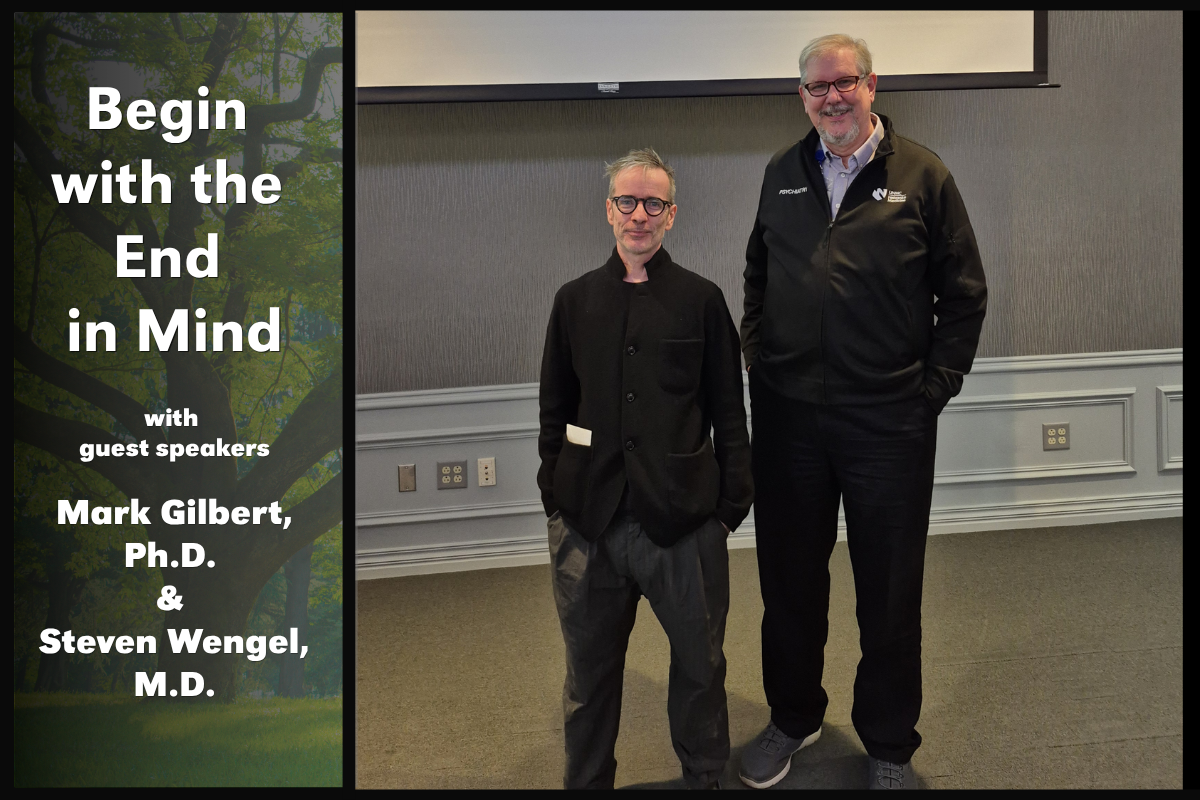
Dr. Mark Gilbert and Dr. Steven Wengel standing in front of a screen with a tree in the background.

The 2026 “Begin with the End in Mind” Lecture Series, part of programming supported by the Department of Gerontology, continued this week with a two-part session examining the intersection of healthcare, burnout, and the healing role of the arts and humanities. The Department of Gerontology also expressed gratitude for the late Terry Haney for his support of the Terry Haney Chair of Gerontology and for funding the “Begin with the End in Mind” series, which makes programming like this possible.

The first segment featured Steven Wengel, MD, Assistant Vice Chancellor for Wellness at the University of Nebraska Medical Center (UNMC) and professor in the Department of Psychiatry. Wengel focused on caregiver burnout, describing it as a widespread and persistent challenge in healthcare environments.

“Burnout of caregivers looks a lot like depression and is often confused with it,” Wengel noted, emphasizing that emotional exhaustion and detachment among caregivers can mirror clinical mental health conditions while stemming from chronic occupational stress. He added that “burnout is alive and well in those who care for others,” underscoring the ongoing strain experienced by professionals in high-demand care roles.

Wengel highlighted engagement with the arts and humanities as a meaningful strategy for resilience and recovery. Activities such as performing arts, poetry, meditation, drawing, and painting, he explained, can activate different areas of the brain and help restore emotional balance. “All of us have creativity,” he said, encouraging attendees to consider how they might tap into their own creative capacities as a form of self-care and reflection.

The second half of the session featured Mark Gilbert, PhD, professor and unit coordinator of Art and Art History with the University of Nebraska at Omaha School of the Arts. Gilbert, an artist and researcher, has led several high-profile art-based research initiatives exploring illness, recovery, and caregiving experiences through portraiture. His work includes projects such as Saving Faces at The Royal London Hospital and Portraits of Care at UNMC, with exhibitions shown internationally, including at London’s National Portrait Gallery.

Gilbert reflected on the impact of art in clinical and end-of-life contexts, noting that “arts have the ability to allow us to engage with some of the most challenging circumstances.” He emphasized that creative expression can help individuals process difficult experiences and find meaning within them. “Art helps to engage and find meaning,” he said, describing it as part of the “healing” dimension of artistic practice.

Gilbert also discussed his doctoral research completed at UNMC in 2014, which examined the experience of portraiture in clinical settings, particularly from the perspectives of both the artist and head and neck cancer patients. His findings contributed to a broader understanding of how visual art can shape patient and caregiver experiences in healthcare environments.

Together, the session underscored a shared theme: that creativity and the humanities are not separate from medicine, but can play an essential role in supporting emotional resilience, particularly in caregiving professions.

News Sections

  • College of Public Affairs and Community Service News Center
  • UNO News Center
  • Maverick Daily
  • The Bullseye
  • Campus Events

Featured

  • UNO Gerontology Students and the Service Learning Academy Host Intergenerational Senior Prom with Omaha Community Partners
  • UNO CPAR Assistant Director Selected as Strategic Data Project Fellow
  • UNO Celebrates 30 Years of Ph.D. in Public Administration, Explores Future of Public Service in Turbulent Times
  • UNO and Michigan State Researchers Find Cybersecurity Carries a Convenience Tax, Until Your Data Is Actually at Stake

Contact Us

If you have a story idea, news tip or inquiry please contact:

CPACS Dean's Office
402.554.2276


About the College of Public Affairs and Community Service

College of Public Affairs and Community Service

Contact Us
  • Dean's Office
  • College of Public Affairs and Community Service
  • CPACS 109
  • 6320 Maverick Plaza
  • Omaha, NE 68182   map
  • 402.554.2276
Social media
CPACS Units and Resources
  • Aviation Institute
  • School of Criminology and Criminal Justice
  • Department of Gerontology
  • Goodrich Scholarship Program
  • School of Public Administration/Emergency Management and Disaster Science
  • Grace Abbott School of Social Work
  • Center for Public Affairs Research
  • William Brennan Institute for Labor Studies

Services and Resources

  • Academic Calendar
  • Course Catalogs
  • MavCARD Services
  • MavLINK
  • my.unomaha.edu
  • UNO Brand Guide

Related Links

  • A-Z List
  • Employment
  • University of Nebraska System

Campus Links

  • Accessibility
  • Billing Office
  • Buildings and Maps
  • Campus Directory
  • Campus Safety
  • Events
  • Human Resources
  • Library
  • Military-Connected Resource Center
  • News
  • Registrar
  • Samuel Bak Museum: The Learning Center

Policies and Reporting

  • Emergency Information Alert
  • MavsReport
  • Notice of Nondiscrimination
  • NU Foundation
  • Privacy Statement
  • University Policies
  1. Privacy Statement
  2. Accessibility
  1. 402.554.2800

University of Nebraska at Omaha
University of Nebraska at Omaha, 6001 Dodge Street, Omaha, NE, 68182
  • ©  

Social Media


Omaha Skyline

Our Campus. Otherwise Known as Omaha.

The University of Nebraska does not discriminate based on race, color, ethnicity, national origin, sex, pregnancy, sexual orientation, gender identity, religion, disability, age, genetic information, veteran status, marital status, and/or political affiliation in its education programs or activities, including admissions and employment. The University prohibits any form of retaliation taken against anyone for reporting discrimination, harassment, or retaliation for otherwise engaging in protected activity. Read the full statement.