

From Research to Recognition: John Ursino Wins Helen Hansen Award
- published: 2026/04/27
- contact: Giselle Miranda - College of Public Affairs and Community Service
- email: unocpacs@unomaha.edu
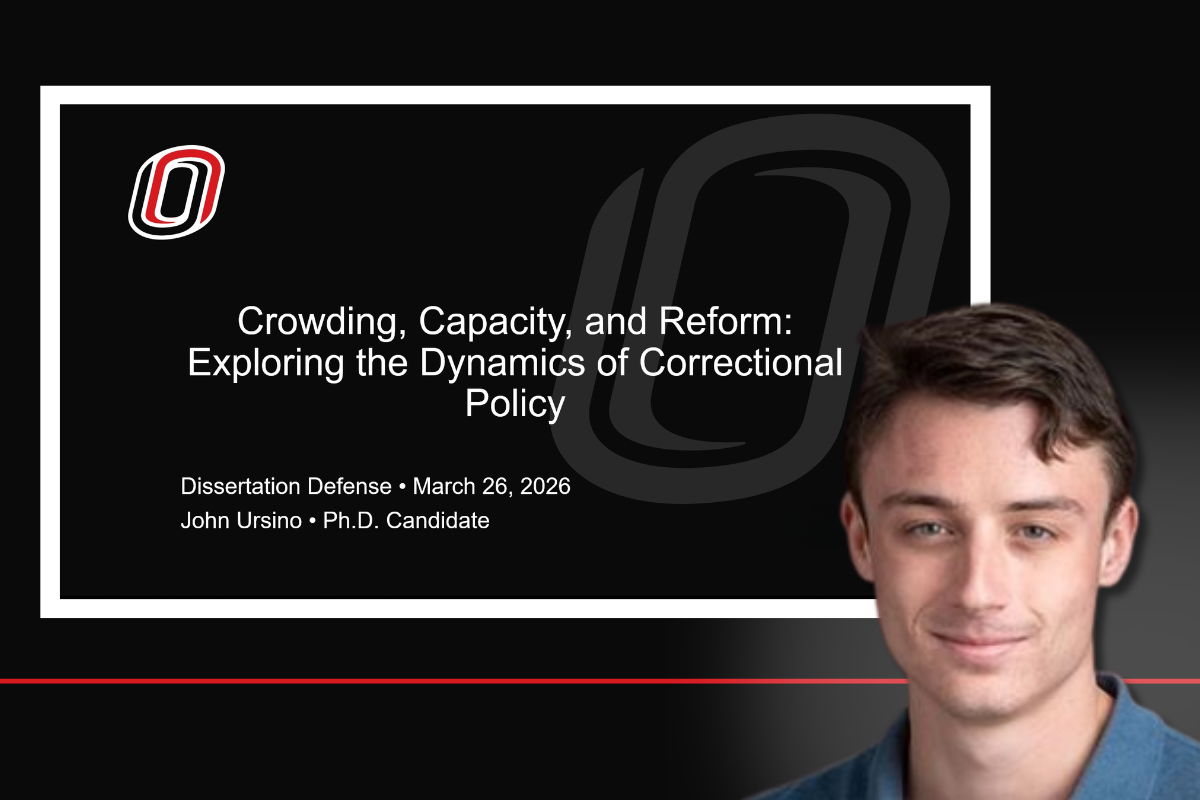
John Ursino, who recently defended his dissertation and completed all requirements for the Ph.D. in the School of Criminology and Criminal Justice, has been named a recipient of the Helen Hansen Outstanding Graduate Student Award. The honor is awarded annually to two graduate students who exemplify academic excellence, leadership, and a commitment to making a difference.
“John’s recognition with the Helen Hansen Award is a tremendous achievement and a testament to his dedication to criminal justice research,” said Gaylene Armstrong, Ph.D., dean of the College of Public Affairs and Community Service. “Awards of this caliber highlight the very best of our students and the difference they are prepared to make.”
For Ursino, the recognition is both humbling and motivating. “Receiving this award is very meaningful to me,” he said. “It reassures me that the work I’m passionate about can make a real impact in the community. This recognition reflects not only my efforts, but also the mentorship and support I’ve received along the way.”
Ursino’s passion for the justice system is deeply rooted in his upbringing. Surrounded by family members working across all facets of the field—from law enforcement to public defense, corrections, and reentry—he developed an early understanding of the system’s complexities.
“Hearing those different perspectives helped me see how closely connected policing, courts, corrections, and reentry are,” he explained. “It also showed me how differences in goals at each stage can create tension within a system that ultimately shares the same broader purpose—improving justice, accountability, and public safety.”
That perspective has shaped Ursino’s academic journey and research focus. His work centers on risk-need assessments, correctional policy, prison and jail crowding, correctional programming, and reentry—areas critical to improving outcomes within the justice system. Through his role in the Advancing Research in Correction (ARC) Lab, Ursino has contributed to high-impact projects across the country.
His work spans the development of a pretrial risk assessment tool for King County, Washington, an evaluation of prison overcrowding in Nebraska, and outcome assessments of correctional programs. More recently, he has focused on advancing decarceration strategies for both jails and state prison systems.
Ursino’s contributions to the field have already led to publications in leading journals such as Justice Quarterly, Crime & Delinquency, and the Journal of Criminal Justice—an impressive accomplishment for a doctoral student.
His research initiatives culminated on March 26 with the successful defense of his dissertation, Crowding, Capacity, and Reform: Exploring the Dynamics of Correctional Policy. Drawing on work conducted in Washington, Lancaster County, and with the Nebraska Department of Correctional Services, this three-paper project—the first of its kind in the program—demonstrates his ability to manage complex, large-scale analyses.
Beyond his research, Ursino has demonstrated a strong commitment to collaboration and leadership. He has served as a peer mentor within the program, frequently assisting fellow graduate students with statistical analysis and research design.
Faculty members describe Ursino as operating at the level of an early-career professor. His work with state agencies, including the Washington State Department of Corrections, has already influenced policy discussions and contributed to ongoing efforts to reduce prison populations through data-driven strategies.
For Ursino, however, the ultimate goal extends beyond publications and accolades.
“I am motivated by the idea that research should not just advance knowledge or inform policy,” he said. “It should be conducted with the intention of improving the personal outcomes of individuals you likely will never meet.”
That philosophy continues to shape his future plans, as Ursino aims to pursue a career in academia where he can conduct meaningful research and mentor the next generation of scholars.
His journey has also been shaped by formative moments in the classroom. One early experience—being asked not just for the correct answer, but to explain why—shifted his entire approach to learning.
“That moment pushed me to think more deeply,” he reflected. “It changed how I approach problems and ultimately how I conduct research today.”
As Ursino continues his work at UNO, his contributions exemplify the mission of the university’s College of Public Affairs and Community Service: to advance knowledge, serve communities, and prepare leaders who drive meaningful change.
Through his research, mentorship, and commitment to improving justice outcomes, John Ursino is not only a deserving recipient of the Helen Hansen Outstanding Graduate Student Award—he is helping shape the future of criminal justice policy and practice.