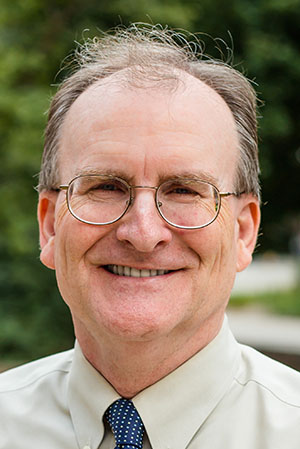
Spotlight: Dr. Charles Johanningsmeier on Teaching, Curiosity, and the Joy of Literature
When Dr. Charles Johanningsmeier arrived at UNO, he felt he was stepping into an adventure. After years of teaching on year-to-year contracts in upstate New York, he interviewed for a position in Omaha and was immediately drawn to the community. “It seemed like an adventure to me and my wife to come to Omaha,” he recalls. “And it has been. It’s been a great place to live and a great place to work.” Years later, his students will easily tell you: UNO is lucky he chose us.
Dr. Johanningsmeier currently teaches Critical Approaches to Literature and Topics in Language and Literature: Guilty Pleasures, two classes that demonstrate the breadth of his interests and the depth of his enthusiasm. Critical Approaches, a course many English majors consider a turning point, introduces students to feminist criticism, queer theory, postcolonial studies, and other major academic lenses. “For so many students, it is liberating,” he explains. “They see there are other ways to look at literature besides what they got in high school.” Instead of hunting for “the main themes,” students discover how varied and personal interpretation can be.
Guilty Pleasures, on the other hand, explores popular fiction and the criteria that make a book a bestseller. Johanningsmeier helped pioneer the study of popular literature in the department and still delights in the energy the course brings. “It’s wonderfully fun,” he says. “We’re asking different questions: Is it a page-turner? Are we invested in the characters?” Its appeal extends beyond English majors, drawing creative writing students eager to understand how compelling stories are crafted.
His passion for teaching is rooted deep in his background. Raised by a science professor father and a librarian mother, Johanningsmeier originally imagined himself becoming a journalist or even a photojournalist. But when job prospects were slim, he followed a recruiter to a high school teaching position in Albuquerque. He liked the work so much that after several years of teaching, he pursued graduate studies at Indiana University. Over time, his interests sharpened into what he now calls being “a historian of print,” someone who studies how literature affects ordinary readers. This interest directly shapes his teaching style.
“I never say, ‘This is what this means,’” he explains. “People interpret things in many different ways.” Citing reader-reception theory, he encourages students to develop interpretations grounded in evidence and shaped by their own experiences. For him, literature lives not on the page but in the exchange between text and reader. “If you start stomping on students’ interpretations, their curiosity dies,” he says. “Then they just go to the internet to find the ‘right’ answer.”
In the classroom, his enthusiasm is unmistakable and contagious. He aims to create a space where students feel both comfortable and intellectually challenged. While his early teaching emphasized sitting in circles to foster discussion, his methods now blend traditional conversation with online tools and resources. But the heart of his classroom remains the same: real people having real conversations about stories that connect to real life.
Johanningsmeier hopes his students carry lessons from literature into their personal and civic lives. Whether discussing race, class, gender, or trauma, he asks students to look beneath surface judgments. For example, his approach to The Catcher in the Rye pushes future teachers to recognize Holden Caulfield not as a “jerk,” but as a grieving, traumatized teenager. He believes literature can sharpen empathy, deepen understanding, and illuminate historical and contemporary movements, from Black Lives Matter to social activism throughout American history.
His career is rich with memorable moments, from taking graduate students on immersive Willa Cather trips to Red Cloud to teaching classes that “just gel.” He still remembers a recent Critical Approaches class whose enthusiasm carried well beyond the semester.
Outside the classroom, Johanningsmeier is actively involved in international scholarship. He is preparing a conference paper for the Henry James Society and may travel to Germany to deliver a keynote on a major literary collection, an especially meaningful opportunity given that he once spent a year in Leipzig as a Fulbright Senior Fellow.
As for the future, he sees English studies maintaining its importance even in an age of AI. In fact, he notices a growing desire for authenticity: letters, cameras, flip phones, and personal writing. Literature, he believes, continues to offer something irreplaceable: a human connection. And as long as students value that connection, Dr. Johanningsmeier will be there, enthusiastically guiding them through the worlds that stories make possible.