Twenty Years of Voices: Celebrating the UNO Writing Center’s Legacy
When the UNO Writing Center first opened its doors two decades ago, nobody could have predicted just how many voices, stories, drafts, and dreams would eventually pass through its tables. What began as a small, hopeful experiment in supporting student writing has now become a campus institution, one that has shaped not only how Mavericks write, but how they convey and view themselves as thinkers and creators.
Although early records are sparse and largely on paper in big filing cabinets, those who were there at the beginning recall a simple, ambitious vision: to build a space where any writer, at any stage, could talk through ideas with someone who cared. In the years since, that vision has held steady even as the center itself has grown dramatically. Under the leadership of many and, since 2013 the first tenure-line director, Travis Adams, the Writing Center has expanded its staff, added new programs, adapted its technology, and developed a reputation for fostering community as much as clarity on the page.
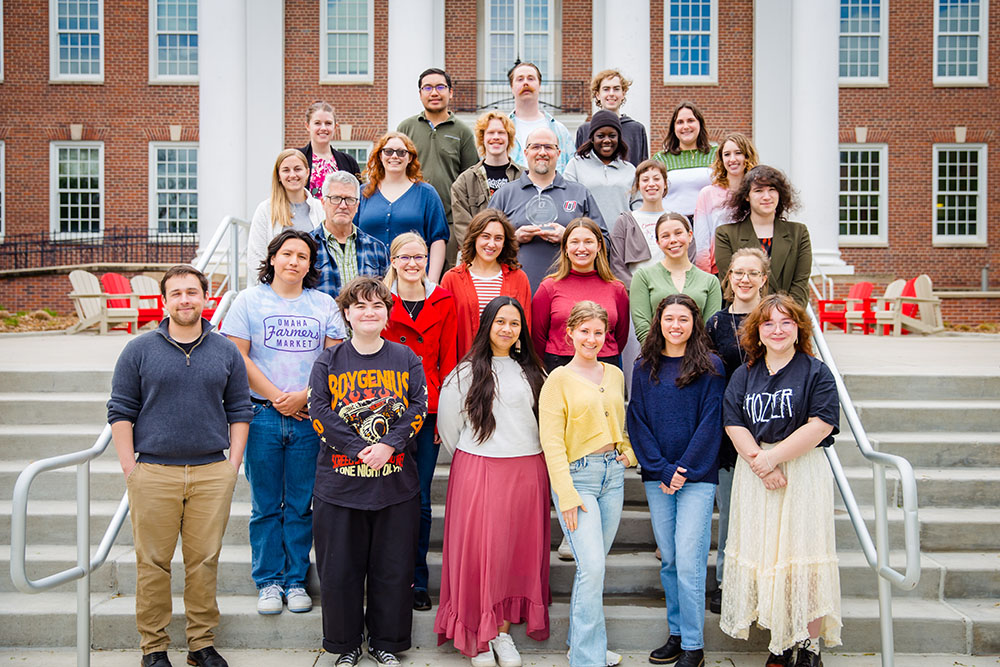
Today, the center’s staffing model is one of its greatest points of pride containing a mix of undergraduate and graduate students. Consultants come from our own English department, but also from engineering, microbiology, creative writing, and dozens more disciplines. A team of office assistants keeps day-to-day operations running smoothly too. It is, in every sense, a collaborative ecosystem. In spring 2025, this ecosystem of collaborators was even recognized as UNO’s Student Employee Team of the Year.
The Writing Center’s impact is best measured in the experiences of the people who live its mission every day. “[We’re a] really optimistic group of people that want to help writers,” describes Graduate Assistant Christina Del Ray. This spirit can be felt as soon as one enters the Writing Center, as students and consultants work together in bright conversation, or as students work quietly, intensely focused on their writing.
Bryce Coulton, a nontraditional student turned Teaching Assistant, adds that what makes the Writing Center special is the “varied majors and backgrounds” of both consultants and students coming in, and how that variety enriches conversations about writing. Coulton shares that the Writing Center changed the trajectory of his life: “If not for the Writing Center, I wouldn’t be teaching… What it’s given me is everything.”
This passion allows consultants to connect with students beyond basic grammar corrections and other conventional writing help. Coulton recalls a student from Afghanistan sharing her story—“how she and her family were dealing with the Taliban and women being restricted … the privilege of hearing stories you're getting exposed to.” The Writing Center exposes consultants to all kinds of stories, especially ones that are often unheard by dominant culture.
matter just as much as help with a thesis or paragraph transition. Del Ray describes working with writers across backgrounds, from first year students to doctoral candidates, saying, “helping them feel so much better… it makes a difference in whether they get their doctorate or not.”
For both Coulton and Del Ray, empathy is the heartbeat of the work. Del Ray describes the community in one word: “dedicated.” Coulton chooses: “understanding.” Writing Center work isn’t something one does for the money, but rather the rich community it creates, both personally and academically.
Consultants also have the opportunity to develop a personal area of interest or study into presentations for Writing Center themed conferences, like the National Conference in Peer Tutoring of Writing (NCPTW) and the International Writing Centers Association (IWCA) conference, or in leading weekly staff meetings, encouraging further collaboration within the staff. Staff members are encouraged to become more fully rounded professionals, and even people. In October of 2025, seven undergraduate and graduate staff members presented at the NCPTW/IWCA conference, including both Del Ray and Coulton.
The Writing Center has also evolved to meet new challenges. Online consultations, made possible through their software,WCOnline, has expanded access for remote students. Conversations about AI, prompted by emerging technologies and explored through staff meetings and conference panels, reflect a center continuously adapting while reaffirming its focus on human connection. As Del Ray puts it, “writing is more about community and humans than sometimes people expect.”
This year’s 20th anniversary invites reflection not only on where the center has been, but where it’s going. For Del Ray, joining the space has been deeply meaningful: “honestly, I think that it is a privilege—I’m excited to be on staff at this point in its history.”
Looking ahead, both hope the center continues prioritizing humanity in an increasingly digital world.
Even for newer staff members, the Writing Center quickly becomes a home. Undergraduate Office Assistant Marcus Pennell explains what first drew them in: “I’ve always been a big reader and writer, and I was hoping to make friends with similar interests. Now, I love sharing my personal writing with fellow staff members. I know they will not ony give me good craft advice, but really build up my confidence in sharing my writing.”
After twenty years, one truth remains clear: the Writing Center is more than a place to improve a paper. It is a space where writers find support, connection, and the confidence to share their stories. As Del Ray says, “talking about writing makes writing easier.” Or, as Coulton puts it more broadly, “I get to hear what people care about, and I am grateful for that.”
And for two decades, and counting, the Writing Center has been grateful for all the student stories it’s helped.