

Undergraduate Physics Research
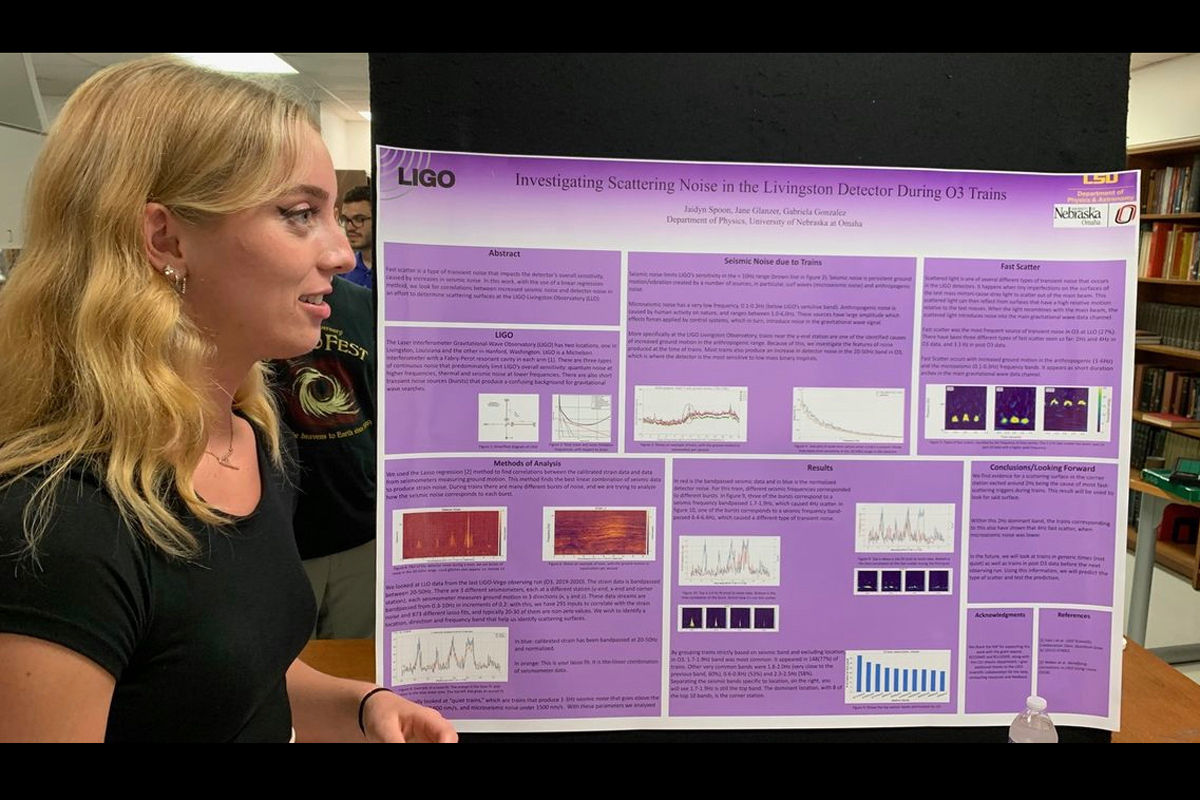
Astrophysics Aspirations: UNO Senior Explores Undergraduate Research Opportunities

UNO Experience Leads Student to Biomedical Physics Research
Create Innovations Before Graduation
Our majors work with faculty to create innovations and solve real problems before graduation. Our faculty are leaders in their field, securing more than $3.4M in grants in the past year.
Our faculty offer student engagement in their research through supervised and independent research projects. If interested, please contact individual faculty about existing opportunities. There are also funding opportunities for students. You can work on exciting research and get paid!
Biophysics (Experimental)
Description: Dr. Krasnoslobodtsev studies nanobiophysics and its practical applications. His research interests lie at the interface of material science, biology, chemistry and physics. His research program uses principles of several disciplines to answer fundamental questions of biology and medicine facilitating early diagnosis and disease prevention. Specific examples of the research projects are: single molecule studies of molecular mechanisms of protein misfolding phenomenon and protein-protein interactions; combination of nanoimaging and nanomanipulation with spectroscopic techniques and development of hybrid biosensing nano-platforms with high sensitivity for early cancer detection.
Contact:
Magnetic Materials (Computational)
Description: Dr. Sabirianov studies magnetic and transport properties nanoscale materials using computational methods. This includes nanostructured magnetic thin films, surface properties of oxides (ZrO2, TiO2 etc.), and magnetic semiconductors.
Contact: Dr. Renat Sabirianov
Ferroelectric Materials (Computational)
Description: Dr. Mei uses various computational techniques to study the properties of ferroelectric materials. Ferroelectricity is a material property that can be used for binary information storage and has applications in non-volatile memories. Dr. Mei also studies polymers, high-dielectric constant materials, rare-earth metal surfaces, and metal oxides.
Contact: Dr. Wai-Ning Mei
Electronic Materials (Experimental)
Description: Dr. Moore studies surface and electronic properties of semiconductor materials, such as ZnO and TiO2. Students learn about film growth via physical and chemical methods, like sputter deposition and sol gel techniques. Characterization techniques include Atomic Force Microscopy (AFM), transmission and adsorption spectroscopy, photoconductivity measures, and photocatalysis. Basic device structures are also fabricated and characterized through maskless photolithography.
Contact: Dr. Christopher Moore
Astrophysics (Observational and Computational)
Description: Dr. Woolf’s research interests involve observational studies of stars using telescopes to measure spectra of stars and then using computer models and analysis routines to measure the chemical signatures in the spectra to find out the stars’ chemical compositions.
Contact: Dr. Vincent Woolf
Physics Education Research (Experimental)
Description: Dr. Moore runs the Physics Education Research Lab at UNO. Using both quantitative and qualitative research methods, the lab focuses on investigations of novice/expert practice within the context of physical science, specifically in the areas of problem solving and scientific reasoning. Dr. Moore also runs a research group studying institutional change in higher education, with a focus on evaluations of teaching.
Contact: Dr. Christopher Moore