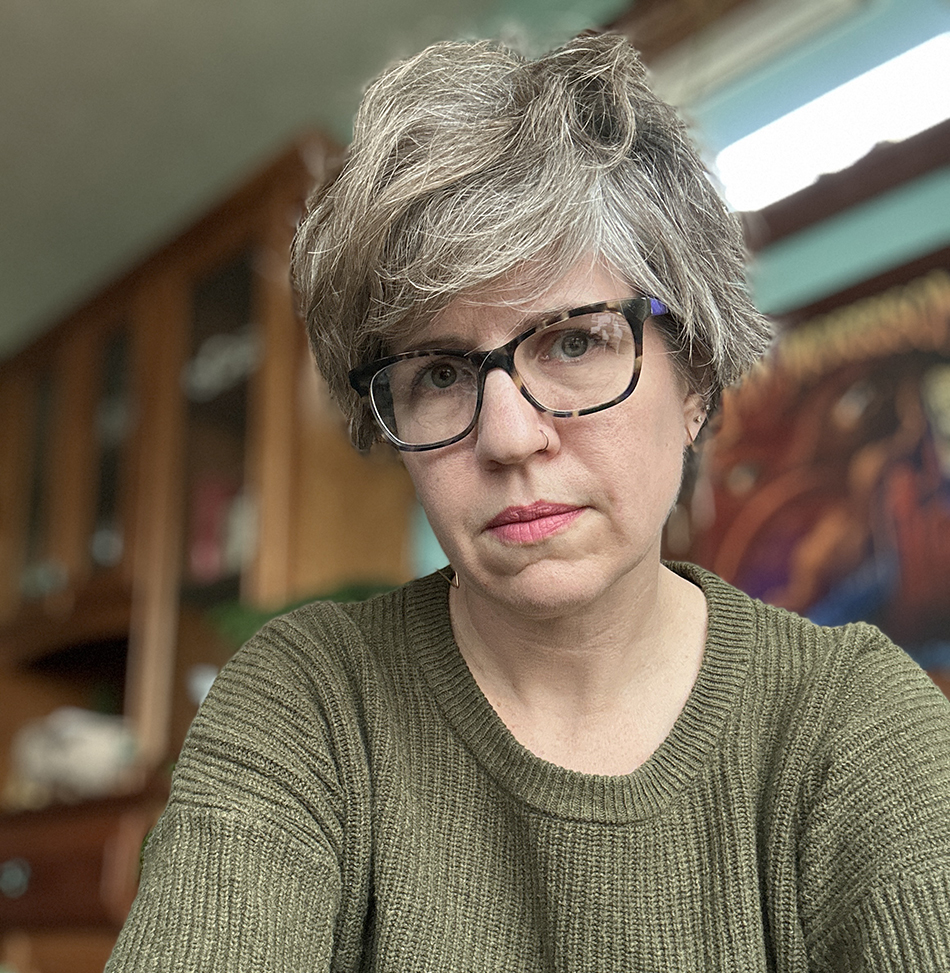
Alumni Spotlight: Kristine Langley Mahler Draws Inspiration from Everyday Life
A lifelong nonfiction writer, Kristine Langley Mahler traces her passion for the genre back to high school. “Truth is always more interesting than fiction, hands down,” she said. That commitment to nonfiction is reflected in her books Curing Season: Artifacts, A Calendar Is a Snakeskin, and Teen Queen Training.
Although she completed her undergraduate degree in English at the University of Iowa in December 2003, her connection to the University of Nebraska Omaha began years later when she enrolled in UNO’s Master of Arts program in English in January 2015. During her time at UNO, she also completed a Certificate in Advanced Writing, graduating in May 2018.
Among her favorite memories from UNO was attending the Association of Writers & Writing Programs (AWP) conferences alongside fellow graduate students. She fondly recalled traveling to Los Angeles in 2016 and Washington, D.C. in 2017. “It was so great to be with people I knew in those massive gatherings of 14,000+ creative writing enthusiasts,” she said.
The faculty in UNO’s creative nonfiction program had a lasting impact on her development as a writer. She praised instructors Lisa Knopp, John Price, Jody Keisner, and Tammie Kennedy, noting that each contributed significantly to her growth. In particular, Lisa Knopp’s Experiments in Creative Nonfiction course was transformative. “There was my writing before that class, and then after. I left a changed person,” she explained. She also highlighted Tammie Kennedy’s Graphic Memoir course, the first graduate class she took at UNO. Although the course initially intimidated her because she did not consider herself an artist, it ultimately expanded her understanding of memoir and visual storytelling.
When asked about favorite projects, she immediately pointed to her creative thesis. “I’d be a fool if I said anything OTHER than my creative thesis was my favorite project,” she said, reflecting the pride she still feels in that accomplishment.
Today, her writing inspiration continues to come from everyday life. As a nonfiction writer, she believes meaningful stories can be found in ordinary experiences if writers pay close attention. She encourages writers “to take a piece they’ve written that they gave up on because it wasn’t working. Try forcing it into a preexisting form (a list, a set of directions, etc) and see what happens—and if it still doesn’t work, try another. Sometimes the very nature of experimenting with your prose can unlock new forms.”
Mahler’s most recent book, Teen Queen Training: Essays after The Seventeen Book of Etiquette and Entertaining, 1963, showcases the same experimental spirit she encourages in emerging writers. Inspired by a 1963 etiquette guide for teenage girls, the collection consists of 26 erasure essays that examine the expectations placed on young women and the lasting effects of those messages. Drawing from her own experiences as a teenager in the 1990s and as the mother of three adolescent daughters, Mahler transforms the guide’s outdated instructions into thoughtful reflections on identity, girlhood, and cultural expectations. The book demonstrates how innovative forms can be used not only to tell personal stories but also to challenge and reinterpret the narratives we inherit.
When asked where she gets her inspiration, Mahler said, “As a nonfiction writer, I’m always drawing inspiration from my daily experiences. The complexity of our lives isn’t always immediately apparent, but by paying careful attention (one easy way is to try a true diary of one day, listing everything you do, and returning to that the next day to write into what you were thinking/seeing/experiencing), you can begin to tweeze out the glimmers.”
For students hoping to pursue writing professionally, she offers reassurance that there is no single correct writing routine. “Don’t be psyched out if you don’t write every day—we all have off times,” she advised. Rather than forcing productivity, she recommends trusting the creative process and giving writing attention when inspiration strikes.
When writer’s block strikes, she turns to editing. “I edit, haha!” she said. Revisiting unfinished work and transcribing handwritten journals allows her to stay connected to her writing practice even when generating new material feels difficult.
Beyond writing, she is deeply invested in the publishing process. Her favorite moments come when she can celebrate the success of others. “Sending acceptances, absolutely—and publication days!” she said. “It’s every writer’s most desired experience, and I’m so grateful I get to be a part of it.”
For students interested in publishing, her advice is simple: volunteer with a literary journal. Working on a reading team, she explained, helped her become a stronger writer by exposing her to successful submissions, editorial discussions, and the qualities that make a piece stand out.