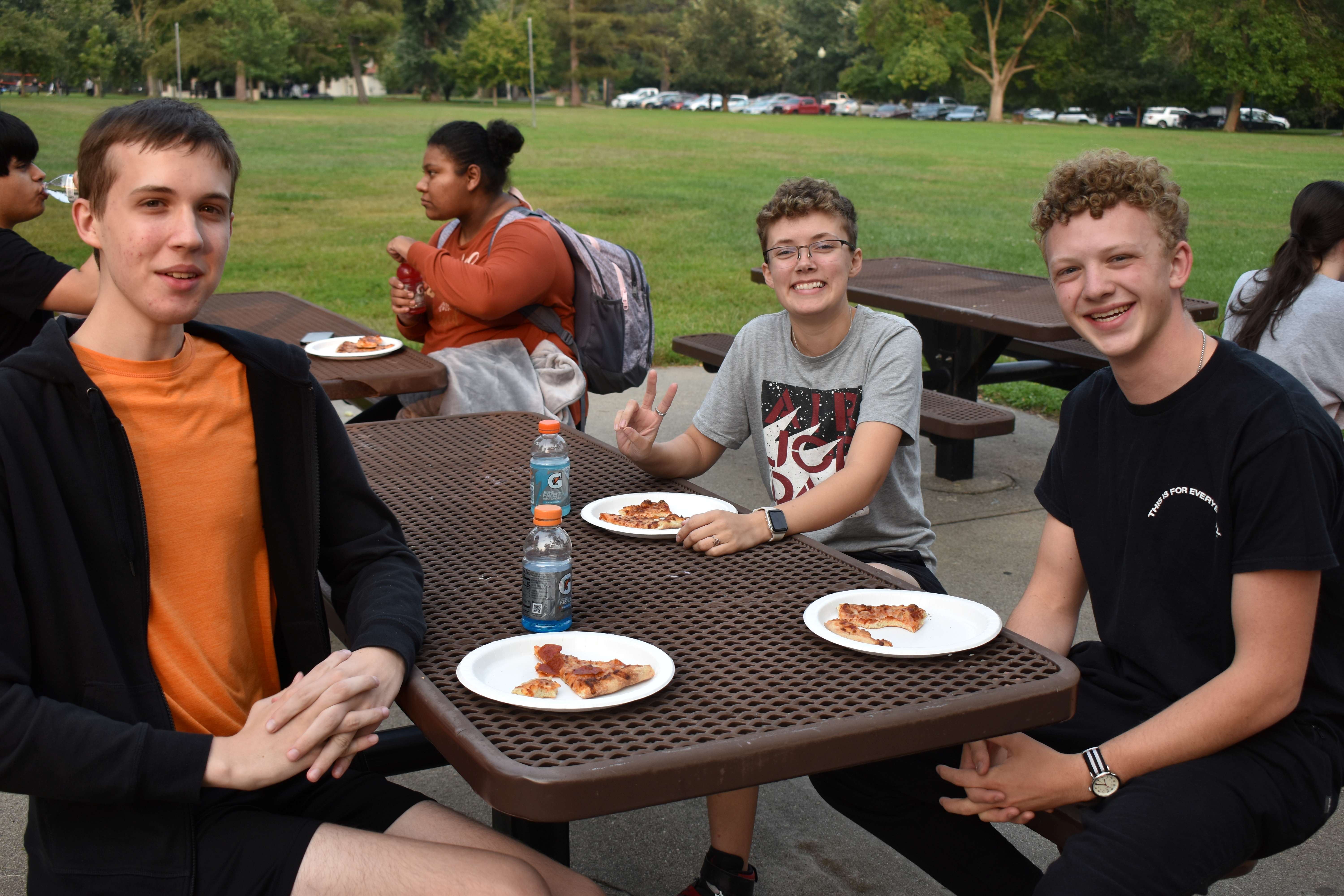
Each semester the Honors Program offers Honors-specific sections of courses as well as Honors Seminars (formerly colloquia).
Students can identify current Honors Program courses in a specific semester in their MavLink class search: just select [Honors Program Courses] in the [Program] field.
Honors Courses
Each semester the Honors Program offers a number of Honors-specific general education courses. These courses are typically smaller class sizes than those of typical general education courses, and they are taught by award-winning faculty. There are more choices in fall than in spring, as that's when so many new students join our program!
The courses thus increase discussion possibilities along with opportunities for students to interact with other students in the program while earning both Honors and general education credits.
Advising
Honors students should all meet with Honors staff before enrolling for the following semester's classes. Any students with 85+ earned hours should schedule a meeting with Dr. Morrison (using MavConnect for availability), as senior year arrives faster than you might think.
Please use MavConnect to find a member of the Honors team with availability; please email the Director if you are having difficulty finding compatible times to connect.
Seminars
Students take two Honors seminar classes, and those interdisciplinary course offerings change every semester. Students are exposed, through a seminar course, to many different perspectives, disciplines, and theoretical and actual possibilities; being compelled to use such multi- and interdisciplinary viewpoints thus encourages students to see their own and other angles of visions anew.
A seminar class is broader, deeper, richer, and more learner-centered in its focus and investigation; it is central to a community of exceptional students and faculty. Seminar classes are generally more discursive and participatory in their structure than many college classes can be since Honors courses have lower enrollment limits.
Through taking an Honors seminar course, students have served Nebraska communities in restoring parks, while others have researched the history of buildings in an Omahan neighborhood and thus served the local Restoration Society as they continue to work to preserve history in Omaha.
There are so many options--and these courses carry general education credits too, in the Humanities and Fine Arts (HONR 3020) and the Social Sciences (HONR 3030) or non-lab natural sciences (HONR 3040). Honors seminar classes are recognizable as they have the HONR for their subject and are at the 3000 level (3000, 3020, 3030, or 3040 in number).
Recent seminars include:
| Course Number | Area |
Description |
| HONR 3020 | Humanities |
“War, Propaganda, and Art”: For many centuries, kings and politicians have used displays of physical prowess and unimaginable wealth to persuade their subjects and citizens to support their rule and political objectives. Through a thematic and chronological approach, this class will study how architecture, painting, sculpture, music, theatrical productions, poster design, television, and social media have been used as tools by ruling elites since the 17th century. We will explore how and why artists produce works of propaganda for various authoritarian demagogues; what mediums and techniques they used to create persuasive visuals; and how the works were presented to these countries’ populations. |
| HONR 3030 | Social Sciences |
“Crime, Data, & Policy Advocacy”: How do we know what we know about crime and justice, and how does that information shape public policy? This course explores the intersection of crime data, media narratives, and policy advocacy. Students will develop critical information literacy skills to evaluate sources, analyze the use (and misuse) of crime statistics, and assess the impact of media coverage on public perception and criminal justice reform. The course culminates in a policy brief project where students apply their knowledge to a contemporary criminal justice issue. “Food, Culture, and Society”: Are you what you eat? From a sociological vantage point, what you eat and why is actually an immensely complicated question (far beyond health and nutrition). This course uses food as an arena in which to study sociology and its unique approach to understanding the world, known as the sociological perspective or sociological imagination. Through our focus on food, food cultures, and food media, we will explore the major questions facing sociology today, including inequality, culture, work, the environment, globalization and social change. In particular, we examine cultural practices in the production and consumption of food; the value and meanings of food; media and the rise of foodie culture and the celebrity chef; the politics of the agri-food system (such as the fight over genetically modified foods); social movements surrounding food (such as slow food, community supported agriculture, and vegetarianism); the culture of restaurant work; the unequal distribution of food, and other topics of interest. Bring your appetite! |
| HONR 3040 | Natural Sciences (non-lab) |
“AI and Business”: With advancements in machine learning, robotics, and natural language processing, AI is revolutionizing traditional business models in unprecedented ways and is poised to drive a new wave of innovation and evolution across industries. It is also going to transform the way we think about the fundamental nature of work and the type of future work skills needed for employees. AI offers a vast array of capabilities with virtually limitless potential, including automating repetitive tasks, providing predictive insights, enabling personalized customer experiences, optimizing supply chain management, and improving risk assessment. As AI continues to transform every aspect of modern business, organizations that embrace it with intent and insight will be empowered to unlock new opportunities, achieve operational efficiencies, and drive sustainable growth, gaining a competitive advantage. |
| HONR 3050 | Arts |
“Modern and Contemporary Art”: A study of the most significant developments in art and architecture dating from the mid-19th century to the present. These works of art will be examined within varied contexts (artistic, religious, political, economic, etc.). The artistic movements covered include Realism, Impressionism, PostImpressionism, Symbolism, Art Nouveau, Cubism, Fauvism, German Expressionism, Russian Constructivism, Dadaism, Social Realism and Regionalism, Abstract Expressionism, Pop Art, Op art, Minimalism, PostMinimalism, Neoexpressionism, and Postmodemism. Join the Honors art exploration! |