

How AI Is Shaping the Future of Policing: CPACS Hosts Two-Day Intensive Course
- published: 2026/02/09
- contact: Amber Evenson - College of Public Affairs and Community Service
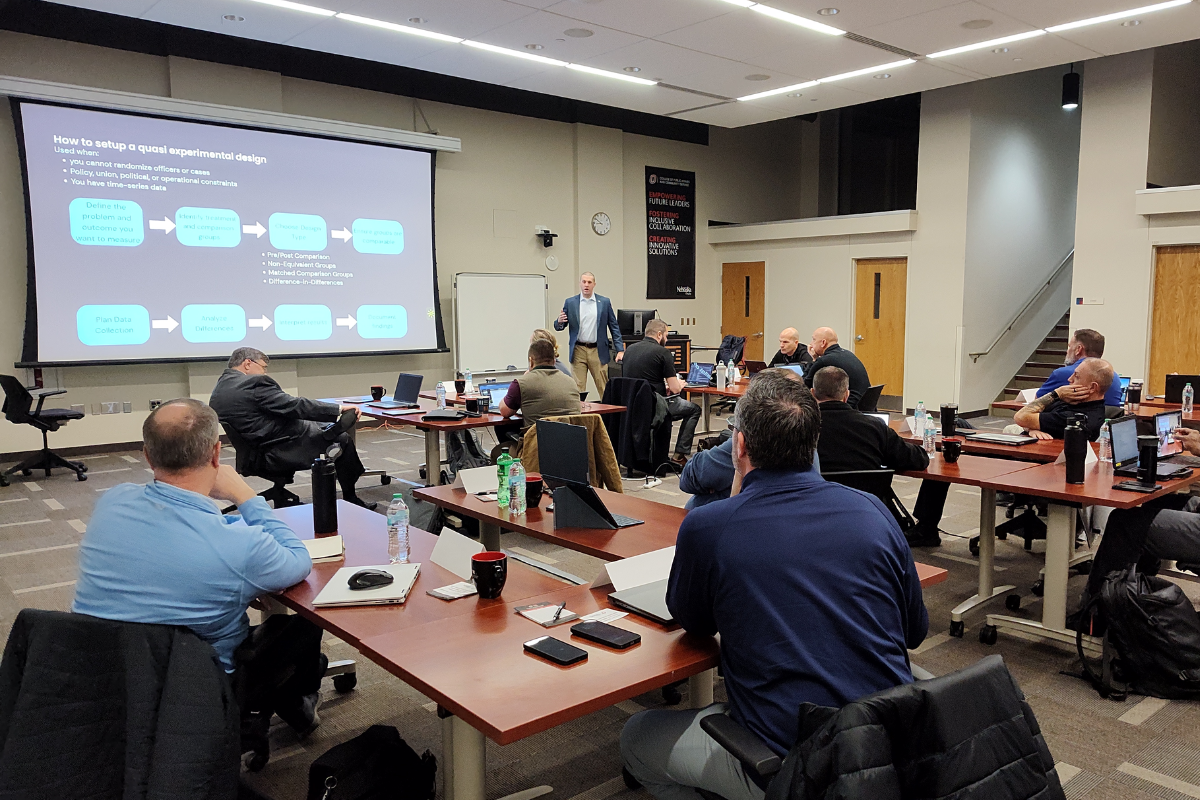
Artificial intelligence is rapidly transforming nearly every profession, and law enforcement is no exception.
The University of Nebraska at Omaha’s (UNO) College of Public Affairs and Community Service (CPACS) recently hosted a two-day intensive course on Policing and Artificial Intelligence, bringing together local law enforcement professionals to explore how emerging AI technologies are reshaping modern policing — and how to use them responsibly.
The course was led by Lieutenant Matthew Barter of the Manchester, New Hampshire, Police Department, who guided participants through the fundamentals of AI, its current and future applications in policing, and the ethical and legal considerations that must inform its use.
“AI is exploding everywhere,” Barter said. “It’s being discussed in all fields, and everything comes back to AI.”
Understanding AI’s Role in Policing
The course introduced participants to what AI is — and what it isn’t — emphasizing practical, real-world uses rather than theoretical concepts. Topics included:
- Fundamentals of artificial intelligence in law enforcement
- Types of AI currently used in policing
- Research applications and data analysis
- Ethical considerations and legal frameworks shaping AI policy
- Appropriate and inappropriate uses of AI tools
A key focus was risk management, particularly with high-stakes technologies such as facial recognition software.
Participants discussed potential consequences of false identifications and the importance of human review and oversight when AI tools are used in policing decisions.
“Use of AI needs to be thought through,” Barter emphasized. “It can’t replace human judgment.”
What Research Reveals
The course also explored current research on AI’s effectiveness in policing. Barter and his team’s research showed a notable finding: AI is not necessarily speeding up police report writing, despite common assumptions.
Where AI shows greater promise, Barter said, is in data analysis and review — particularly with body-worn camera footage.
“Less than 5% of bodycam footage is ever viewed,” Barter said. “AI can help review that footage to identify areas of growth potential as well as highlight positive police actions, increasing transparency and accountability. Recent research shows promise in this application of AI."
Hands-On Learning and Future Applications
Participants engaged in hands-on exercises using free, open-source AI tools tailored to law enforcement scenarios. Officers learned how to:
- Write effective prompts for AI tools
- Explore custom, reusable AI applications
- Understand “vibe-coding,” or using AI tools to help build simple software solutions
- Evaluate how AI could support future policing tasks
Throughout the course, Barter emphasized that AI adoption should never be one-size-fits-all.
“Use of these tools is going to be different for each community,” he said. “You need to do assessments and create policies that fit your local area.”
Preparing Public Servants for Emerging Technology
By convening law enforcement professionals for applied learning and critical discussion, CPACS continues to support UNO’s mission to prepare public servants for complex, evolving challenges — balancing innovation with ethics, accountability, and community trust.
As AI continues to expand across industries, courses like this help ensure that public safety professionals are equipped not only with new tools, but with the knowledge and judgment needed to use them responsibly.
“AI is exploding everywhere. It’s being discussed in all fields, and everything comes back to AI.”