

Criminology Graduate Students Investigate Drug Cartel Money Laundering
Two University of Nebraska (UNO) graduate students affiliated with the National Counterterrorism Innovation, Technology, and Education (NCITE) Center, spent part of their summer examining how drug cartels may use real estate transactions to launder illicit proceeds and identified approaches that could help federal investigators improve detection of such activity.
- published: 2026/10/14
- contact: Ben Battafarano - NCITE Communications
- phone: 4025542972
- email: benbattafarano@unomaha.edu
- search keywords:
- cartels
- money laundering
- real estate
- timeshare fraud
- criminology and criminal justice
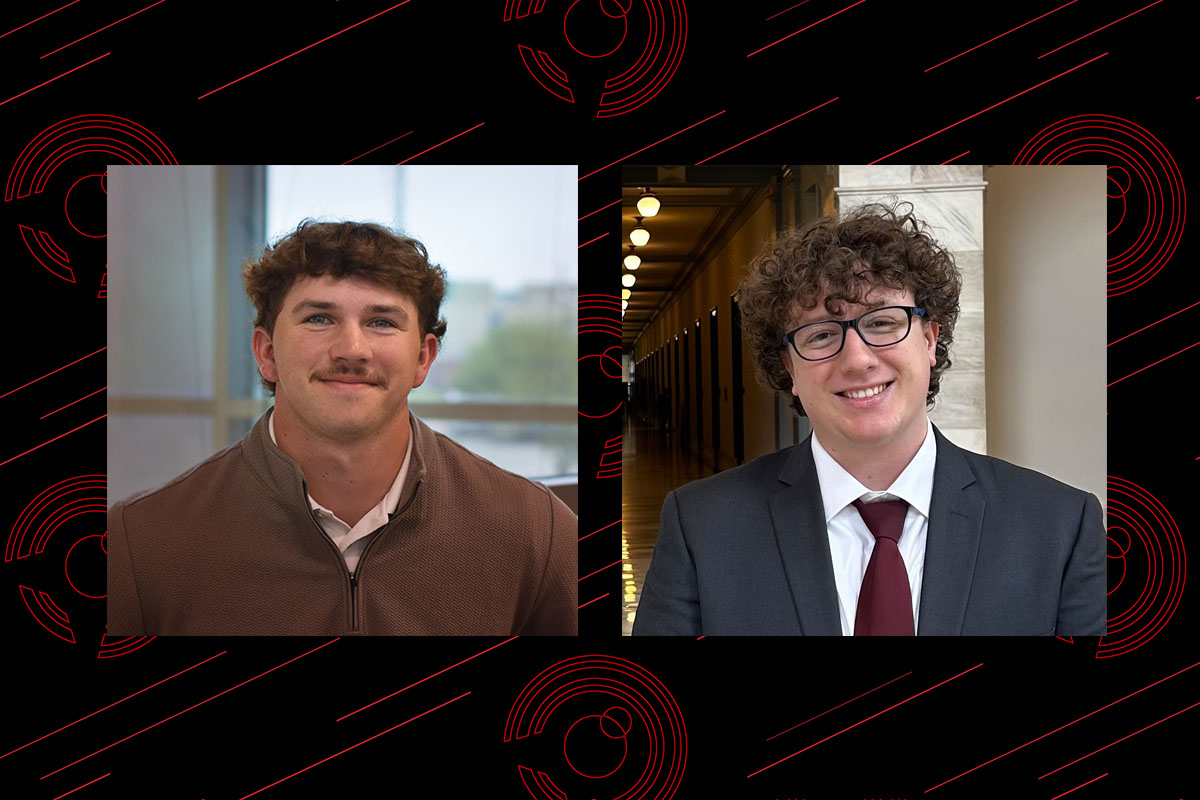
Two University of Nebraska (UNO) graduate students affiliated with the National Counterterrorism Innovation, Technology, and Education (NCITE) Center, spent part of their summer supporting U.S. Customs and Border Protection (CBP) National Targeting Center (NTC) examining how drug cartels may use real estate transactions to launder illicit proceeds and identified approaches that could help federal investigators improve detection of such activity.
Camden Carmichael and Kyle Stopak, master's students in criminology and criminal justice, spent three weeks conducting remote open-source research before traveling to Sterling, Virginia for one week of in-person work with NTC officers and analysts utilizing CBP systems. Their research culminated in presentations to NCITE scientists and CBP officials, including senior leadership from the Counter Network Division (CND) at NTC, and in the Department of Homeland Security (DHS) Science and Technology (S&T) Directorate.
Why it matters: Real estate purchases may enable criminal networks to conceal beneficial ownership, move illicit funds, and generate additional revenue. By examining these methods, Carmichael and Stopak were able to identify potential indicators that could help investigators recognize properties possibly connected to criminal organizations.
Zoom in: The students' research examined several methods used by criminal organizations to exploit real estate transactions, including:
- Straw buyers and nominees: Using individuals or entities to acquire or hold property on behalf of cartel members, thereby concealing the true beneficial owners and those exercising control of the assets.
- Shell companies: Using entities with no legitimate independent business operations to obscure ownership interests or facilitate the movement of illicit funds through real estate transactions.
- Tourism and timeshare fraud: Exploiting resorts, casinos, and vacation properties to launder illicit proceeds, obtaining customer information for fraudulent purposes, and generating revenue through deceptive schemes.
The students examined real-world cases involving cartel-linked properties and proposed a framework for assessing suspicious real estate activity. Their recommendations:
- Create a standardized set of risk indicators.
- Develop a scoring system to help analysts prioritize properties for further investigation.
- Collaborate closely with federal and international partners including the Financial Crimes Enforcement Network (FinCEN), FBI, Office of Foreign Assets Control (OFAC), and Mexican law enforcement.
What they're saying:
- NTC CND Leaders
- "Technologies are evolving at a much quicker pace than we can keep up with. Bringing in the college interns who have grown up with the rapidly evolving technology helps us identify new tools or methodologies in the open-source realm that we could be leveraging."
- Camden Carmichael, NCITE graduate research assistant, criminology & criminal justice
- "Diving into this research question, it kind of felt like we were fish out of water. These people live in this problem set, and they're working with it every day, all day. But something that really helped us is we were able to attend briefings that they were doing and kind of see the flow and the norms and how these things operate in this context."
- Kyle Stopak, NCITE graduate research assistant, criminology & criminal justice
- "I learned that you don’t have to be an expert in the room to add value. You just have to be curious. We both asked a lot of questions, some of them basic, and the different teams were happy to explain how and why they do what they do. Those conversations taught me more than any reading could have. I left this internship realizing that good research starts with asking good questions. This is a lesson I will take with me wherever my career may go."
The big picture: For Carmichael and Stopak, the experience offered an opportunity to translate academic research into practical recommendations for federal investigators, reflecting UNO and NCITE's commitment to workforce development, impactful research, and partnerships that serve the public good.
What's next: NCITE will continue to build partnerships with public and private stakeholders for workforce development. The Center also offers an ongoing internship program; keep an eye on our social media and job postings page for opportunities.