

In Seventh Year, NCITE Adds Projects on CBRN Deterrence, AI Vulnerabilities at Large Venues, and More
NCITE launches its seventh year of research with 17 projects examining emerging homeland security threats, including AI, UAS, CBRN risks, and security at major venues, while welcoming five new universities to its consortium.
- published: 2026/08/17
- contact: NCITE Communications
- phone: 402.554.6422
- email: ncite@unomaha.edu
- search keywords:
- counterterrorism
- research
- technology
- DHS
- innovation
OMAHA, Neb. — How could bad actors exploit artificial intelligence systems, initially implemented to improve security, to target mass-gatherings at sports or entertainment venues such as the World Cup 2026 or the 2028 Summer Olympics in Los Angeles?
This question and others will be explored by experts at the National Counterterrorism Innovation, Technology, and Education (NCITE) Center in its seventh research year, funding five new projects that expand scope across its three-point strategic framework examining threat actors, tactics, and targets.
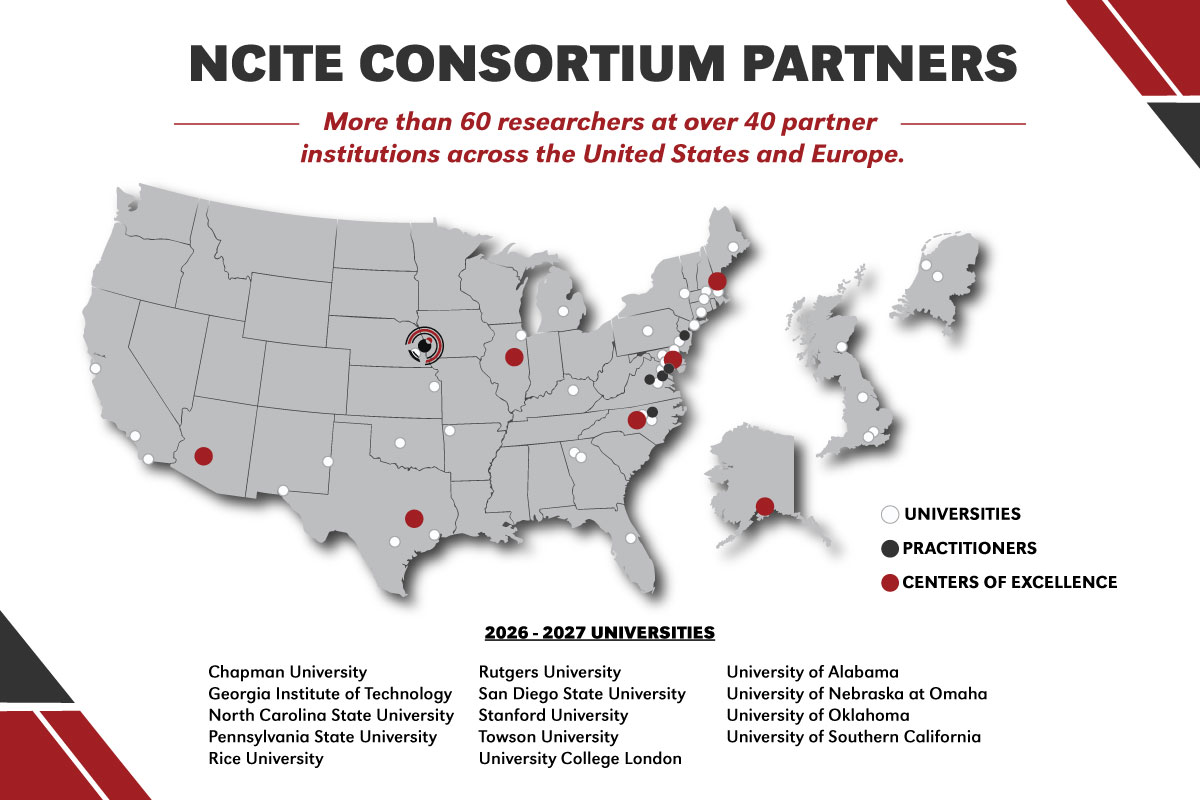
The new projects supplement existing Center research investigating the emerging technology — and potential malign use — of UAS and AI systems and introduce new lines of inquiry into assessing the threat and economic consequences of chemical, biological, radiological, and nuclear (CBRN) attacks. New consortium researchers are represented at Georgia Institute of Technology, North Carolina State University, Rutgers University, Towson University, and the University of Southern California. Researchers with continuing projects from last year are also represented from Chapman University, Pennsylvania State University, Rice University, San Diego State University, Stanford University, University of Alabama, University of Oklahoma, University College London and the University of Nebraska at Omaha (UNO).
The new selections followed a competitive application process this spring from a pool of 26 applicants who submitted and revised proposals and workplans over a five-month period. After an initial NCITE review for rigor, innovation, and alignment with the Center’s current portfolio, the Department of Homeland Security Science & Technology Directorate (DHS S&T) managed a blind peer-review process that evaluated feasibility and utility to the practitioner workforce.
"The breadth and depth of the proposals we received was outstanding, and I'm grateful for the robust appraisal by NCITE and DHS S&T colleagues," NCITE Director Gina Ligon, Ph.D., said. "Our new projects reaffirm our commitment to actionable research in a year of security challenges that continue to reflect in current events, experimental technology and policy initiatives."
The Center was approved for its $6.1 million annual allocation under its 10-year cooperative agreement grant by the DHS Office of University Programs on July 10, with the 17 new and existing projects scheduled to kick off in early September. Since 2020, NCITE has been awarded a total of more than $58 million in DHS grants and contracts.
NCITE provides critical research on terrorism, cartels, border security, and other evolving threats facing our country. This is important for our national security. And it’s how we stay ahead for years to come.
NCITE benefits from the strong support from Nebraska’s congressional delegation, including longtime champion Senator Pete Ricketts, who played an integral role in keeping the UNO-based Center and its research federally funded in 2025.
“Keeping Americans safe means understanding threats and stopping them before they become attacks,” Ricketts said. “NCITE provides critical research on terrorism, cartels, border security, and other evolving threats facing our country. This is important for our national security. And it’s how we stay ahead for years to come.”
NCITE's mission is to produce actionable research through a user-inspired approach, which combines social science, business, and technology for the security of the homeland. We aim to build a community of the most innovative, curious, and security-minded students and researchers to be part of the call to keep our country safe.
2026-2027 Research Projects:
THREAT ACTORS: WHO is trying to harm the U.S.?
- Organizational Psychology of Homeland Threat Actors
- Sam Hunter, Gina Ligon at University of Nebraska at Omaha (UNO)
- Prosecuting Illicit Threat Actors
- Seamus Hughes, Mackenzie Harms at UNO
- Understanding Threats to Public Officials
- Pete Simi at Chapman University, Seamus Hughes at UNO
- Youth Terrorist Mobilization
- Bettina Rottweiler at UNO, Caitlin Clemmow at University College London
TACTICS: HOW could they do it?
- Emerging UAS Threats to U.S. Homeland Security and Defense
- Austin Doctor, Joel Elson at UNO
- FALCON: Framework for Adversarial Learning and Capability Observation in Networked UAS
- Ryan Shandler at Georgia Institute of Technology
- Improving Behavioral Analysis in Assessing the Economic Consequences of CBRN Attacks
- Adam Rose at University of Southern California
- Richard John at University of Southern California
- Interoperable Counter-UAS Systems: Building a Unified Operating Environment for Drone Threats
- Suat Cubukcu at Towson University
- Malevolent Creativity: The Varied Use of Artificial Intelligence as an Emerging Threat
- Sam Hunter, Joel Elson at UNO
TARGETS: WHERE would they attack?
- AI Enhancement, Psychometric Examination, and Adaptation of a K-12 Risk Assessment
- Sydney Reichin at North Carolina State University
- Potential Vulnerabilities of Artificial Intelligence Systems at Sports and Entertainment Venues
- Fred Roberts at Rutgers University
- Supporting Trusted Recognition and Interpretation of Data from Events to Enhance Fusion Center and Law Enforcement Insights
- Erin Kearns, Brian Ricks at UNO
- Understanding and Preparing for Terrorism Risks at Event Venues
- Tin Nguyen, Erin Kearns at UNO
2026-2027 Transition and Workforce Development Projects
OPERATIONAL IMPACT: WHY does research matter?
- Digital Twin Center Security
- Jessica Menold, Scarlett Miller at Pennsylvania State University
- Immersive CyberAI Professional Development
- Allen Johnson at University of Alabama,
Matthew Jensen at University of Oklahoma
- Allen Johnson at University of Alabama,
- Mapping Militants
- Kaitlyn Robinson at Rice University, Martha Crenshaw at Stanford University
- Building Homeland Security Capacity Through Workforce Development
- Lance Larson, Robert Harkins at San Diego State University