

UNL Legal Intern Lends Expertise to NCITE Research
- published: 2026/09/21
- contact: Ben Battafarano - NCITE Communications Manager
- email: benbattafarano@unomaha.edu
- search keywords:
- legal internship
- UNL
- legal research
In 2025, an attorney in a Nebraska divorce proceeding flagged their opposing counsel’s appellate brief for suspected fake citations. The accusation was later elevated to the Nebraska Supreme Court. In their review, the court found that the brief was “riddled” with fictitious case citations and quotes.
After an initial denial, the offending attorney admitted he used generative AI to draft the brief without verifying its accuracy. The court noted that this was their first opportunity to address such misuse of AI in the legal profession, and in April suspended the attorney’s license indefinitely.
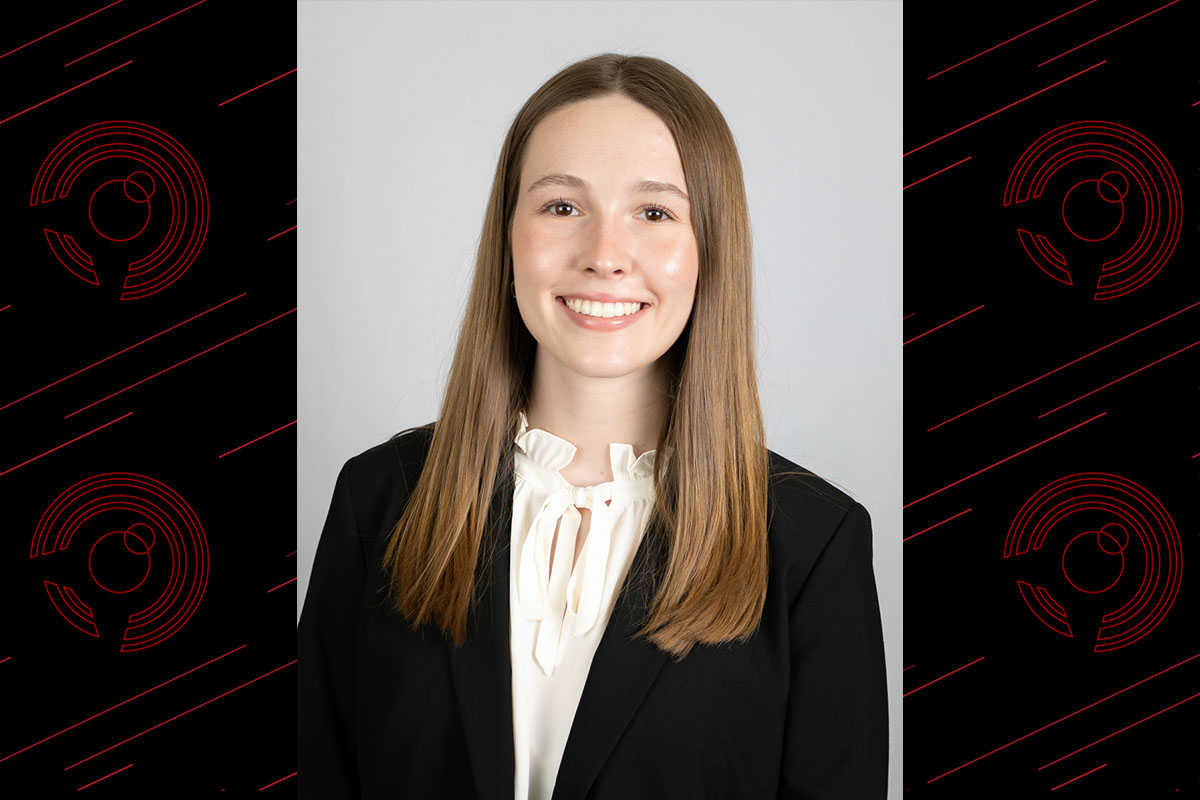
As part of an internship with the National Counterterrorism Innovation, Technology, and Education (NCITE) Center this summer, Sydney Kucera refined the Center’s AI policies to provide clear usage guidance for faculty, staff, and students. As a University of Nebraska at Omaha alumna and second-year law student at the University of Nebraska-Lincoln, Kucera leveraged her expertise to investigate several legal problem sets during her time at the Center. From drafting terms and conditions to charting prosecution trends against cartels, she served as a key asset for NCITE’s research and operations teams.
It was a great opportunity to apply my research skills.
As an undergraduate, Kucera majored in political science with minors in history and criminology. During a legislative internship her junior year, she was encouraged by State Sen. Wendy DeBoer to consider law, and later worked as a judicial extern with Senior U.S. District Court Judge Joseph Bataillon. While the learning curve was steep, she said her time at NCITE complemented her first year of law school.
“I didn’t have knowledge on AI and the other projects I was working on before this,” she said. “It was a great opportunity to apply my research skills.”
Kucera’s work required extensive self-directed learning. NCITE’s unique placement under the auspices of UNO and the Department of Homeland Security necessitates compliance with two sets of operating regulations — a navigation challenge not for the faint of heart.
“There were gaps for me personally, because I didn’t have a supervising attorney,” she said. “So I had to fill those myself.”
In an initiative for NCITE’s technology transition team, she researched the long-term steps and potential legal challenges for deploying software designed to help educational institutions scope their security and safety planning. To forecast, she dove into the dense network of NCITE’s federal acquisition regulations (FAR) and University and federal software-as-a-service (SaaS) rules.
“That got really technical with the licensing agreements,” she said. “Some are more favorable to the creator, some for the user.”
While examining AI policies, Kucera edited NCITE’s workplace handbook and suggested that guidance be reviewed with personnel beyond onboarding on a quarterly basis, particularly as the technology continues to rapidly develop.
“Realistically, people need more reminders,” she said. Without a roadmap, she said, people are less comfortable integrating the tools and uncertain about enforcement.
“If someone breaches the policy, what’s gonna happen? We don’t know,” she said. “We also don’t want to chill the effects of using the tech.”
Beyond the legalese, Kucera had to get up to speed on complex subject matter, like U.S. regulation of drone technologies. For NCITE research on unmanned aerial system (UAS) threats, she was tasked with identifying legal obstacles that local law enforcement face when joining counter-UAS operations. In another project, she investigated the scope of the Racketeer Influenced and Corrupt Organizations Act (RICO) and how prosecutors may be applying the law to cartels that were newly designated as foreign terrorist organizations in 2025.
As a senior, Kucera became intrigued by NCITE’s mission and kept it on her radar as she transitioned into graduate work. Last winter, she asked about internships and presented her expertise. Despite a lack of relevant open positions, NCITE Director of Operations Matt Allen, Ph.D., said his team recognized the potential of Kucera’s skillset.
“When Sydney and I first spoke, her ability to support NCITE’s mission was immediately clear,” Allen said. “Her legal training, combined with a background in national security and interest in research made her a perfect fit to answer questions we were wrestling with.”
Kucera is grateful she got to attend NCITE’s Law Enforcement Summit in June, where she heard directly from practitioners on the diverse challenges of the homeland security space, saying it has expanded her career possibilities. Looking ahead, she’s curious about being a law clerk and perhaps one day a judge.
“The research this summer prepared me for some of my classes this semester,” she said, “Particularly future applications in national security law.”