

NCITE Webinar Recap: Tactical Innovation and Special Operations in Mexican Drug Cartels
NCITE scientists and national security experts discussed the evolving capabilities of high-resource, innovative Mexican cartels and the challenges they present to U.S. law enforcement.
- published: 2026/11/12
- contact: Alia Seoane - NCITE Director of Communications
- phone: 4025542972
- email: ncite@unomaha.edu
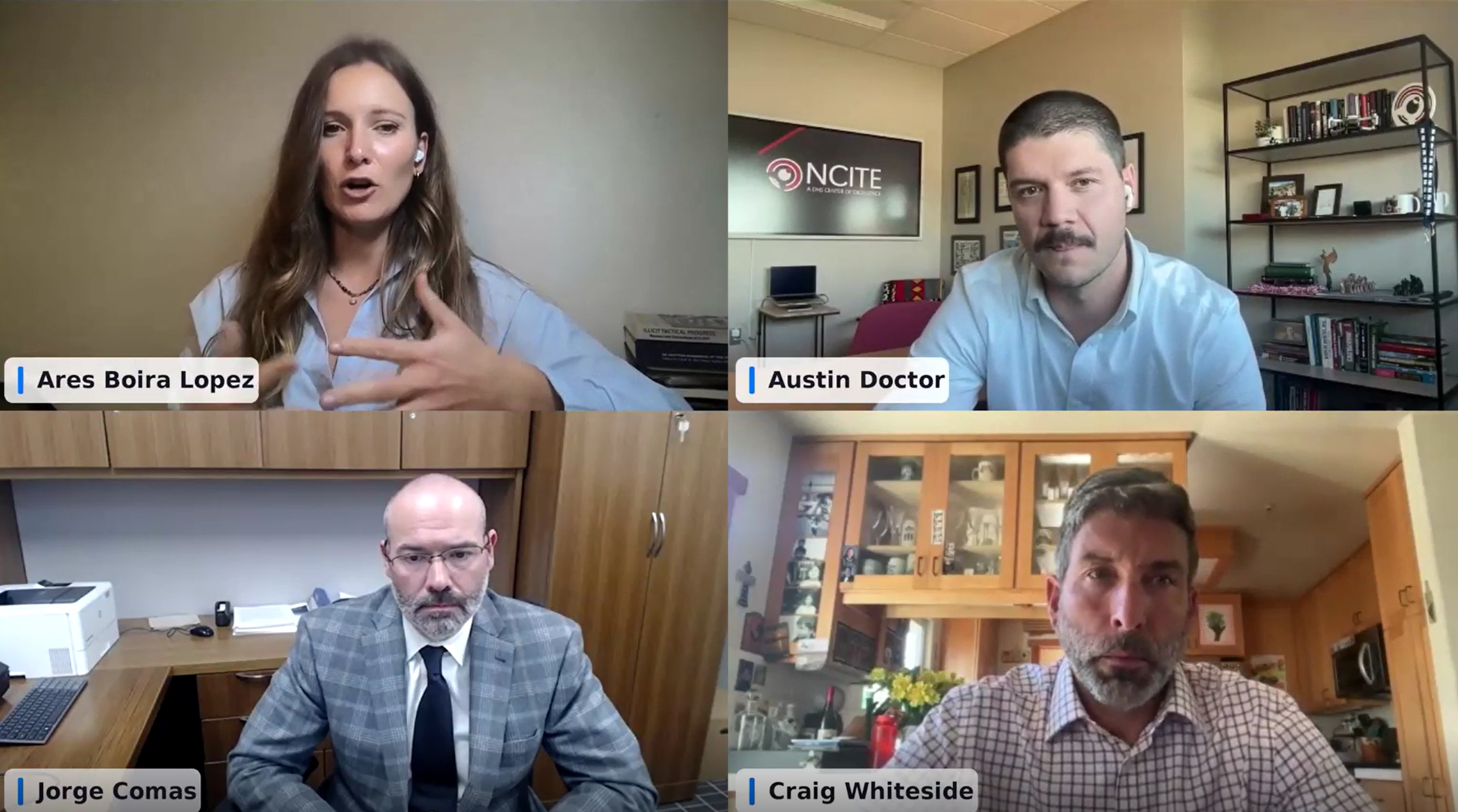
On Nov. 10, NCITE hosted a webinar with two NCITE scientists who work on the Disrupting Cartels research project, a leader of frontline border operations teams and a national security expert to address the difficulty of disrupting these highly adaptive networks. Register here to watch the full webinar on demand.
Panelists were:
- Jorge Comas, Director, Counter Network Division at U.S. Customs and Border Protection’s National Targeting Center
- Craig Whiteside, Ph.D., Professor of National Security Affairs at the U.S. Naval War College
- Ares Boira Lopez, Ph.D., NCITE Assistant Research Professor
- Moderator: Austin Doctor, Ph.D., NCITE Director of Strategic Initiatives; Co-PI, Disrupting Cartels research project
Key Takeaways:
Achieving long-term disruption of Mexican cartel activity means preventing the groups from adapting in the first place.
While stopping a cartel’s current tactic of transporting drugs across the U.S.-Mexico border is important, it can cause a repeated loop as the cartel innovates to find new methods, Boira Lopez said. For sustained prevention, authorities need to target the factors that aid cartels to innovate.
Doctor and Boira Lopez’s research focuses on understanding how the groups adapt and watching for early signs that they are changing operations.
“When an established method stops working, what allows these networks to recognize the problem, develop an alternative, obtain the knowledge and resources necessary to implement it and ultimately put that innovation into practice?” Boira Lopez said.
Cartel innovation varies from region to region.
The U.S. Customs and Border Protection counts more than 64,000 in the agency, and despite the large force, Comas said, Mexican cartel innovation can be vastly different in one section of the border, like Rio Grande Valley, compared to another area, like the Otay Mesa corridor, making training a challenge.
“How do we enable our workforce to be aware of [tactics, techniques and procedures (TTPs)] that we’re seeing in other geographic areas, how can they benefit from understanding what those TTPs are and the countermeasures against those TTPs while still persisting the capability that they have at their organic location?” Comas said. “It’s a big push-pull.”
When an established method stops working, what allows these networks to recognize the problem, develop an alternative, obtain the knowledge and resources necessary to implement it and ultimately put that innovation into practice?
Frontline workers should listen to each other and notice contrary intelligence indicators.
Since Mexican cartels are constantly adapting, it’s difficult to train workers to be aware of methods that haven’t happened before, Whiteside said.
“Sometimes they’re the first time this group has ever done anything, kind of tying into innovation again,” Whiteside said. “So it’s going to be a surprise. By definition, it’s an anomaly.”
However, Whiteside stressed to listen to frontline operators when there is a general sense of abnormality and be careful to not deny it out of hand. In his research, he found too many examples of people who were naïve and didn’t believe cartels had the capability to be successful in rare non-state special operations like prison breaks or hostage snatching.
Cartel innovation isn’t always sophisticated.
Boira Lopez pointed out that cartels are creative in trying new methods, and while some members use semi-submersibles or AI-assisted drones, others use low-cost, rudimentary materials as a quick idea to see whether the cartels’ objective fails.
“The creativity behind some of these inventions doesn’t have to be flashy,” she said. “Sometimes it’s sort of like a small experiment, fast fail sort of thing, especially along the southern border where we’re not talking about semi-submersible or AI-enabled drones.”
Additional Reading and Resources:
- "Drivers and Early Warning Indicators of Cartel Tactical Innovation", by NCITE's Ares Boira Lopez, Ph.D. and Austin Doctor, Ph.D.
- Summary Report of "Cartel Tactical Innovation: Network Drivers and Early Warning Indicators" by Ares Boira Lopez, Ph.D. and Austin Doctor, Ph.D.
- “Cartel Special Operations and Implications For U.S. Homeland Security and Defense” by Ian Rice, Craig Whiteside, Ph.D., and Austin Doctor, Ph.D.
- A new report examining Mexican cartel foreign terrorist organizations, part of an ongoing series by NCITE looking at all the 2025 and 2026 designations.
- Dr. Doctor's Nov. 9 op-ed, "Counterterrorism and the Growing Convergence in Homeland Security and Homeland Defense" published in Real Clear Defense
- "Criminal Entrepreneurial Ecosystem Dictionary": A reference guide to understand Foreign Terrorist Organization-designated Transnational Criminal Organization activity, design, and adaptation within ecosystems. By NCITE's Samuel Hunter, Ph.D., Amanda Moeller, Ph.D., Alex Bruens, Ph.D.