University of Nebraska at Omaha logo University of Nebraska at Omaha
REQUEST INFO VISIT APPLY

MY UNO DIRECTORY
University of Nebraska at Omaha logo
A U.S. Department of Homeland Security Center of Excellence National Counterterrorism Innovation, Technology, and Education Center (NCITE)
REQUEST INFO VISIT APPLY
MY UNO DIRECTORY
  • About Backback to Main menu
    • We Are NCITE
    • Newsletters
    • Our Community
    • Center Directory
  • Research Backback to Main menu
    • Research Portfolio
    • Published Reports
  • News Backback to Main menu
    • News Center
    • NCITE in the News
    • Podcast
  • Evolving Threats Backback to Main menu
    • Global Jihadism: 25 Years After 9/11
    • Nihilistic Violent Extremism (NVE)
    • Foreign Terrorist Designations Series
  • Events Backback to Main menu
    • Upcoming Events
    • ENVISION Conference
  • Get Involved Backback to Main menu
    • Donate to NCITE
    • Job Opportunities
  • Service Center
  1. UNO
  2. National Counterterrorism Innovation, Technology, and Education Center (NCITE)
  3. News
  4. 2026
  5. 11
  6. FTO Series: Analyzing Networks of Eight Major Mexican Cartels

FTO Series: Analyzing Networks of Eight Major Mexican Cartels

A new NCITE paper in an ongoing series details the alliance and subgroup structures of the Mexican cartels that were recently designated as foreign terrorist organizations.

  • published: 2026/11/04
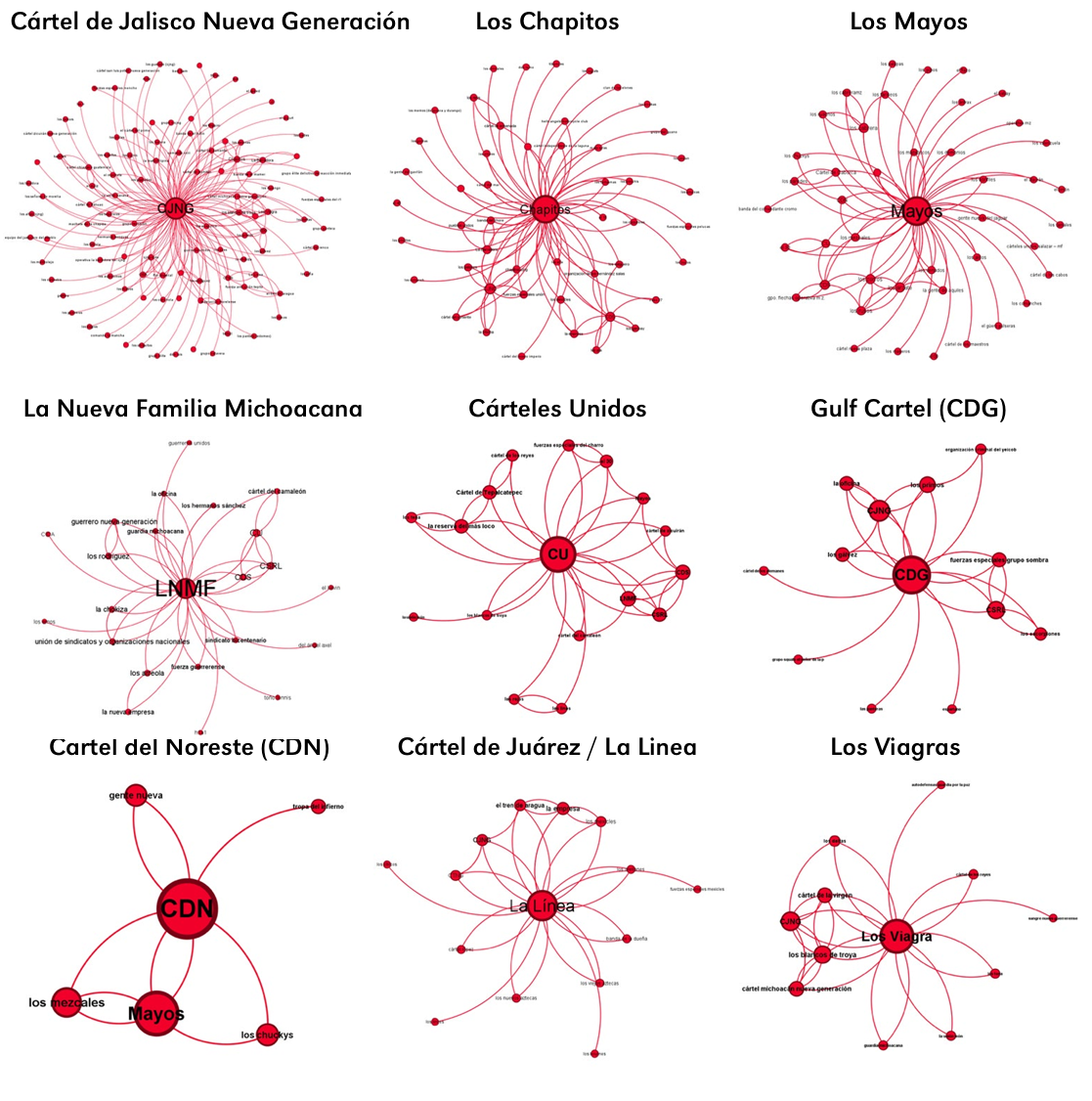
Alliance networks for nine Mexican cartel organizations and factions, illustrating variation in the number and arrangement of documented relationships surrounding each focal group.

Alliance networks for nine Mexican cartel organizations and factions, illustrating variation in the number and arrangement of documented relationships surrounding each focal group.

Removing a powerful Mexican drug cartel leader might seem like a major victory in combating organized crime. But the criminal networks operating beneath that leader can remain intact, adapt, and even grow stronger.

New research from the National Counterterrorism Innovation, Technology, and Education (NCITE) Center examines how Mexico's most powerful cartels operate through interconnected networks of criminal organizations, shifting alliances and increasingly sophisticated technologies — and why traditional strategies for dismantling these groups may not be enough.

Read the paper: “The Cartel-Terrorism Nexus: Assessing Mexican Cartels Designated as Foreign Terrorist Organizations” which examines the eight Mexican criminal organizations recently designated as foreign terrorist organizations. The paper is written by Nathan P. Jones, an associate professor of security studies in the College of Criminal Justice at Sam Houston State University.

Why it matters: The Mexican cartel threats posed to the U.S. is less about large-scale attacks and more about the steady harm that comes from transporting illicit drugs, people, weapons and money across the U.S.-Mexico border. Violence against local residents, Mexican government officials or U.S. citizens and law enforcement still persist among low-level leadership.

Key takeaways:

  • Taking down a cartel leader doesn’t take down the cartel. In February 2026, Mexican forces killed El Mencho, the leader of the largest and most powerful cartel in Mexico, Cártel de Jalisco Nueva Generacion (CJNG). However, thanks to CJNG’s extensive and dense network of alliances, the group suffered little fragmentation.
  • Cartel criminal activity extends far beyond drug trafficking. Cartels have diversified into fuel theft, cargo theft, extortion, smuggling, money laundering and other illicit enterprises affecting critical infrastructure and legitimate businesses. Their operations can exploit transportation, energy, telecommunications and other sectors, creating security challenges that extend beyond traditional counternarcotics enforcement.
  • Success in stopping the cartels depends on continued Mexico-U.S. cooperation. Authorities should plan for retaliation before a strike, consider targeting financial, alliance or laundering ties instead of a senior leader, and account for downstream impacts due to the cartels’ interconnectedness.

What they're saying:

  • Mackenzie Harms Wickersham, Ph.D., FTO series editor
    • “Of the groups covered in this series, the Mexican cartels designated as Foreign Terrorist Organizations in 2025 and 2026 pose the most direct and persistent threat to U.S. communities … They operate along the roughly 1,954-mile shared border and inside the United States.”

What’s next: This report is part of an ongoing NCITE research series examining the more than 30 groups designated as foreign terrorist organizations by the U.S. Department of State in 2025 and 2026. Look for more reports to be published this month, and go to the series homepage to read about all the groups.

News Sections

  • National Counterterrorism Innovation, Technology, and Education Center (NCITE) News Center
  • UNO News Center
  • The Maverick
  • The Bullseye
  • Campus Events

Featured

  • FTO Series: Analyzing Networks of Eight Major Mexican Cartels
  • FTO Series: Iran-Aligned Groups Pose Multi-Faceted Threats to U.S. in Wake of War
  • DHS Science & Technology Leaders Visit NCITE to Strengthen Government, Academic, Industry Partnerships
  • Criminology Graduate Students Investigate Drug Cartel Money Laundering

Most Viewed

  • In Seventh Year, NCITE Adds Projects on CBRN Deterrence, AI Vulnerabilities at Large Venues, and More

National Counterterrorism Innovation, Technology, and Education Center (NCITE)

Connect with NCITE
  • 6001 Dodge St.
  • Omaha, NE
  • ncite@unomaha.edu
Social media
Our DHS Partners
  • Centers of Excellence
  • Science & Technology Directorate (S&T)
  • Office of University Programs (OUP)
U.S. Department of Homeland Security Science and Technology Grant Acknowledgement and Disclaimer. The material on this website is based on work supported by the U.S. Department of Homeland Security under Grant Award Number 20STTPC00001-05. The views and conclusions included here are those of the authors and should not be interpreted as necessarily representing the official policies, either expressed or implied, of the U.S. Department of Homeland Security.

Services and Resources

  • Academic Calendar
  • Course Catalogs
  • MavCARD Services
  • MavLINK
  • my.unomaha.edu
  • UNO Brand Guide

Related Links

  • A-Z List
  • Employment
  • University of Nebraska System

Campus Links

  • Accessibility
  • Billing Office
  • Buildings and Maps
  • Campus Directory
  • Campus Safety
  • Events
  • Human Resources
  • Library
  • Military-Connected Resource Center
  • News
  • Registrar
  • Samuel Bak Museum: The Learning Center

Policies and Reporting

  • Emergency Information Alert
  • MavsReport
  • Notice of Nondiscrimination
  • NU Foundation
  • Privacy Statement
  • University Policies
  1. Privacy Statement
  2. Accessibility
  1. 402.554.2800

University of Nebraska at Omaha
University of Nebraska at Omaha, 6001 Dodge Street, Omaha, NE, 68182
  • ©  

Social Media


Omaha Skyline

Our Campus. Otherwise Known as Omaha.

The University of Nebraska does not discriminate based on race, color, ethnicity, national origin, sex, pregnancy, sexual orientation, gender identity, religion, disability, age, genetic information, veteran status, marital status, and/or political affiliation in its education programs or activities, including admissions and employment. The University prohibits any form of retaliation taken against anyone for reporting discrimination, harassment, or retaliation for otherwise engaging in protected activity. Read the full statement.