

Matrix Business Systems Builds a Better Way to Manage Print
What began as a leap from corporate to entrepreneurship is now a company redefining how organizations manage print infrastructure.
- published: 2026/04/09
- contact: NBDC Communications - Nebraska Business Development Center
- phone: 402.554.6256
- email: melissalindell@unomaha.edu
Lincoln, NE – When Kevin Frey and his business partner, Scott Hoyt, launched Matrix Business Systems nearly 20 years ago, they weren’t simply starting a company; they were challenging an industry model they believed no longer worked.
For Frey, that realization came after years in the office technology industry and a defining moment during a meeting with a Fortune 100 company.
During the discussion, Frey began outlining a different approach, one that reduced reliance on service intervention and gave organizations greater control over their environments.
“The CEO stopped the meeting and asked, ‘Why don’t you just start your own company?’” Frey said. “I really didn’t have a good answer.”
That moment became the catalyst for Matrix Business Systems, a Nebraska-based company focused on helping organizations manage print infrastructure in a simpler, more controlled, and more reliable way. The company’s first customer was the same organization that encouraged Frey to make the leap.
From the beginning, Matrix was built around a different idea of how the industry could operate.
“We looked at how the industry was operating and realized it was built around the limitations of the technology,” Frey said. “That’s what created the need for service technicians. Once that changes, the model can change with it.”
Rather than refining the traditional model, Matrix focused on a more fundamental issue.
That thinking led to the development of InPower®, a 24/7 print infrastructure program designed to give organizations full control over their environments by removing dependence on ongoing service intervention.
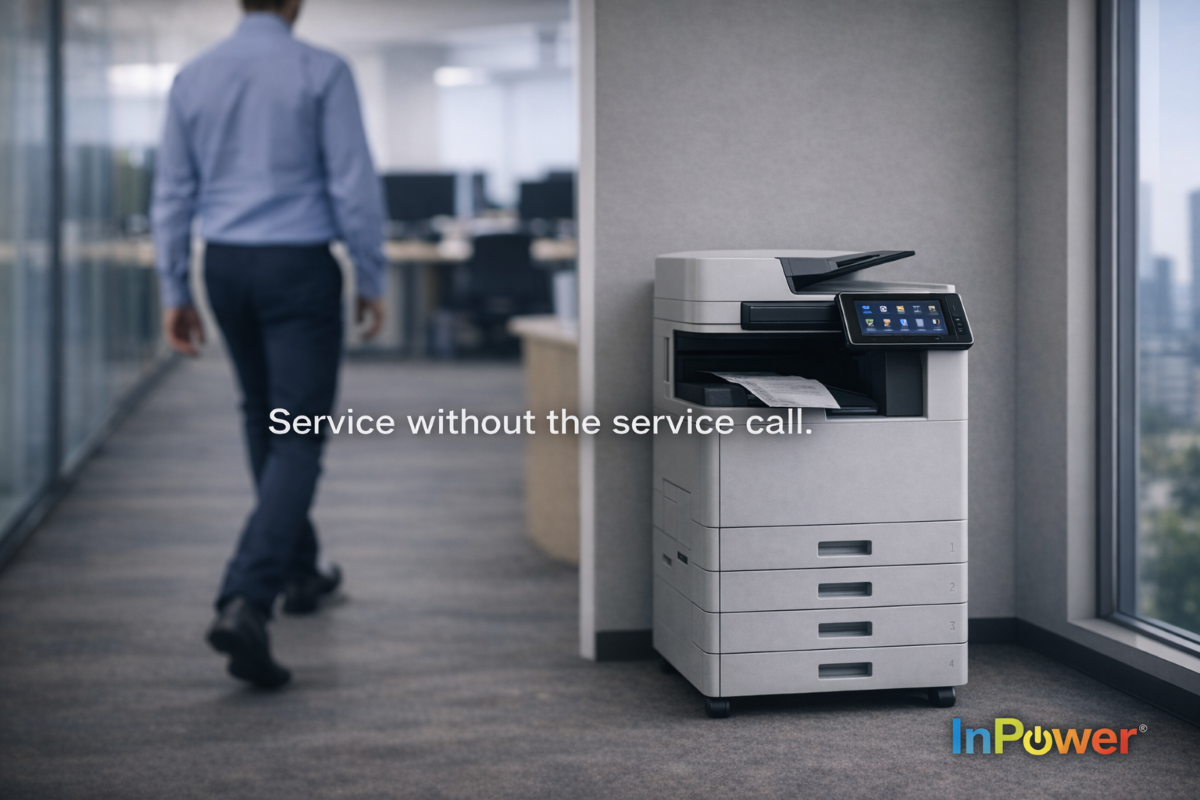
“InPower® allows organizations to manage their own environment without relying on ongoing service calls,” Frey said. “It’s not a managed service; it’s a transfer of capability.”
That model became especially relevant during the COVID-19 pandemic, when on-site service calls were restricted, and businesses across the country were forced to rethink how they supported equipment. While much of the industry stalled, Matrix was already aligned with a different approach.
“Our industry was so service-dependent that it came to a complete halt,” Frey said. “Companies were asking if we could leave parts at the door and walk them through things remotely. That’s exactly the kind of problem we had already been working to solve; it validated the direction we were going.”
At the same time, the role of these devices was beginning to change.
Printers were no longer just output devices; they had become part of the broader digital infrastructure, connected to workflows, document security, and compliance.
Intellectual property is today’s modern currency.
When an MFD scans a contract, prints a medical order, or routes a legal document into a workflow, it becomes a secure transport point for that currency.
This makes the MFD more than office equipment; it becomes part of the organization’s digital boundary.
“As printers became part of the digital infrastructure, they also became part of the security boundary,” Frey said. “What we were building aligned with the need for greater control over those environments.”
A key part of that shift was Matrix’s early adoption of Epson’s PrecisionCore technology. While many organizations still associated inkjet with outdated limitations, Matrix recognized that the technology had fundamentally shifted, from mechanical dependency to digital control.
The shift from heat-based mechanical systems to digitally controlled print systems significantly reduces wear components and service dependency, helping stabilize performance over the life of the device.
“The biggest challenge was convincing people that what they thought they knew about the technology wasn’t true anymore,” Frey said. “There was about a 30-year gap between perception and reality.”
Despite that challenge, Matrix continued to grow by staying focused on innovation, building trust with customers, and advancing a different operating model.
As the company began exploring government contracting opportunities, Frey turned to the Nebraska Business Development Center (NBDC) and its APEX Accelerator program for guidance.
“They helped us understand how the government evaluates solutions,” Frey said. “It’s different from enterprise business. They helped us align our positioning with expectations around security, control, and performance.”
“APEX helped us understand how the government evaluates solutions, not just how to sell them,” he added.
Frey said NBDC’s support has been especially valuable in helping Matrix navigate the government marketplace and better understand what agencies are looking for in contractor relationships.
“What the government is looking for now isn’t just vendors,” he said. “They’re looking for partners.”
He also credited NBDC APEX consultant Quentin Farley for providing clarity, honest feedback, and practical guidance throughout the process.
“Some days are just days, and some days are impactful,” Frey said. “I’ve had impactful days working with NBDC. Quentin has been a very good resource, available, focused, and committed to helping us succeed.”
“Kevin is an innovator and solutions-oriented individual,” Farley said. “He approaches each client with a deep understanding of their needs and tailors his solutions accordingly. Connecting him with government opportunities has been exciting because of that understanding. He actively engages with government buyers and proactively reaches out to agencies.”
Although Matrix works with manufacturers and customers on a broad scale, Frey said Nebraska remains central to the company’s identity.
“We chose to be in Nebraska because it puts us in the middle of it all,” he said. “It gives us perspective, access, and a way to stay connected to the environments we serve.”
That mindset has shaped Matrix’s culture. Following the pandemic, the company operates with a lean team of four, reflecting its shift away from service dependency toward a model that requires far less external intervention.
“When you put four people together focused on outcomes, it’s amazing what can get done,” Frey said.
Beyond business growth, Matrix is also committed to expanding access to technology and education. Frey said the company is working with manufacturers and school districts to bring advanced tools, including robotics, into classrooms and rural communities.
“If students don’t have exposure or opportunity, we’ll never know what they could become,” he said.
Looking ahead, Matrix plans to deepen its work within government and other controlled environments while continuing to collaborate with manufacturers on advancements in print technology and device security.
For Frey, success is not just about growth; it’s about shifting an industry that has operated the same way for decades.
“Success for me will be that we influenced and changed the direction of an industry that hasn’t had movement in 30 years,” he said.
Now, as the technology has advanced, the operating model is beginning to follow.
InPower™ is a program developed and delivered by Matrix Business Systems.