

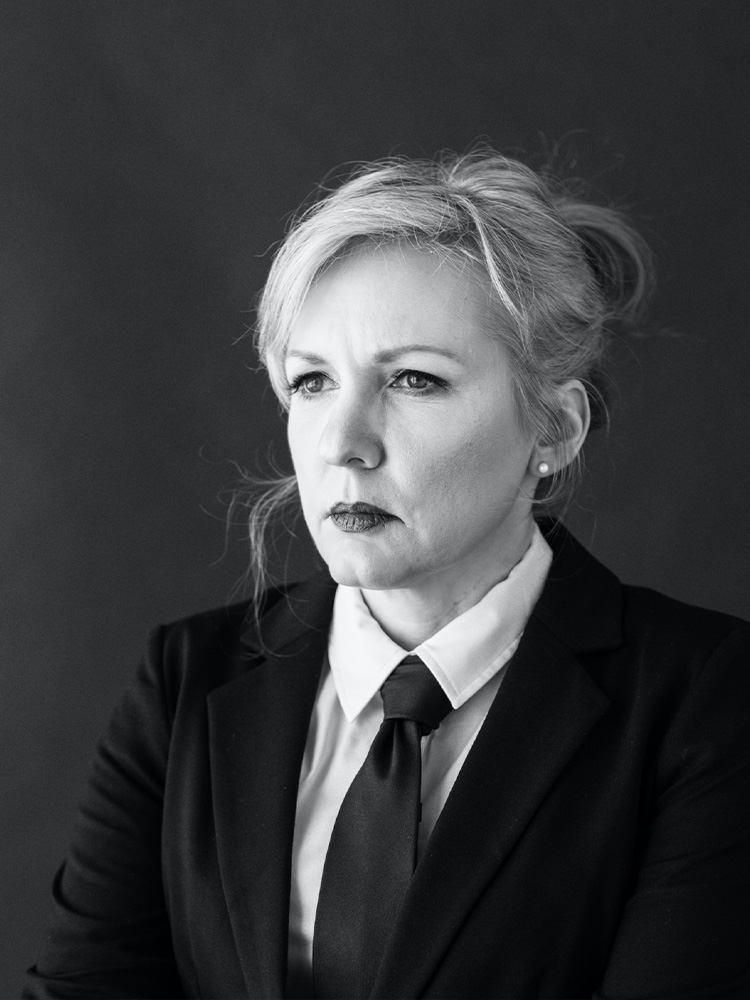
Chris Harding Thornton
- Fiction Mentor
- MFA in Writing
Biography
Chris Harding Thornton grew up in rural Nebraska and Omaha, where most of her ancestors, lacking more lucrative options, began arriving in 1856. She was born with eleven grandparents (her parents’ parents, six great-grandparents, and one great-great-grandmother). She’s held many strange jobs (stuffing Easter eggs in a gym basement, screwing lids on canisters in a plastics factory, doing quality assurance for a condom company, running record stores and hole-in-the-wall clubs, booking ill-fated tours for bands, selling porn and lottery tickets while her car was broken down in Iowa, flipping burgers, interior designing corporate apartments—only the IRS knows the rest). Yet none of these vocations has been as strange as writing.
Chris has published fiction, creative nonfiction, and poetry. Her two novels were released by an imprint of Farrar, Straus & Giroux, then Picador. The first, Pickard County Atlas, was chosen by author Tana French as a PBS Masterpiece Best Mystery of 2021 and was published in German translation in 2022. The second, Little Underworld, was a USA Today bestseller. Her books have been featured in the Wall Street Journal, The New Yorker, The New York Times, The Washington Post, and other publications. She holds a PhD from University of Nebraska–Lincoln and an MFA from University of Washington, where she was honored to mentor with National Book Award-winner and MacArthur Fellow Charles Johnson. Chris teaches writing and literature courses, offers developmental and line-level feedback to writers working in a range of genres, crafts artist biographies and promotional copy for musicians, and is jotting down a third novel.
Teaching Philosophy
"I approach what I read from the perspective of how I write, which is ever-changing. But to give you a feel, I often begin with a kernel and end up with a thing that is maybe tangentially related. I’m grateful for that (as the adage goes, “Our stories are smarter than we are”). I write to grapple with what I don’t understand, to experience and transcribe senses, and to let myself be surprised by the music of language, the humdrum wonders I take for granted, and the unexpected directions a piece takes.
After I do all that, I see my task as this: I respect the work, empathize with it, listen for its intentions (letting go of mine), then shape and hone until not one word, phrase, sentence, or comma can be plucked out without the whole thing falling apart.
Do I achieve this? Come on.
I am an organism who changes from moment to moment, and writing is made of words like these. These are sets of squiggles that stand for things that are usually not squiggles. I desperately piddle in this medium of symbolic generalizations in search of brief epiphanies and good times (broadly defined). That said, when I know why a word must be italicized here and not there, I get a burst of momentary satisfaction.
Then I’ll go read The Dhammapada or some other wise old book, lament that I’m limited to reading a translation, remember text is inherently translation, and go back and forth about my urges for momentary satisfaction. So:
As a mentor, my first priority is to read organically—to be transported and immersed, maybe to be told a yarn, always to experience. Then I reread, taking into consideration where the writer perceives the piece to be, process-wise. I often remind myself and the writer that our processes can change over time and from piece to piece (here’s another sometimes-useful generalization: “Every story/poem/essay teaches you how to write it”).
In feedback, I tell writers where I’m swept up and where (if anywhere) I’ve stumbled. I do this with recognition that a stumble may serve a crucial purpose, if not in this draft, maybe the next. Or the one after that. I do the best I can to ground my observations within the framework—the universe—of the piece as I understand and feel it, and I encourage workshops to do the same (I find this helps avoid a pile of well-intentioned but weird suggestions like “What if this meditation about a carrot were instead a scene featuring a bear robbing a bank?” The answer is: That would be a different story. Here, we have a carrot).
When I’ve offered feedback, I then work hard to listen to the writer. I sometimes reply, Oh! Never mind! Other times, I offer tips and tricks that have been helpful for me. Those range from finessing verb tenses to finding a sweet spot in the day to write. But I always stress this: If feedback doesn’t resonate with you, scrub it from your brain. Redact the wrong bits with a magic marker. And if some feedback is a little too resonant, a reasonable reaction is to stew in resentment for a while. Just try not to let it be two years before you axe and rewrite that paragraph or stanza or chapter.
Mainly, though, I encourage. Some would say I enable. What we do is irrational, fiscally irresponsible, and subject to derision. But on our good days, we find pinpoints of light in dark places. We offer a breath, maybe even a laugh that, for one moment, transforms and transcends suffering. I’ll enable that. I am all for that."