University of Nebraska at Omaha logo University of Nebraska at Omaha
REQUEST INFO VISIT APPLY

MY UNO DIRECTORY
University of Nebraska at Omaha logo
College of Arts and Sciences
REQUEST INFO VISIT APPLY
MY UNO DIRECTORY
  • About Us Backback to Main menu
    • About Us
    • Departments & Programs
    • News & Events
    • Dean's Office Staff
    • Faculty/Staff Resources
    • Organizational Chart
  • Academics Backback to Main menu
    • Undergraduate Programs
    • Graduate Programs
    • Love Your Major
    • Pre-Health
    • Pre-Law
    • Arts and Sciences Minors
    • Academic Advising
    • Academic Support
  • Admissions
  • Student Opportunities Backback to Main menu
    • Scholarships
    • Student Organizations
    • Internships
    • Study Abroad
  • Community Engagement Backback to Main menu
    • Community Engagement
    • College Centers
    • Conferences
    • Nature Preserves
    • Professional Services
    • Teacher Training
    • Youth Programs
  • Research Backback to Main menu
    • Research
    • Student Research Support
    • Social Science Research Commons
  • Support Us
  1. UNO
  2. College of Arts and Sciences
  3. CAS News
  4. 2026
  5. 04
  6. Journal Club Turns Complex Research into Conversation

Journal Club Turns Complex Research into Conversation

Journal Club helps students at all levels engage with scientific literature, preparing them for future careers in health and research.

  • contact: Annie Albin
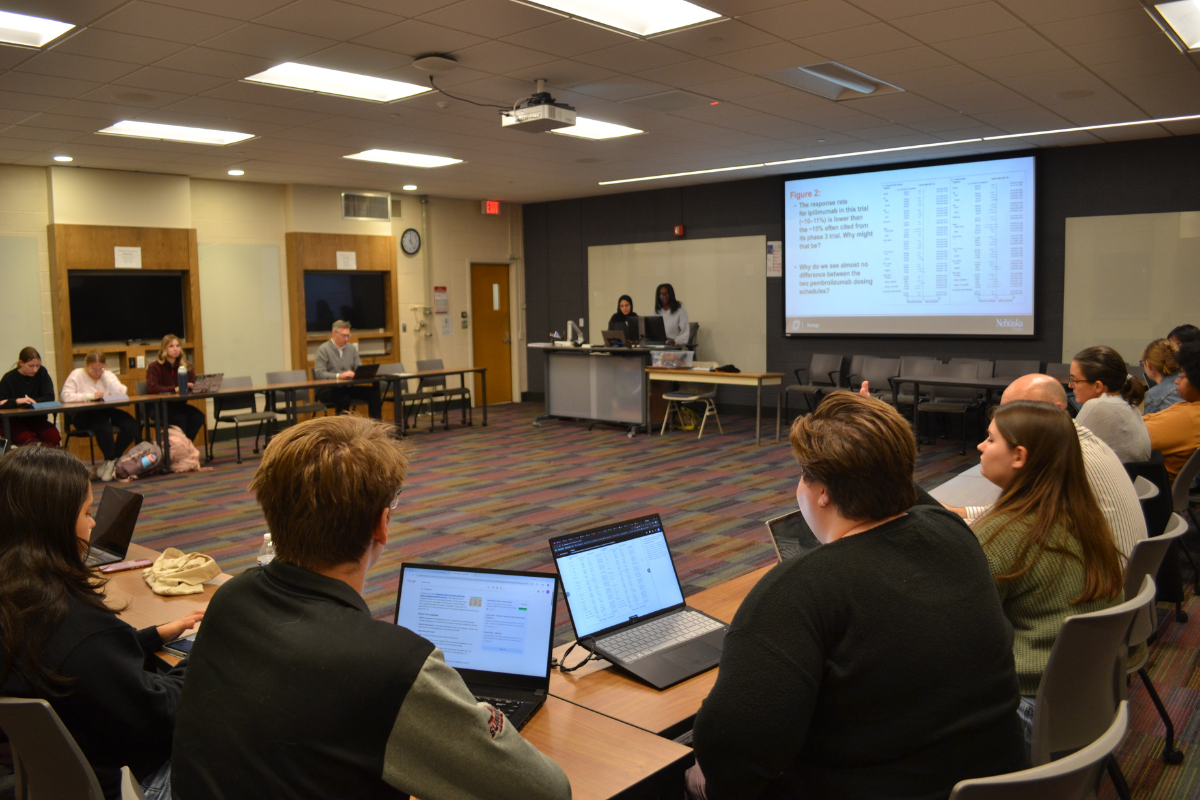
Students sit in Journal Club and discuss a reading.

Tucked into a classroom in Allwine Hall, scholarly students are staring at a presentation about scientific advancements in complete silence. They look from their notebooks, to their laptops, to their fellow learners surrounding them, waiting for someone to break the ice.

Finally, a lone hand reaches into the air. As they begin to speak, the energy in the room shifts. More hands climb, and more voices join the conversation.

It’s another evening at Journal Club. The group, led by Profs. Paul Denton and Karen Kim-Guisbert, convenes every other week to dive into a different academic journal article. Every semester they focus on articles around a specific subject— from following a drug from idea to FDA approval, to neurogenerative diseases.

At each meeting, groups of two-to-three students present a new article. After pouring over the evidence, they pose questions to the audience and prompt discussions that range from the methods used by the researchers, to the interpretations of the data, and to the broader implications of the findings.

Attendees come from all levels of science – from students still in their first few semesters of undergraduate courses, to those pursuing graduate degrees, to professors with cemented scholarly experience.

Together, they dig through the daunting journal articles as a collective. No question is wrong, no statement straightforward — they break down the paper line by line, measurement by measurement, examining every part of the study to help them understand its intentions, findings, and applications.

Rachel Ma is a first-year student and active Journal Club member. For Ma, the club provides an opportunity to gain familiarity with journals — something she’s sure she’ll see often in her future medical career.

“As a pre-health student, I think it just gives a lot more exposure to these different scientific concepts, even if it's just a short glimpse,” Ma said.

Patricia Harte-Maxwell also joined Journal Club as a first-year student. Even now as a graduate teaching assistant in the biology department, Harte-Maxwell still attends Journal Club as a regular practice.

“One of the greatest things about Journal Club is sort of reminding people... okay, you don't just know everything,” Hart Maxwell said. “Reading science, learning, is a constant thing. It's a muscle that you keep using.”

--

Announcements and notification regarding the journal club are made via a Canvas module. If you are interested in participating in the journal club and you have not previously been added to the Journal Club Canvas module, please reach out directly to Dr. Paul W Denton: pdenton@unomaha.edu

News Sections

  • College of Arts and Sciences News Center
  • UNO News Center
  • Maverick Daily
  • The Bullseye
  • Campus Events

Featured

  • Journal Club Turns Complex Research into Conversation
  • 18th Student Research and Creative Activity Fair Showcases Innovation Across UNO
  • CAS Student Gets Research Experience Abroad
  • UNO to Launch Humanities Internship Initiative

Most Viewed

  • Chief Justice Role Provides UNO Student with Foundation for Legal Education
  • From On-Campus in 1971 to Online in 2025: Ben Simmons's UNO Experience
  • OLLAS Announces New Cohort of Next Generation Leadership Scholars

About the College of Arts and Sciences

College of Arts and Sciences

Contact Us
  • 220 Arts & Sciences Hall
  • College Advising Office
Social media
College Resources
  • For Faculty and Staff
  • Math-Science Learning Center
  • The Writing Center
Arts and Sciences Hall building with large white columns in front of a pink and orange sunset.

Services and Resources

  • Academic Calendar
  • Course Catalogs
  • MavCARD Services
  • MavLINK
  • my.unomaha.edu
  • UNO Brand Guide

Related Links

  • A-Z List
  • Employment
  • University of Nebraska System

Campus Links

  • Accessibility
  • Billing Office
  • Buildings and Maps
  • Campus Directory
  • Campus Safety
  • Events
  • Human Resources
  • Library
  • Military-Connected Resource Center
  • News
  • Registrar
  • Samuel Bak Museum: The Learning Center

Policies and Reporting

  • Emergency Information Alert
  • MavsReport
  • Notice of Nondiscrimination
  • NU Foundation
  • Privacy Statement
  • University Policies
  1. Privacy Statement
  2. Accessibility
  1. 402.554.2800

University of Nebraska at Omaha
University of Nebraska at Omaha, 6001 Dodge Street, Omaha, NE, 68182
  • ©  

Social Media


Omaha Skyline

Our Campus. Otherwise Known as Omaha.

The University of Nebraska does not discriminate based on race, color, ethnicity, national origin, sex, pregnancy, sexual orientation, gender identity, religion, disability, age, genetic information, veteran status, marital status, and/or political affiliation in its education programs or activities, including admissions and employment. The University prohibits any form of retaliation taken against anyone for reporting discrimination, harassment, or retaliation for otherwise engaging in protected activity. Read the full statement.