

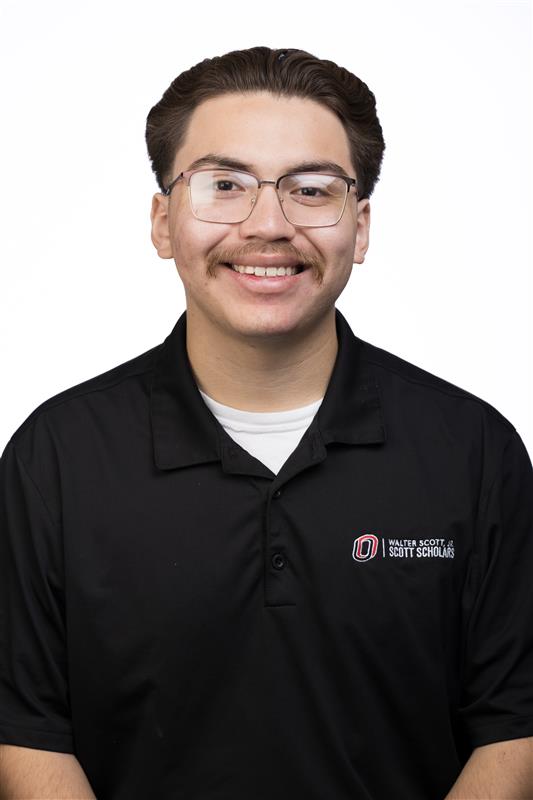
Bryan Benitez
- Scott Scholar | Class of 2027
- Neuroscience | Spanish
email:
Bryan currently serves as an INBRE Research Associate in Dr. Ganesh Naik’s lab in the UNO Department of Chemistry, where he helped establish a new cancer biochemistry research space and investigates signaling pathways involved in MYC-amplified medulloblastoma. His work focuses on the relationship between SYK, AKT/mTOR signaling, MYC, and oxidative stress in cancer cells. Previously, Bryan participated in UNMC’s Summer Undergraduate Research Program in Dr. Donald Ronning’s lab, where he studied EgtD, an enzyme involved in the ergothioneine biosynthesis pathway of Mycobacterium tuberculosis. Bryan has also conducted cancer disparities research through UNMC, identifying barriers to breast and colorectal cancer screening among Hispanic patients in Omaha and examining outcomes among patients with esophageal cancer. His technical experience includes protein crystallization, X-ray crystallography, protein structure refinement and computational modeling, biochemical and enzymatic assays, cell culture, Western blotting, gel electrophoresis, and behavioral assays. He also has experience conducting literature reviews and analyzing oncogenic signaling pathways involving MYC, SYK, AKT, and mTOR.
At UNO, Bryan serves as president of Sigma Delta Pi, the Spanish Honor Society, and supply and operations director for the UNO chapter of Blueprints for Pangaea. He has also served as agency director for the American Multicultural Students Agency, treasurer of the Public Health Student Association, and in multiple leadership positions within the Association of Latin American Students, including president and vice president. Bryan has additionally served in UNO Student Government and is involved with the Elevate Omaha Steering Committee and UNMC's Long Term Enhanced Advising and Preparation for Medical School (LEAP) program.
Bryan plans to pursue an MD or MD/PhD and a career integrating medicine, biomedical research, and public health. His research interests include cancer biology and therapeutics, particularly the molecular pathways underlying aggressive cancers, as well as cancer health disparities and access to screening and treatment. Long term, he hopes to combine oncology, translational research, and public health efforts to improve cancer outcomes in medically underserved and marginalized communities.