

WEBINAR RECAP: Reimagining Suspicious Activity Reporting
On May 12, NCITE hosted a webinar on next-generation technologies – such as AI, spatial computing, and autonomous systems – being integrated into the full suspicious activity reporting (SAR) process, emphasizing how they enhance human judgment rather than replace it.
- published: 2026/05/15
- contact: NCITE Communications
- phone: 4025542972
- email: ncite@unomaha.edu
- search keywords:
- suspicious activity report
- next-generation technology
- AI
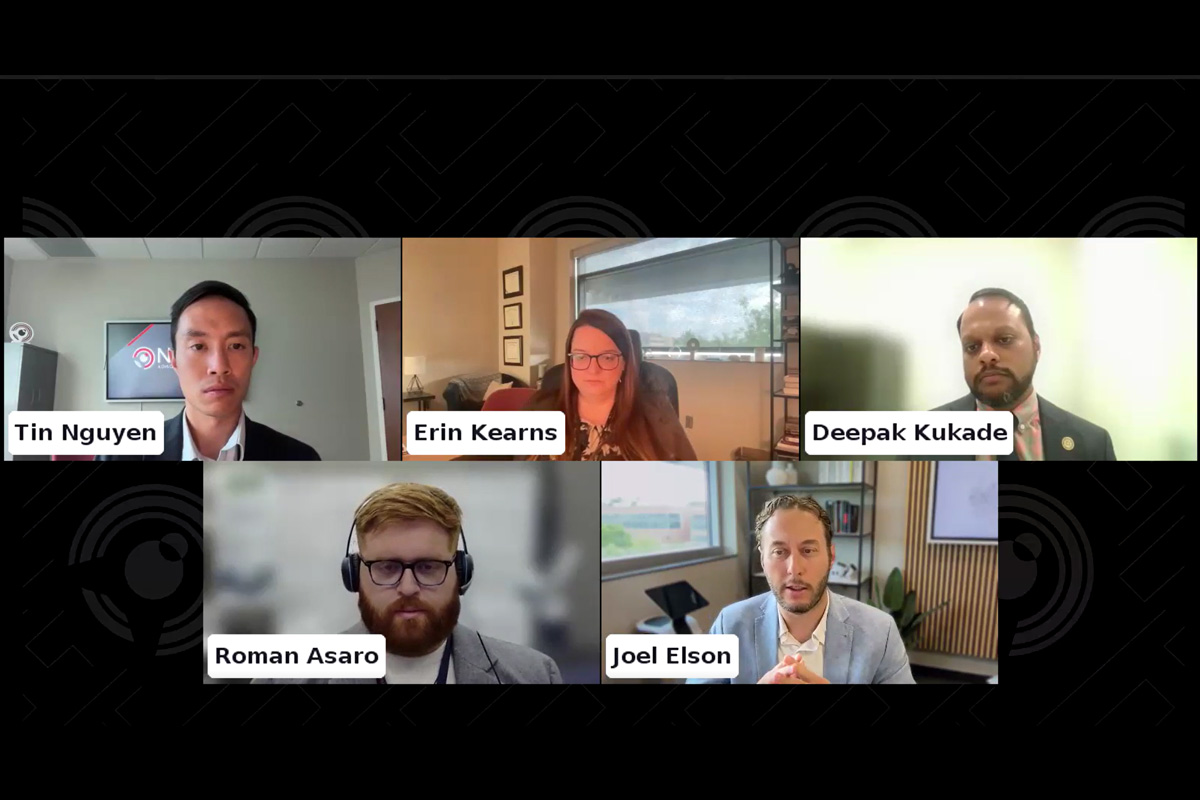
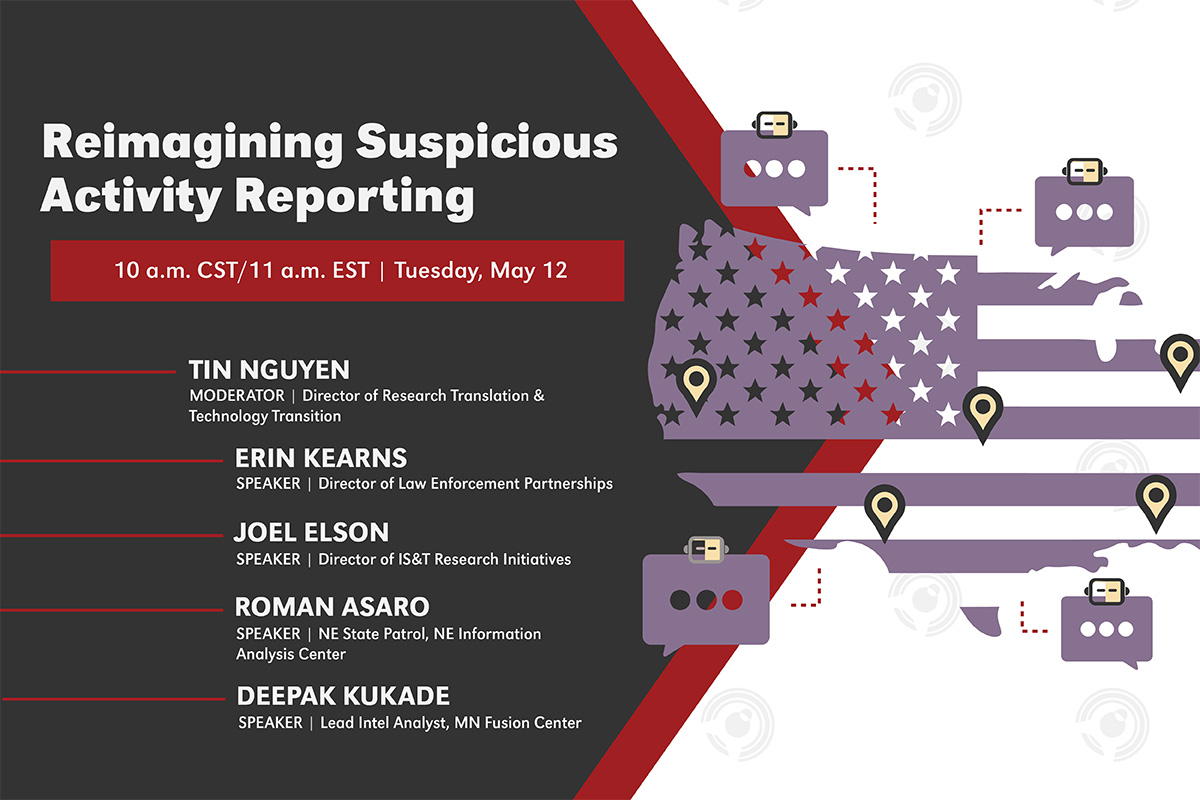
On May 12, NCITE hosted a webinar introducing a lifecycle framework that maps next-generation technologies – such as AI, spatial computing, and autonomous systems – onto the full suspicious activity reporting (SAR) process, emphasizing how they enhance human judgment rather than replace it. Panelists included:
- Tin Nguyen, Ph.D. | Director of Research Translation & Technology Transition
- Erin Kearns, Ph.D. | Director of Law Enforcement Partnerships
- Joel Elson, Ph.D. | Director of IS&T Research Initiatives
- Roman Asaro | Crime Analyst, NE Information Analysis Center (NE State Patrol)
- Deepak Kukade | Lead Intel Analyst, MN Fusion Center
Check out a recording and key takeaways below.
Key Takeaways
Sourcing high-quality information from the public remains a core challenge. It requires that the public can (1) identify concerning behaviors, (2) know that it should be reported to authorities and be willing to do so, (3) know how to report that information, and (4) provide enough information for analysts. “In short, there’s a lot in the chain of events that can go wrong,” Nguyen said. Other barriers include reporter concerns on maintaining anonymity and “not wanting to waste law enforcement’s time,” Kearns said.
In some contexts, there’s an oversaturation of tip reporting mechanisms. In Minnesota, according to Kukade, the upward trend of targeted violence and mass shootings on schools in recent years has prompted schools, their districts, local government, local law enforcement, and state government to promote distinct tip reporting systems. The wide field of options makes it difficult for the public to know where to turn and hampers fusion centers’ ability to corral all the information.
- “The official marketing and messaging that goes around that is that we aim and strive to be force multipliers to give the public, and especially juveniles, an avenue to report confidently and securely and anonymously,” Kukade said. “But I do think that this may have led to a decrease in overall reporting.”
Improving reporting quality requires direct user engagement. Teaching the public the nuance of what indicators to look for – and in what scenarios – is difficult through PSA vehicles like billboards and TV and digital advertising. Fusion centers and other tips reporting agencies need to “go back to the old school, just go on a road show and go meet and engage with the community,” Kukade said.
- Kukade and Asaro acknowledged that the general public is largely unaware of fusion centers, what they do, and tips reporting in general. “That is a huge limitation we have, and with that comes public trust,” Asaro said.
Ongoing research is necessary – before and after tool implementation. Kearns and her team have analyzed fusion center SAR platforms across the country, evaluating components like ease of access, UI, and which questions are required. Their review revealed a diverse range of SAR infrastructure. “We are a stone's throw from Iowa, and yet the two states have vastly different ways of collecting this information,” Kearns said.
- To develop emerging technology integration best practices, Kearns and Elson are developing a national experiment in which participants will be presented with a suspicious scenario and then randomly assigned to a reporting mechanism (web form or chatbot) where they will vary what information is specifically requested. “This allows us to actually empirically validate which questions are eliciting the most accurate information while decreasing inaccuracies in reporting,” Kearns said.
- Elson noted that while the reporting stage is crucial, ongoing evaluation of the potential of AI tools in the broader SAR lifecycle is necessary to ensure total efficacy. “Triage, validation, information sharing in response teams – digital intake is just the tip of the iceberg,” Elson said.
Adoption will be a cautious process. AI tools are not currently integrated into most fusion center operations, according to Asaro and Kukade, and civil liberty concerns (as codified in the Code of Federal Regulations, title 28, part 23) around criminal intelligence systems will likely require legislative review before implementation. Demonstrating value with research and applied case studies, too, will take time.
- “A lot of it depends on our education of the technology at hand and becoming more familiar and incorporating that into the policies in place,” Kukade said.
Disclaimer: The views and conclusions contained in this webinar are those of the authors and should not be interpreted as necessarily representing the official policies or views, either expressed or implied, of the U.S. Department of Homeland Security, the University of Nebraska, or guest-affiliated institutions.