

NCITE Briefing — Iran-Aligned Newly Designated FTOs
In response to the escalating U.S.–Israel–Iran conflict, NCITE has developed a rapid report examining Iran-aligned, newly-designated Foreign Terrorist Organizations (FTOs).
- published: 2026/03/02
- contact: NCITE Communications
- phone: 4025542972
- email: ncite@unomaha.edu
- search keywords:
- Iran
- homegrown violent extremism
- Hamas
- Hezbollah
- FTO
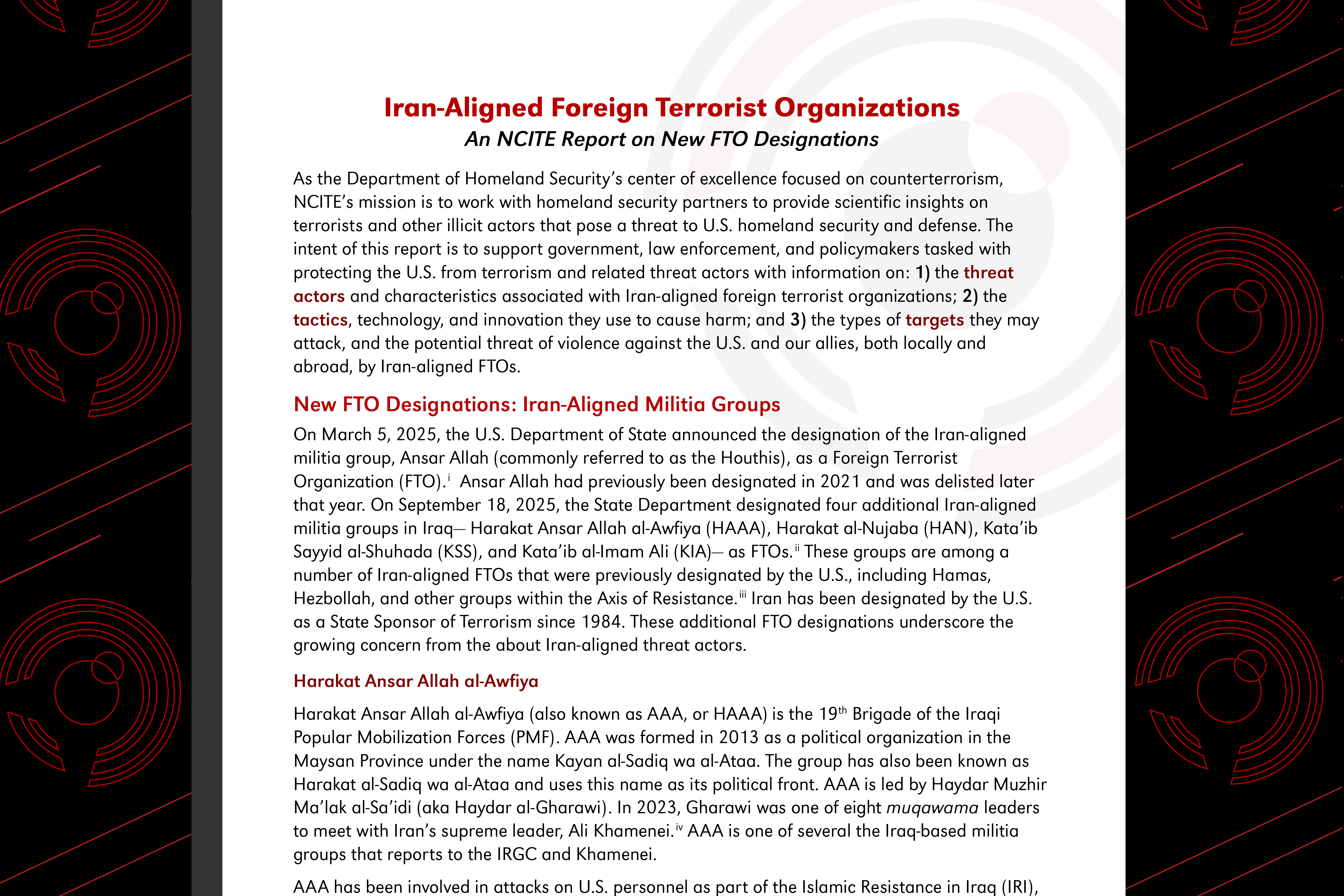
In response to the escalating U.S.–Israel–Iran conflict, NCITE has developed a rapid report examining Iran-aligned, newly-designated Foreign Terrorist Organizations (FTOs). As the Department of Homeland Security’s Center of Excellence focused on counterterrorism, NCITE developed the report to support policymakers, law enforcement, and homeland security partners navigating the current security environment.
The FTOs profiled include:
- Harakat Ansar Allah al-Awfiya
- Harakat Hezbollah al-Nujaba
- Kata’ib Sayyid al-Shuhada
- Kata’ib al-Imam Ali
- Ansar Allah (Houthis)
Beyond these profiles, the report examines the tactics and capabilities of the Iran-backed Axis of Resistance and the implications for U.S. homeland security and defense.
Further Resources
For further context, see items below from the NCITE repository.
On Homegrown Violent Extremism (HVE)
Homegrown: U.S. Federal Cases Against ISIS (2014-2025)
- This NCITE report analyzes 272 U.S. federal ISIS-related cases from 2014–2025, illustrating the scope, demographics, and legal outcomes of ISIS-linked activity in the United States.
On Hezbollah
The Mapping Militants Project, helmed by NCITE consortium experts Martha Crenshaw, Ph.D., and Kaitlyn Robinson, Ph.D., updated their profile on the Lebanon-based foreign terrorist organization Hezbollah in early 2026. In October 2024, Crenshaw recorded a podcast with NCITE on the group's history, drawing from over four decades of experience researching in the counterterrorism field.
On Malign Use of Drones
Read two articles below from NCITE's research into malign exploitation of unmanned aerial systems (UAS).
- Drones provide versatile operational capabilities across the terrorist ecosystem today
- Terrorists value drones for disruption, precision, and reputational signaling effects
- Adoption driven by network diffusion, affordability, and commercial accessibility
- Barriers remain but continue weakening as technology advances globally
- Enabling conditions suggest sustained growth in terrorist drone threats
- Drones exploit aerial vulnerabilities bypassing traditional ground-based security measures
- Military installations and critical infrastructure frequently targeted by drone attacks
- Open spaces and exposed buildings remain highly susceptible to intrusion
- Infrastructure sectors risk cascading disruptions from coordinated drone attacks
- Proactive geospatial risk mapping essential for effective counter-UAS strategies
On Feb. 3, NCITE hosted a webinar on the widespread adoption of drones by Mexican cartel forces and the robust supply chains that support these operations. Read the key takeaways from the team's panelists, Austin Doctor, Ph.D., Joel Elson, Ph.D., and Suat Cubukcu, Ph.D., and watch a recording below.