

WEBINAR RECAP: Homegrown: ISIS in the U.S. with Meghann Teubner
On Jan. 22, NCITE hosted a webinar with Meghann Teubner, assistant commissioner of intelligence analysis in the Intelligence Division of the NYPD Intelligence and Counterterrorism Bureau, on ISIS cases in the United States.
- published: 2026/01/30
- contact: NCITE Communications
- phone: 4025542972
- email: ncite@unomaha.edu
- search keywords:
- ISIS
- homegrown terrorism
- domestic extremism
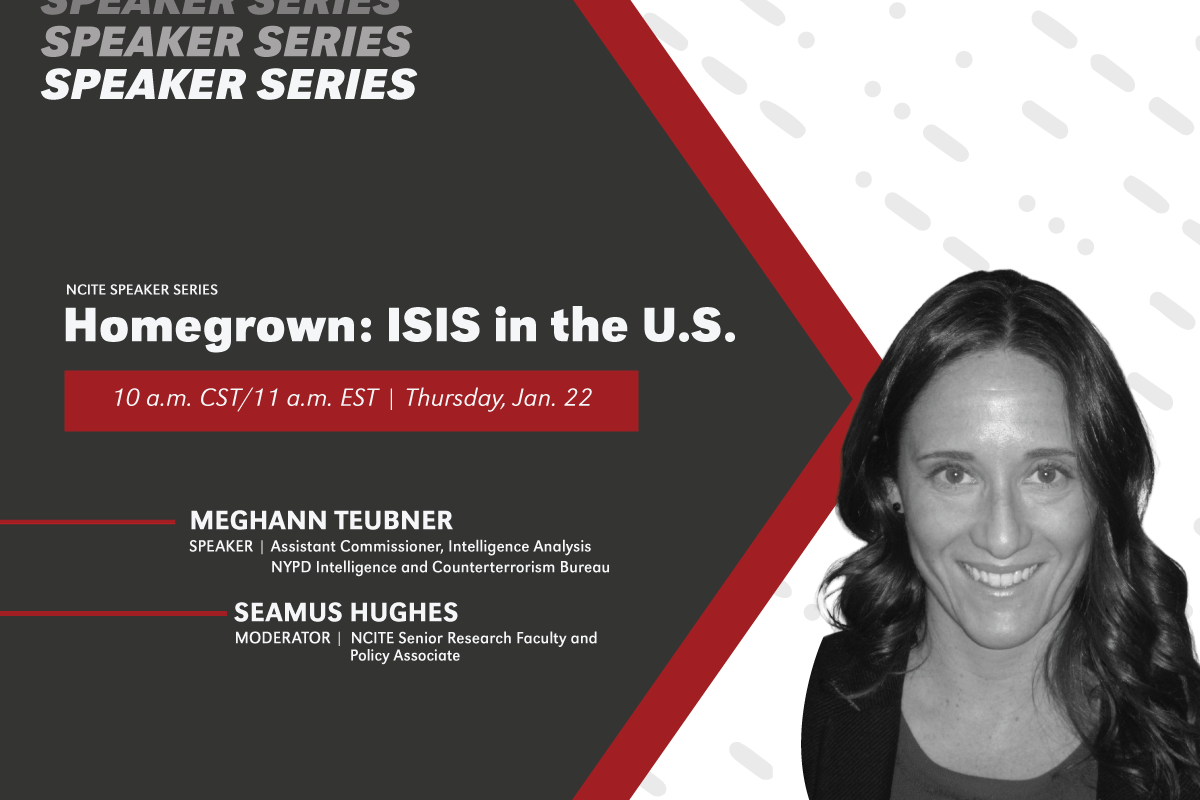
On Jan. 22, NCITE hosted a webinar with Meghann Teubner, assistant commissioner of intelligence analysis in the Intelligence Division of the NYPD Intelligence and Counterterrorism Bureau, on ISIS cases in the United States and the NYPDs approach to countering the threat.
During the webinar, NCITE released new research on ten years of data regarding U.S.–based individuals arrested for support of ISIS. The event was moderated by Seamus Hughes, NCITE senior research faculty and policy associate.
A recording of the webinar is available upon request to ncite@unomaha.edu.
Key Takeaways
ISIS inspiration is prevalent. In 2025, over half of the NYPD’s 29 counterterrorism arrests and disruptions (spread across eight states and five countries) were at least partially motivated by some form of violent jihadi ideology.
- Teubner noted several cases from 2025, including arrests in Texas and North Carolina, of ISIS-inspired individuals motivated to conduct attacks inside the U.S.
- In another case, a man was arrested at Newark airport while waiting to fly overseas to fight for ISIS in coordination with an associate in Seattle and foreign fighters. As ISIS has expanded activity in Africa, Teubner said, there’s been a corresponding rise in American sympathizers traveling to the region.
ISIS influence is persistent – and trending. Teubner said there has been a surge in sharing content from the Islamic State’s height (2015-2017), including speeches by Abu Mohammad al-Adnani and Abu Bakr al-Baghdadi, instructions on how to build explosives, and videos on how to conduct attacks.
- Teubner said ISIS continues to inspire other groups like Al-Qaida in the Arabian Peninsula, which has adopted the Islamic State’s strategy of deploying pithy, English-language videos that encourage violence.
- “ISIS, despite losing the caliphate, despite years of counterterrorism pressure, continues to put out propaganda that reaches a wide audience," Teubner said.
ISIS, despite losing the caliphate, despite years of counterterrorism pressure, continues to put out propaganda that reaches a wide audience.
Partnerships are essential for prevention. Teubner is in constant contact with her counterparts at the New York Joint Terrorism Task Force and other federal partners. With an increasingly diverse and anonymized online environment and “the cross pollination between threat actors and narratives”, Teubner stressed the importance of coordinating across sectors.
- “It is a landscape that reminds us regularly the importance of partnerships, both across the federal, state, and local mission sets, and with our partners in academia and the private sector, in order to have the right tools to adapt to this evolving threat,” Teubner said.
Nihilistic violent extremism needs more attention. NVE, a recent arrival on the ideology spectrum, is described by the FBI as rooted in “a hatred of society at large” with adherents trying to arrange its collapse by “sowing indiscriminate chaos, destruction, and social instability”. (Read our NVE research).
Because of its broad appeal, Teubner said, NVE serves as an ideology vector, particularly for perennially online youth. As ISIS and other groups use AI to streamline their propaganda machines, Teubner is concerned that the dangers of NVE-adherent networks like 764 aren’t being discussed enough.
On the CT Workforce
Near the end of the webinar, an NCITE student asked for advice on entering the counterterrorism field. Teubner said that while an entry-level job might not be what they want long-term, early career professionals should take opportunities to gain experience and get in the door.
She also advised being content starting from the bottom. Teubner herself started in the operations center of the National Counterterrorism Center (NCTC), working 12-hour day and night shifts – each two weeks at a time.
- “I felt like I had jet lag for nine months,” Teubner said, but that the experience she earned was priceless.
- “I love that people still want to do this work,” she said.
About Meghann Teubner
Assistant Commissioner of Intelligence Analysis Meghann Teubner oversees the Intelligence Operations and Analysis Section of the Intelligence Division in the New York City Police Department’s Intelligence and Counterterrorism Bureau. In coordination with her operational counterpart, Assistant Commissioner Teubner ensures integration of intelligence analysis and operational efforts in support of the NYPD’s crime fighting, counterterrorism, counterintelligence, and cyber threat intelligence missions.
In this capacity, Assistant Commissioner Teubner further manages strategic and investigative analysis, production, and dissemination for internal NYPD executives and officers as well as NYPD’s public and private law enforcement and security partners. She previously served as Director of Counterterrorism Intelligence Analysis, leading strategic and tactical analysis on investigations, global terrorism developments and trends, and potential threats to New York City.
Prior to joining the NYPD, Assistant Commissioner Teubner served as an analyst and senior representative at the National Counterterrorism Center (NCTC.) As NCTC’s Senior Representative based in New York, she ensured the integration of effort between NCTC and its federal, state, local, and tribal partners in the Northeast region, facilitating information sharing and collaboration in support of all partners’ counterterrorism missions.
As an analyst in NCTC’s Directorate of Intelligence, Ms. Teubner developed strategic terrorism analysis on al-Qa‘ida-related issues and the evolution of the terrorism threat landscape. Ms. Teubner was recognized with multiple NCTC Director’s Awards and a National Intelligence Certificate of Distinction from the Director of National Intelligence for her dedication and support to NCTC’s mission.