


APPLY NOW | REQUEST MORE INFO
Bachelor of Science in Education - Early Childhood Inclusive Education (Birth–Grade 3)
Support learning from the very beginning
The Early Childhood Inclusive Education (ECI) major at UNO prepares you to support the learning and development of infants, toddlers, and young children from birth through third grade. You’ll explore how young children grow and learn, develop inclusive teaching strategies, and gain hands-on experience in early childhood and elementary settings that serve children with diverse needs and abilities.
Why Choose UNO ECI Education?
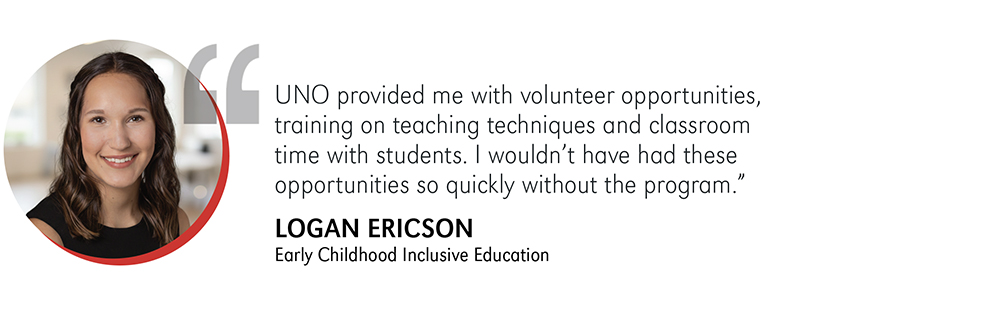
- Gain hands-on experience early in your program — apply what you’re learning in real early childhood and elementary classrooms starting your first semester.
- Learn to teach in inclusive settings — develop strategies to support all learners, including children with disabilities, across a variety of early learning environments.
-
Receive personalized advising and mentoring — work closely with award-winning academic advisors and faculty coaches who support your progress and help you reach certification milestones.
-
Prepare for a range of early childhood careers — build skills that translate across classrooms, community programs, and family-centered settings.
Hands-On Teacher Preparation
- Built-in classroom experiences throughout your courses — gain hands-on practice in infant, toddler, preschool, and early elementary settings as you move through the program.
- Capstone student teaching semester —complete a full-semester, full-day placement where you take the lead in an early childhood or elementary classroom with support from mentor teachers and faculty.
- 120 credits with focused teacher preparation — learn the depth, practice, and confidence needed to support young children and families from day one.
Program Overview
The Early Childhood Inclusive Education Program is designed to meet Nebraska Department of Education requirements for teacher licensure in Birth–Grade 3. The program emphasizes child development, inclusive curriculum and pedagogy, socio-cultural understanding, and evidence-based practices to support the well-being and learning of young children across diverse settings.
Graduates are prepared to design meaningful learning experiences for infants, toddlers, and young children while partnering with families and communities to support early development.
A minimum of 120 credit hours and a minimum cumulative GPA of 2.75 are required to graduate from the College of Education, Health, and Human Sciences.
Already working in early childhood or childcare? The ECI PRO Pathway is designed for individuals currently working full-time in an early childhood setting who hold an associate's degree or have general education and prerequisite courses completed.
Career Paths
Graduates of the UNO Early Childhood Inclusive Education program are prepared to work with young children and families across a variety of settings. Common career paths include:
- Preschool teacher
- Infant and toddler teacher
- Kindergarten through third grade teacher
- Early childhood special education teacher
- Early intervention specialist
- Family support or youth services professional
ECI graduates work in settings such as preschools, elementary schools, childcare centers, community and nonprofit organizations, early intervention programs, and family-centered services
Academic Advising
From your first semester through graduation, you’ll work closely with dedicated, award-winning academic advisors who specialize in teacher education. Our advising team is known for its personalized support and plays a key role in student success and retention across the college. Advisors help you plan your coursework, navigate program requirements, and stay on track for certification—so you can focus on becoming an excellent teacher.
Field Experiences
You’ll begin gaining classroom experience early in the program through field experiences and practicums built directly into your education courses. These hands-on opportunities allow you to observe, assist, and teach alongside expert master teachers—so you can connect what you’re learning in class to real early childhood settings.
Learn more about field experiences for teacher candidates.
Clinical Practice (Student Teaching)
Clinical practice is the capstone experience of the Education program. During this all-day, full-semester placement, you’ll teach in an Omaha metropolitan area school and take on the role of a early childhood classroom teacher—with guidance and support from a master teacher, experienced mentor-coaches, and award-winning UNO faculty.
Learn more about the clinical practice experience.
Ready to Get Started?
Start your UNO application or contact our Office of Academic Advising to connect with an advisor: unocoeadvising@unomaha.edu or 402.554.2717.
Admission Requirements
Admission toEarly Childhood Inclusive Education is a two-step process.
Step 1: Apply to the University
First-year and transfer students apply to the University of Nebraska at Omaha and indicate education as their intended major on the Undergraduate Application for Admission.
-
First-year students must meet UNO’s assured admission criteria.
-
Transfer students must have a minimum cumulative GPA of 2.50.
Undergraduate Application for Admission
Step 2: Apply to the Educator Preparation Program
After completing key coursework—typically by the sophomore year—students apply for admission to the Educator Preparation Program. Admission requires meeting course and GPA benchmarks, including a minimum cumulative GPA of 2.75.
Educator Preparation Admission
Certification & Accreditation
The Bachelor of Science degree in Early Childhood Inclusive Education (BECI) is accredited by the Association for Advancing Quality in Educator Preparation (AAQEP) and approved by the Nebraska State Department of Education. The BSED degree in Early Childhood Inclusive Education allows UNO to recommend graduates for Nebraska licensure (Birth - Grade 3)
View information about: