

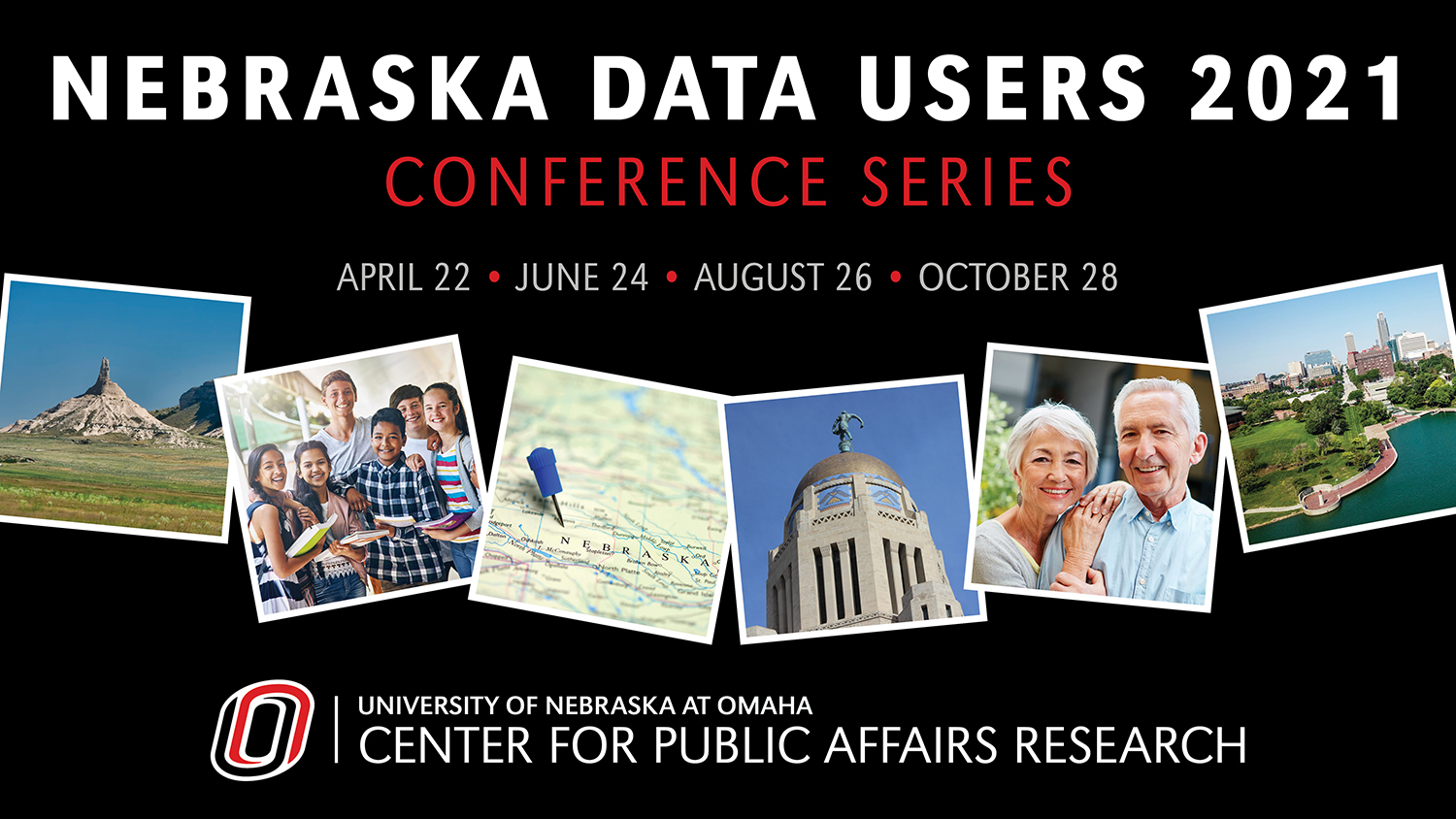
The University of Nebraska at Omaha Center for Public Affairs Research (CPAR) is pleased to present its 32nd annual professional development data series.
April 22, 2021 | Virtual Only (Zoom Webinar)
Using data.census.gov
See the latest features and learn tips and tricks to get the most out of data.census.gov; the online platform where you can access 2020 Census results, as well as data from the American Community Survey, Economic Census, and Population Estimates Program.
- Pauline Nuñez, partnership coordinator, U.S. Census Bureau-Denver Region
Data Resources from the Center for Public Affairs Research
CPAR offers several online resources so you can easily access common demographic and socioeconomic data about Nebraska, our region, and the nation. Learn how to access these resources and when they are updated to ensure you have timely data insights.
- Melanie Kiper, J.D., community service specialist, University of Nebraska at Omaha Center for Public Affairs Research
Exploring Nebraska's Workforce Using the Census Bureau's Current Population Survey
This session will explore the workforce and economic insights that can be produced using the Census Bureau's Current Population Survey and other business and economic resources. Insights about working families and how the pandemic has impacted these families will be highlighted using these sources.
- Josie Gatti Schafer, Ph.D., director, University of Nebraska at Omaha Center for Public Affairs Research
Presentation Slides
- Using data.census.gov
- Data Resources from the Center for Public Affairs Research
- Exploring Nebraska's Workforce Using the Census Bureau's Current Population Survey
Resources
- 2021 Data User Conference Series Welcome Video
- Key Tables for Finding Commonly Used Census Data
- American Community Survey Data Tables and Tools
Recording
- Using data.census.gov
- Exploring Nebraska's Workforce Using the Census Bureau's Current Population Survey
June 24, 2021 | Virtual Only (Zoom Webinar)
Understanding Vulnerable Populations: An Exploration of Data Sources and Research Methods
Three sessions will examine vulnerable populations and the data available to explore these groups and trends about them.
- Human Mobility: Human mobility, in its different manifestations - international and domestic migration; refugees, asylum seekers, and displaced populations; and human trafficking - is at the center of many political and public debates. In research presentations by UNO faculty, the demographics of highly mobile populations will be explored as well as the impacts of moblity on communities in Nebraska.
- Cristián Doña-Reveco, Ph.D., director, Office of Latino/Latin American Studies; associate professor, Department of Sociology; University of Nebraska at Omaha
- Teresa Kulig, Ph.D., assistant professor, University of Nebraska at Omaha School of Criminology and Criminal Justice
- Barbara Gomez-Aguinaga, Ph.D., assistant professor of public policy and social equity, University of Nebraska at Omaha School of Public Administration
- Thomas Jamieson, Ph.D., assistant professor, University of Nebraska at Omaha School of Public Administration
- Dakota Caldwell, M.P.A., doctoral student, University of Nebraska at Omaha School of Public Administration
- Women and the Economy: Nationally, and in Nebraska, a persistent gender, racial, and ethnic wage gap exists. This session will explore women's earnings, spending habits, and financial knowledge to understand their critical role in the economy.
- Jamie Wagner, Ph.D., assistant professor, Department of Economics; director, Center for Economic Education; University of Nebraska at Omaha
- Tiffany Seibert Joekel, M.A., research and policy director, Women's Fund of Omaha
- Aging: A large population, like here in Nebraska, has an impact on a variety of public policies and facets of life for all ages. Two Nebraska researchers will introduce a variety of data sources and resources on aging adults, review gaps in knowledge about this population, and share efforts to build a stronger evidence base about the policy impacts of aging.
- Lindsay Wilkinson, Ph.D., assistant professor, University of Nebraska at Omaha Department of Gerontology
- Julie Blaskewicz Boron, Ph.D., associate professor, doctoral program chair, University of Nebraska at Omaha Department of Gerontology
Presentation Slides
- Human Mobility
- Women and the Economy
- Aging
Resources
- Human Trafficking and the T Visa Process: Insights from Legal Representatives Working with Victims from Latin Ameria Representatives Working with Victims from Latin America
- Survey of the States
Recordings
August 26, 2021 | Virtual Only (Zoom Webinar)
Nebraska State and Local Population Trends
Explore population trends during the 2010s for Nebraska's Congressional and Legislative Districts, including birth and death rates, aging of the population, rising diversity, brain drain, changes in housing and household composition.
- David Drozd, M.S., research coordinator, University of Nebraska at Omaha Center for Public Affairs Research
Redistricting: Examples and Experiences from Other States
The processes for redistricting vary by state. In advance of redistricting here in Nebraska, learn about the political processes and technical details of redistricting in other states as well as some basics that will impact the process here.
- Wendy Underhill, director, National Conference of State Legislatures Elections and Redistricting Program
- Wayne Bena, J.D., deputy secretary of state for elections, State of Nebraska
Presentation Slides
- Nebraska State and Local Population Trends
- Redistricting: Examples and Experiences from Other States - Wendy Underhill
- Redistricting: Examples and Experiences from Other States - Wayne Bena
Recording
October 28, 2021 | Virtual Only (Zoom Webinar)
2020 Socioeconomic Data and What It Tells Us About the Pandemic
Learn what data is available, efficient ways to access it, and compare various statistics and trends over time.
- David Drozd, M.S., research coordinator, Center for Public Affairs Research, University of Nebraska at Omaha
Maps for Information Sharing: Pros and Cons
When making a data visualization you have lots of choices, including, maps. Learn from two professionals that use maps in their work about when and how to best use maps to share your data and gain some insights for getting started with making maps.
- Rex Cammack, Ph.D., associate professor, Department of Geography and Geology; coordinator, Graduate Certificate in Geographic Information Sciences; University of Nebraska at Omaha
- Emily Nguyen, M.S.W., M.P.A., director of research and strategy, Omaha Community Foundation
Presentation Slides
- 2020 Socioeconomic Data and What It Tells Us About the Pandemic
- Maps for Information Sharing: Pros and Cons
Resource
Recording
Questions? Contact unocpar@unomaha.edu or 402.554.7533.
UNO is an AA/EEO/ADA institution. For Title IX concerns, please contact the Title IX Coordinator (phone:402.554.2120). For ADA/504 accommodations or assistance, please call/contact the ADA/504 Coordinator (phone 402.554.2463) or the Accessibility Services Center (phone: 402.554.2872).