

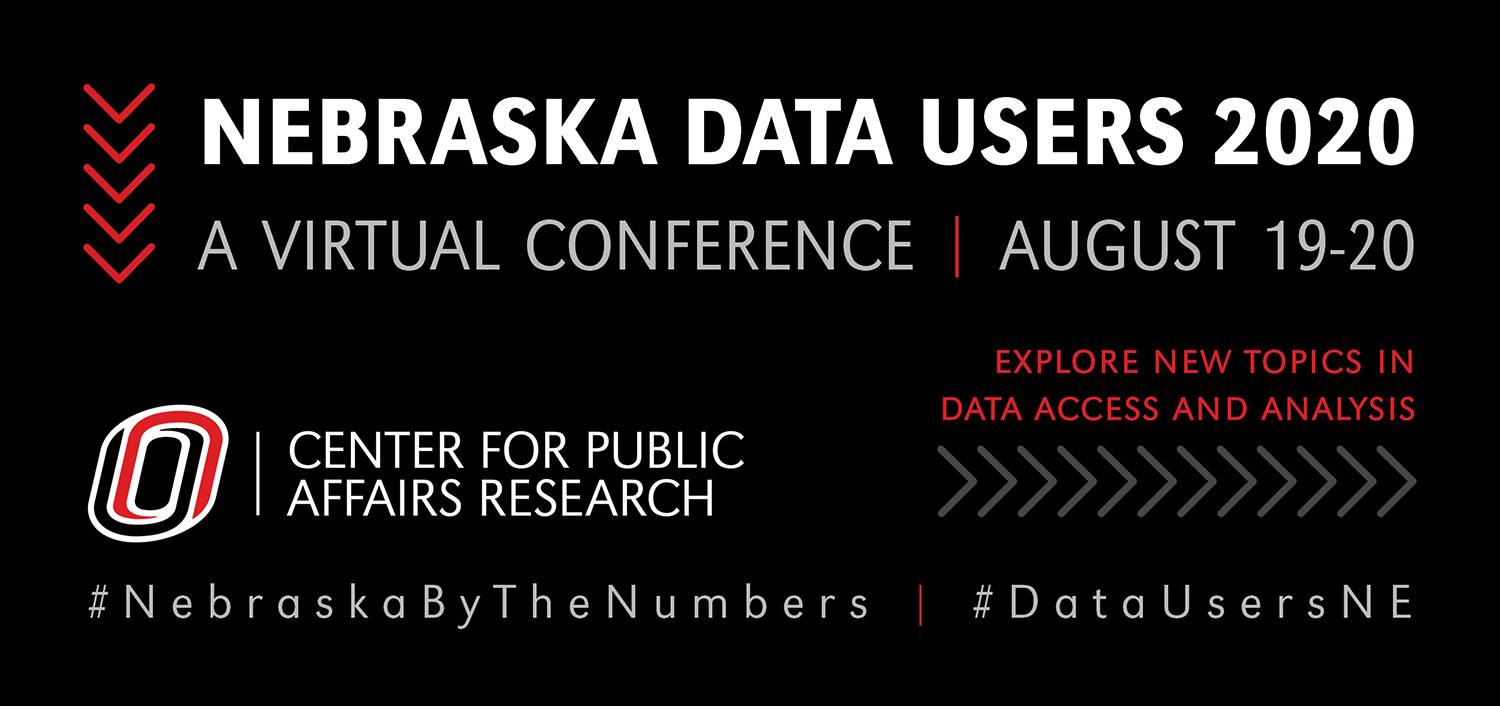
The University of Nebraska at Omaha Center for Public Affairs Research (CPAR) is pleased to present its 31st annual professional development data series.
August 19, 2020 | Virtual Only (Zoom Webinar)
2020 Census in Review and Yet to Come
The 2020 Census is underway! This session will provide a 2020 Census overview to include adjustments made to conducting a decennial count during a major challenge like a pandemic. Examples will be provided on how the Nebraska partnership team and census partners are strategically using the self-response map to develop initiatives for increasing self-response. Information will be provided on what lies ahead and what you can do to boost selfresponse in your community.
- Blanca Ramirez-Salazar, partnership coordinator, U.S. Census Bureau
2020 Data Products and the Basics and Potential Impacts of Differential Privacy
The Census Bureau is rethinking the way it will produce and release the data from 2020 Census. There are concerns that personal information could be discovered given current computing power, other data sources, and Census 2020 results. Currently the Bureau is working to balance data privacy with high quality data products. This presentation will present the basics of the Disclosure Avoidance System including applying differential privacy and its impacts on data quality, what the data user community needs to know, and how to be prepared. The session will focus on 2020 data products with a special emphasis on the redistricting dataset, the release schedule, and how to access the new figures.
- James Whitehorne, chief of the Census Redistricting & Voting Rights Data Office, U.S. Census Bureau
- Elizabeth Garner, state demographer, Colorado Department of Local Affairs State Demography Office
Nebraska State and Local Population Trends
Nebraska’s population is changing. This session will focus on key demographic aspects, such as aging, increasing diversity, and comparisons between urban and rural Nebraska. Highlights will include information from the population estimates program, which shows changes since 2010 and what the 2020 Census data might indicate, as well as a focus on birth and death trends from the completed 2010s decade and their implications for schools or the workforce.
- David Drozd, research coordinator, University of Nebraska at Omaha Center for Public Affairs Research
Presentation Slides
- 2020 Census in Review and Yet to Come
- 2020 Data Products and the Basics and Potential Impacts of Differential Privacy - James Whitehorne
- 2020 Data Products and the Basics and Potential Impacts of Differential Privacy - Elizabeth Garner
- Nebraska State and Local Population Trends
Recording
- 2020 Census in Review and Yet to Come
- 2020 Data Products and the Basics and Potential Impacts of Differential Privacy
- Nebraska State and Local Population Trends
August 20, 2020 | Virtual Only (Zoom Webinar)
The Latest in Economic Data and Tools from the Census Bureau
While some of the Census Bureau’s 130+ programs have been around for decades, the ever-changing nature of our economy often requires the creation of new surveys. This presentation will start with an update on the Economic Census data for Nebraska. Then move to three brand new Census business surveys: the Annual Business Survey, the Small Business Pulse Survey, and the updated Business Formation Statistics. Easily accessing these data is important, so the session will feature live demos of the latest version of Census Business Builder as well as the new COVID-19 Data Hub. Bring your burning economic data questions to stump Andy, who has more than 30 years of service at the Census Bureau.
- Andy Hait, economist, U.S. Census Bureau
A New Reality? Evaluating State and Local Finances
This panel will focus on tools and resources for examining state and local government finances and economic conditions. We will emphasize tools that are easily manageable and resources easily accessible. These data sources include but are not exclusively available via the U.S. Census Bureau.
- Craig Maher, Ph.D., chair and professor, UNO School of Public Administration
- Bruce McDonald, Ph.D., associate professor, North Carolina State University Department of Public Administration
- Chris Decker, Ph.D., chair and professor, UNO Department of Economics
- Moderator: Josie Schafer, Ph.D., director, UNO Center for Public Affairs Research
What We Know (and What We Don't): The Impact of COVID-19 Among Communities of Color in Nebraska
As the state of Nebraska moves forward to reopen after the coronavirus disease (COVID-19) outbreak, more information is needed to assess the extent to which COVID-19 has affected minority groups. This presentation evaluates the data released by the state on the cases of COVID-19 and deaths from the virus, how often it is updated, and how it can be improved to inform policy decisions to reduce the disproportionate impacts of COVID-19 on communities of color in Nebraska, which is one of the states with the highest health disparities in COVID-19 cases among racial groups.
- Barbara Gomez Aguinaga, Ph.D., assistant professor, UNO School of Public Administration
Presentation Slides
- The Latest in Economic Data and Tools from the Census Bureau
- A New Reality? Evaluating State and Local Finances - Craig Maher
- A New Reality? Evaluating State and Local Finances - Bruce McDonald
- A New Reality? Evaluating State and Local Finances - Chris Decker
- What We Know (and What We Don't): The Impact of COVID-19 Among Communities of Color in Nebraska
Recording
- The Latest in Economic Data and Tools from the Census Bureau
- A New Realilty? Evaluating State and Local Finances
- What We Know (and What We Don't): The Impact of COVID-19 Among Communities of Color in Nebraska
Questions? Contact unocpar@unomaha.edu or 402.554.7533.
UNO is an AA/EEO/ADA institution. For Title IX concerns, please contact the Title IX Coordinator (phone:402.554.2120). For ADA/504 accommodations or assistance, please call/contact the ADA/504 Coordinator (phone 402.554.2463) or the Accessibility Services Center (phone: 402.554.2872).