University of Nebraska at Omaha logo University of Nebraska at Omaha
REQUEST INFO VISIT APPLY

MY UNO DIRECTORY
University of Nebraska at Omaha logo
A U.S. Department of Homeland Security Center of Excellence National Counterterrorism Innovation, Technology, and Education Center (NCITE)
REQUEST INFO VISIT APPLY
MY UNO DIRECTORY
  • About Backback to Main menu
    • We Are NCITE
    • Newsletters
    • Our Community
    • Center Directory
  • Research Backback to Main menu
    • NCITE Research
    • Published Reports
    • Annual Request for Proposals
  • News Backback to Main menu
    • News Center
    • NCITE in the News
  • Rapid Report: NVE
  • Events Backback to Main menu
    • Upcoming Events
    • ENVISION Conference
  • Get Involved Backback to Main menu
    • Donate to NCITE
    • Job Opportunities
  • Podcast
  1. UNO
  2. National Counterterrorism Innovation, Technology, and Education Center (NCITE)
  3. news
  4. 2025
  5. 03
  6. WEBINAR RECAP: Stopping Terrorism at the Border

WEBINAR RECAP: Stopping Terrorism at the Border

On March 5, NCITE hosted a webinar with Jorge Comas, director of the Counter Network Division at U.S. Customs and Border Protection’s (CBP) National Targeting Center, about efforts to keep terrorists from crossing U.S. borders.

  • published: 2025/03/11
  • contact: NCITE Communications
  • email: ncite@unomaha.edu
  • search keywords:
  • terrorism
  • border protection
  • cbp
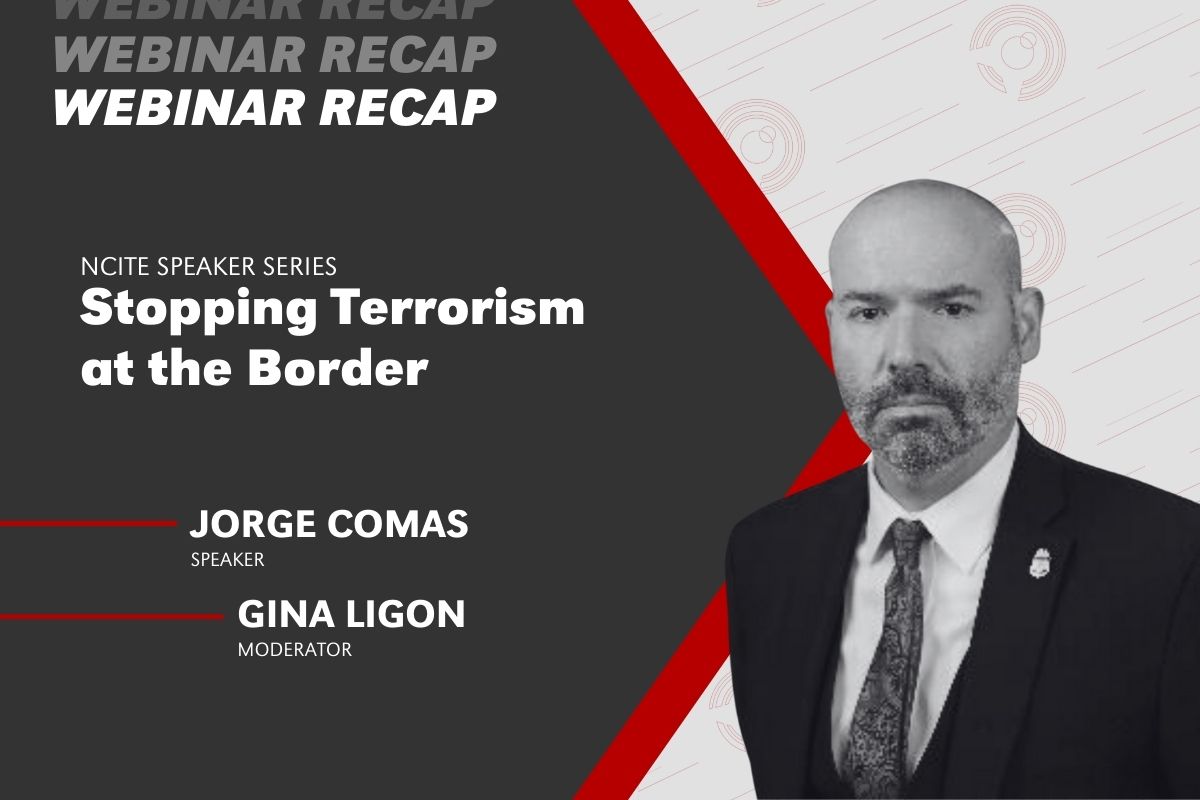
Headshot of Jorge Comas next to the title "NCITE Speaker Series: Stopping Terrorism at the Border""

On March 5, NCITE hosted a webinar with Jorge Comas, director of the Counter Network Division at U.S. Customs and Border Protection’s (CBP) National Targeting Center. The discussion was moderated by NCITE Director Gina Ligon, Ph.D.

Comas provided an expert’s view of the realities of counterterrorism at the U.S. border, emphasizing the critical role of intelligence, technology, and interagency collaboration in mitigating homeland security threats.

Key Takeaways

The Role of the National Targeting Center and Counter Network Division

Comas outlined the role of the National Targeting Center, which, he said, collaborates with other agencies to identify individuals who could be affiliated with terrorism and criminal activity well before they reach the U.S. border.

  • "We’re looking at basically the supply chain of, what does it look like for an individual to travel to the United States? What does it look like for a piece of cargo to come to the United States? And how do we identify those threats at the earliest possible point?" he said.
  • As director of the Counter Network Division, Comas leads a team that focuses on identifying and countering illicit networks, including terrorist networks and transnational organized crime.

The Danger of the Convergence Threat

Comas spoke about the intersection of terrorist organizations and transnational criminal networks, using the example of ISIS.

  • “A lot of the activities that they were executing on were human smuggling activities,” he said. “They were leveraging transnational criminal organizations to facilitate human smuggling.”
  • Comas emphasized this threat, in particular, should be a priority for researchers at institutions like NCITE.

The Challenges of Emerging Technology

Comas spoke of the technology tools available to law enforcement to help stop criminal activity. But many of those same tools are being exploited by malicious actors, he said.

  • “We are seeing both on the transnational organized crime, as well as on the terrorism side, these networks have become much more adept at using technology,” he said, specifically naming cryptocurrency and online communication tools.
  • “The adversary is constantly looking at that latest innovation, and trying to figure out how can they leverage that as part of their illicit activities,” he said.

News Sections

  • National Counterterrorism Innovation, Technology, and Education Center (NCITE) News Center
  • UNO News Center
  • Maverick Daily
  • The Bullseye
  • Campus Events

Featured

  • NCITE Insights No. 40 — Fighting Fentanyl: A Book Talk with Jake Braun
  • NCITE Briefing: The Annunciation Attack and Nihilistic Violent Extremism
  • WEBINAR RECAP: Non-State Special Operations With Craig Whiteside
  • NCITE Insights No. 38 — Methods: The Value of Data-Generating Processes

National Counterterrorism Innovation, Technology, and Education Center (NCITE)

Connect with NCITE
  • 6001 Dodge St.
  • Omaha, NE
  • ncite@unomaha.edu
Social media
Our DHS Partners
  • Centers of Excellence
  • Science & Technology Directorate (S&T)
  • Office of University Programs (OUP)
U.S. Department of Homeland Security Science and Technology Grant Acknowledgement and Disclaimer. The material on this website is based on work supported by the U.S. Department of Homeland Security under Grant Award Number 20STTPC00001-05. The views and conclusions included here are those of the authors and should not be interpreted as necessarily representing the official policies, either expressed or implied, of the U.S. Department of Homeland Security.

Services and Resources

  • Academic Calendar
  • Course Catalogs
  • MavCARD Services
  • MavLINK
  • my.unomaha.edu
  • UNO Brand Guide

Related Links

  • A-Z List
  • Employment
  • University of Nebraska System

Campus Links

  • Accessibility
  • Billing Office
  • Buildings and Maps
  • Campus Directory
  • Campus Safety
  • Events
  • Human Resources
  • Library
  • Military-Connected Resource Center
  • News
  • Registrar

Policies and Reporting

  • Emergency Information Alert
  • MavsReport
  • Notice of Non-Discrimination
  • NU Foundation
  • Privacy Statement
  • University Policies
  1. Privacy Statement
  2. Accessibility
  1. 402.554.2800

University of Nebraska at Omaha
University of Nebraska at Omaha, 6001 Dodge Street, Omaha, NE, 68182
  • ©  

Social Media


Omaha Skyline

Our Campus. Otherwise Known as Omaha.

The University of Nebraska does not discriminate based on race, color, ethnicity, national origin, sex, pregnancy, sexual orientation, gender identity, religion, disability, age, genetic information, veteran status, marital status, and/or political affiliation in its education programs or activities, including admissions and employment. The University prohibits any form of retaliation taken against anyone for reporting discrimination, harassment, or retaliation for otherwise engaging in protected activity. Read the full statement.